8 Best Sights in The Vatican, Rome

Background Illustration for Sights

We've compiled the best of the best in The Vatican - browse our top choices for the top things to see or do during your stay.

Basilica di San Pietro

Vatican Fodor's Choice
Vatican fountain.
WDG Photo / Shutterstock

The world's largest church, built over the tomb of St. Peter, is the most imposing and breathtaking architectural achievement of the Renaissance (although much of the lavish interior dates to the Baroque period). No fewer than five of Italy's greatest artists—Bramante, Raphael, Peruzzi, Antonio da Sangallo the Younger, and Michelangelo—died while striving to erect this new St. Peter's.

The history of the original St. Peter's goes back to AD 326, when the emperor Constantine completed a basilica over the site of the tomb of St. Peter, the Church's first pope. The original church stood for more than 1,000 years, undergoing a number of restorations and alterations, until, toward the middle of the 15th century, it was on the verge of collapse. In 1452, a reconstruction job began but was abandoned for lack of money.

In 1503, Pope Julius II instructed the architect Bramante to raze all the existing buildings and build a new basilica, one that would surpass even Constantine's for grandeur. It wasn't until 1626 that the new basilica was completed and consecrated.

Highlights include the Loggia delle Benedizioni (Benediction Loggia), the balcony where newly elected popes are proclaimed; Michelangelo's Pietà; and Bernini's great bronze baldacchino, a huge, spiral-columned canopy—at 100,000 pounds, perhaps the largest bronze object in the world—as well as many other Bernini masterpieces. There are also collections of Vatican treasures in the Museo Storico-Artistico e Tesoro and the Grotte Vaticane crypt.

For views of both the dome above and the piazza below, take the elevator or stairs to the roof. Those with more stamina (and without claustrophobia) can then head up more stairs to the apex of the dome.

 The basilica is free to visit, but a security check at the entrance can create very long lines. Arrive before 8:30 or after 5:30 to minimize the wait and avoid the crowds.

Piazza San Pietro, Rome, 00120, Italy
Sight Details
Free
Closed during Papal General Audience (Wed. until 1 pm) and during other ceremonies in piazza

Something incorrect in this review?

Cappella Sistina

Vatican Fodor's Choice
The Last Judgement, Sistine Chapel, Vatican, Rome
(c) Anitasstudio | Dreamstime.com

In 1508, the redoubtable Pope Julius II commissioned Michelangelo to fresco the more than 10,000 square feet of the Sistine Chapel's ceiling. (Sistine, by the way, is simply the adjective form of Sixtus, in reference to Pope Sixtus IV, who commissioned the chapel itself.) The task took four years, and it's said that, for many years afterward, Michelangelo couldn't read anything without holding it over his head. The result, however, was the greatest artwork of the Renaissance. A pair of binoculars helps greatly, as does a small mirror—hold it facing the ceiling and look down to study the reflection.

More than 20 years after his work on the ceiling, Michelangelo was called on again, this time by Pope Paul III, to add to the chapel's decoration by painting the Last Judgment on the wall over the altar. By way of signature on this, his last great fresco, Michelangelo painted his own face on the flayed-off human skin in St. Bartholomew's hand. 

The chapel is entered through the Musei Vaticani, and lines are slightly shorter after 2:30 (reservations are always advisable)—except free Sundays, which are extremely busy and when admissions close at 12:30.

Musei Vaticani

Vatican Fodor's Choice
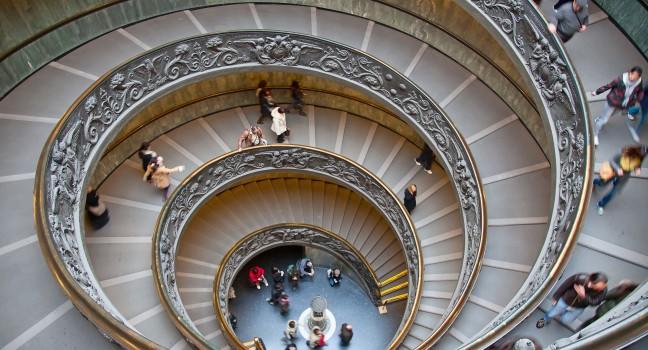
A double spiral staircase in Vatican, Italy.
Fedor Selivanov / Shutterstock

Other than the pope and his papal court, the occupants of the Vatican are some of the most famous artworks in the world. The Vatican Palace, residence of the popes since 1377, consists of an estimated 1,400 rooms, chapels, and galleries. The pope and his household occupy only a small part; most of the rest is given over to the Vatican Library and Museums.

Beyond the glories of the Sistine Chapel, the collection is extraordinarily rich: highlights include the great antique sculptures (including the celebrated Apollo Belvedere in the Octagonal Courtyard and the Belvedere Torso in the Hall of the Muses); the Stanze di Raffaello (Raphael Rooms), with their famous gorgeous frescoes; and the Old Master paintings, such as Leonardo da Vinci's beautiful (though unfinished) St. Jerome in the Wilderness, some of Raphael’s greatest creations, and Caravaggio’s gigantic Deposition in the Pinacoteca ("Picture Gallery").

For those interested in guided visits to the Vatican Museums, tours start at €40, including entrance tickets, and can also be booked online. Other offerings include a regular three-hour guided tour of the Vatican gardens; call or check online to confirm. For more information, call  06/69884676 or go to  www.museivaticani.va. For information on tours, call  06/69883145 or  06/69884676; visually impaired visitors can arrange tactile tours by calling  06/69884947.

Viale Vaticano, Rome, 00165, Italy
06-69883145
Sight Details
€20
Closed Sun. (except the last Sun. of each month) and Roman Catholic holidays

Something incorrect in this review?

Recommended Fodor's Video

Piazza San Pietro

Vatican Fodor's Choice

Mostly enclosed within high walls that recall the papacy's stormy history, the Vatican opens the spectacular arms of Bernini's colonnade to embrace the world only at St. Peter's Square, scene of the pope's public appearances and another of Bernini's masterpieces. The elliptical Piazza di San Pietro was completed in 1667—after only 11 years' work—and holds about 100,000 people.

Surrounded by a pair of quadruple colonnades, the piazza is gloriously studded with 140 statues of saints and martyrs. At its center is the 85-foot-high Egyptian obelisk, which was brought to Rome by Caligula in AD 37 and moved here in 1586 by Pope Sixtus V. The famous Vatican post offices can be found on both sides of St. Peter's Square and inside the Vatican Museums complex. 

The main information office is just left of the basilica as you face it.

Castel Sant'Angelo

Borgo

Standing between the Tiber and the Vatican, this circular castle has long been one of Rome's most distinctive landmarks. Opera lovers know it well as the setting for the final scene of Puccini's Tosca. Started in AD 135, the structure began as a mausoleum for the emperor Hadrian and was completed by his successor, Antoninus Pius. From the mid-6th century the building became a fortress, a place of refuge for popes during wars and sieges.

Its name dates to AD 590, when Pope Gregory the Great, during a procession to plead for the end of a plague, saw an angel standing on the summit of the castle, sheathing his sword. Taking this as a sign that the plague was at an end, the pope built a small chapel at the top, placing a statue next to it to celebrate his vision—thus the name, Castel Sant'Angelo.

In the rooms off the Cortile dell'Angelo, look for the Cappella di Papa Leone X (Chapel of Pope Leo X), with a facade by Michelangelo. In the Pope Alexander VI courtyard, a wellhead bears the Borgia coat of arms. The stairs at the far end of the courtyard lead to the open terrace for a view of the Passetto, the fortified corridor connecting Castel Sant'Angelo with the Vatican. In the appartamento papale (papal apartment), the Sala Paolina (Pauline Room) was decorated in the 16th century by Perino del Vaga and assistants with lavish frescoes of scenes from the Old Testament and the lives of St. Paul and Alexander the Great.

Giardini Vaticani

Vatican

Neatly trimmed lawns and flower beds extend over the hills behind St. Peter's Basilica, an area dotted with some interesting structures and other, duller ones that serve as office buildings. The Vatican Gardens occupy almost 40 acres and include a formal Italian garden, a flowering French garden, a romantic English landscape, and a small forest.

There's also the little-used Vatican railroad station, which now houses a museum of coins and stamps made in the Vatican, and the Torre di San Giovanni (Tower of St. John), restored by Pope John XXIII as a retreat for work and now used as a residence for distinguished guests. To visit the gardens, join a three-hour walking tour that also includes the Sistine Chapel. Garden visits must be booked online.

Vatican City, Rome, 00120, Italy
06-69883145-tour info
Sight Details
€45 for 3-hour walking tour (includes admission to the Musei Vaticani)
Closed Sun.

Something incorrect in this review?

Necropoli Vaticana

Vatican

With advance notice you can take a one-hour guided tour in English of the Vatican Necropolis, under the Basilica di San Pietro, which gives a rare glimpse of early Christian Roman burial customs and a closer look at the tomb of St. Peter. Apply via the contact form online, specifying the number of people in the group (all must be age 10 or older), preferred language, preferred time, available dates, and your contact information in Rome. Each group will have about 12 participants. Visits are not recommended for those with mobility issues or who are claustrophobic.

Ufficio Scavi, Rome, 00120, Italy
06-69885318
Sight Details
€20
Closed Sun. and Roman Catholic holidays
Reservations required

Something incorrect in this review?

Ponte Sant'Angelo

Borgo

Angels designed by Baroque master Bernini line the most beautiful of central Rome's 20-odd bridges. Bernini himself carved only two of the angels (those with the scroll and the crown of thorns), both of which were moved to the church of Sant'Andrea delle Fratte shortly afterward at the behest of the Bernini family. Though copies, the angels on the bridge today convey forcefully the grace and characteristic sense of movement—a key element of Baroque sculpture—of Bernini's best work.

Originally built in AD 133–134, the Ponte Elio, as it was originally called, was a bridge over the Tiber to Hadrian's Mausoleum. Pope Gregory changed the bridge's name after he had a vision of an angel sheathing its sword to signal the ending of the plague of 590. In medieval times, continuing its sacral function, the bridge became an important element in funneling pilgrims toward St. Peter's. As such, in 1667 Pope Clement IX commissioned Bernini to design 10 angels bearing the symbols of the Passion, turning the bridge into a sort of Via Crucis.

Between Lungotevere Castello and Lungotevere Altoviti, Rome, 00186, Italy

Something incorrect in this review?

Not finding what you're looking for?

We've got a few suggestions for nearby spots.
Piazza Navona, Campo de' Fiori, and the Jewish Ghetto

San Giovanni Battista dei Fiorentini0.5 miles away

Via Acciaioli, 2, Rome, Latium, 00186, Italy
We recommend 30 Sights in Piazza Navona, Campo de' Fiori, and the Jewish Ghetto
Piazza Navona, Campo de' Fiori, and the Jewish Ghetto

Oratorio dei Filippini0.7 miles away

Piazza della Chiesa Nuova (Corso Vittorio Emanuele), Rome, Latium, 00186, Italy
We recommend 30 Sights in Piazza Navona, Campo de' Fiori, and the Jewish Ghetto
Piazza Navona, Campo de' Fiori, and the Jewish Ghetto

Santa Maria in Vallicella/Chiesa Nuova0.7 miles away

Corso Vittorio Emanuele II, Rome, Latium, 00186, Italy
We recommend 30 Sights in Piazza Navona, Campo de' Fiori, and the Jewish Ghetto
Piazza Navona, Campo de' Fiori, and the Jewish Ghetto

Museo Napoleonico0.7 miles away

Piazza di Ponte Umberto, I, Rome, Latium, 00186, Italy
We recommend 30 Sights in Piazza Navona, Campo de' Fiori, and the Jewish Ghetto
Piazza Navona, Campo de' Fiori, and the Jewish Ghetto Fodor's Choice

Via Giulia0.7 miles away

Via Giulia, Rome, Latium, 00186, Italy
We recommend 30 Sights in Piazza Navona, Campo de' Fiori, and the Jewish Ghetto