11 Best Sights in Nieuwmarkt, Amsterdam

Background Illustration for Sights

We've compiled the best of the best in Nieuwmarkt - browse our top choices for the top things to see or do during your stay.

Stopera

Nieuwmarkt Fodor's Choice

Taking its nickname from the combination of "Stadhuis" (City Hall) and "Opera," this brick-and-marble complex, which opened in 1986, houses both, as well as the Dutch National Ballet and large-scale productions, both domestic and international. Popularly derided by locals for looking like a set of dentures, the colossal white marble tiled building is currently undergoing phased renovations. Before the first brick was in place, locals protested over the razing of historic houses in the old Jewish Quarter and around Nieuwmarkt to make way for it. (In particular, look for the moving memorial that marks the spot of a Jewish orphanage, which honors the saga of how, in 1943, three teachers voluntarily accompanied 100 children to the extermination camp of Sobibor: "None of them returned. May their memory be blessed."). Twice-weekly tours offer a ''behind the scenes look'' at the daily life of set dressers, costume designers, and performers at the National Opera and Theater (Tuesday and Saturday from September to June).

Montelbaanstoren

Nieuwmarkt
Montelbaanstoren, Amsterdam, Netherlands
© Halie Cousineau/ Fodors Travel

Rembrandt loved to sketch this slightly leaning redbrick tower, which was built in 1516 as part of the city's defenses. In 1606, the Dutch sculptor and architect Hendrick de Keyser oversaw the addition of an octagonal brick superstructure and spire complete with clockworks that was known as Malle Jaap (Crazy Jaap) by locals because the bells pealed at odd times. The year 1610 saw the tower embark on a lean too far, and with lots of manpower and ropes it was reset on a stronger foundation. From 1878 to 2006, it housed the City Water Office. Today it's the office of a company that rents out classic saloon boats (captain included).

Museum Rembrandthuis

Nieuwmarkt
Rembrandt House Museum, Amsterdam
Rembrandt House Museum by Eugene Phoen

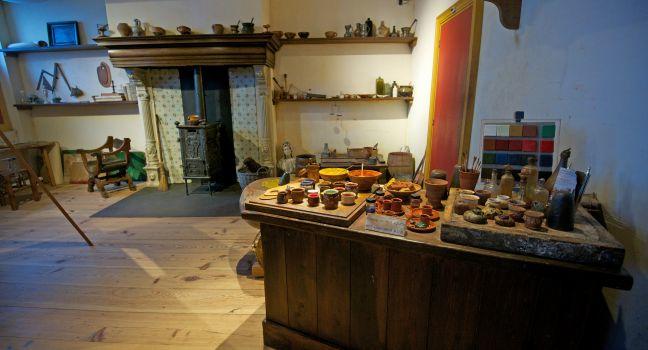
This is the house that Rembrandt, flush with success, bought for 13,000 guilders (a princely sum) in 1639, and where he lived and worked until 1656, when he declared bankruptcy. The house interior has been restored with elegant contemporaneous furnishings and artwork in the reception rooms—a collection of rarities that match as closely as possible the descriptions in the inventories made when Rembrandt was forced to sell everything—but it doesn't convey much of the humanity of Rembrandt himself. When he left here, he was not only out of money but also out of favor with the city after relationships with servant girls following the death of his wife, Saskia. The little etching studio is perhaps the most atmospheric. Littered with tools of the trade, a printing press, and a line hung with drying prints (there are demonstrations), it's easy to imagine Rembrandt finding respite here, experimenting with form and technique, away from uncomfortable schmoozing for commissions (and loans) in the grander salon. The museum owns a huge collection of etchings (260 of the 290 he made), and a changing selection is on permanent display. His magisterial prints Hundred Guilder and Three Crosses show that Rembrandt was almost more revolutionary in his prints than in his paintings, so this collection deserves respectful homage, if not downright devotion, by printmakers today.

Jodenbreestraat 4, Amsterdam, 1011 NK, Netherlands
020-520–0400
Sight Details
€18

Something incorrect in this review?

Recommended Fodor's Video

De Waag

Nieuwmarkt

Built in 1488, the Waag functioned as a city gate, Sint Antoniespoort, until 1617. It would be closed at exactly 9:30 pm to keep out not only bandits but also the poor and diseased who squatted outside the city's walls. When Amsterdam expanded, the structure began a second life as a weigh house for incoming goods. The top floor of the building accommodated the municipal militia and several guilds, including the stonemasons, who did the evocative decorations that grace each of the seven towers' entrances. One tower housed a teaching hospital for the Surgeons' Guild. The Theatrum Anatomicum (Anatomy Theater), with its cupola tower covered in painted coats of arms, was the first place in the Netherlands to host public autopsies; for obvious reasons, these took place only in the winter. The building is now occupied by Restaurant-Café In De Waag and the Waag Society (Institute for Art, Science, and Technology).

Nieuwmarkt 4, Amsterdam, 1012 CR, Netherlands
020-422–7772-Restaurant-Café In De Waag
Sight Details
Free

Something incorrect in this review?

Huis De Pinto

Nieuwmarkt

Jewish financier, economist, and scholar Isaac de Pinto was a significant investor in the Dutch East Indies Company and bought this house in 1651. It was grandly renovated in the style of Dutch Classicism by his son, together with architect Elias Bouwman, in the 1680s. In the 1960s it was almost demolished so that the street could be widened, but activists saved the building. The restored interior features recent additions, such as beautiful painted ceilings and by the entrance, a little cherub reading a book, a reference to the building's current manifestation as a literary and cultural center. The reading room is a peaceful place to while away a few hours on a rainy day (or swap a book in the book exchange library) and ''coffee concerts,'' book presentations, and other cultural events are regularly held here.

Sint Antoniesbreestraat 69, Amsterdam, 1011 HB, Netherlands
020-370–0210
Sight Details
Free
Closed Sun.

Something incorrect in this review?

Joods Historisch Museum

Nieuwmarkt

Four Ashkenazi synagogues (or shuls, in Yiddish), dating to the 17th and 18th centuries, were combined with glass-and-steel constructions in 1987 to create this warm and impressive museum commemorating four centuries in the history of the Jewish people in Amsterdam and the Netherlands. Back in the 17th century, Ashkenazi Jews fled the pogroms in Central and Eastern Europe. Sephardic Jews had already settled here---and each community built its own synagogues. There are four of them in this complex: the Neie Sjoel (New Synagogue, 1752) shows the history of Jews in the Netherlands from 1900 until today; the Grote Sjoel (Great Synagogue, 1671) presents the tenets of Judaism as well as the history of Jews in the Netherlands before 1900; the Obbene Sjoel (Upstairs Synagogue, 1685) is home to the children's museum; and the Dritt Sjoel (Third Synagogue, 1700/1778) houses the museum's offices. The museum is also home to one of the city's few kosher cafés. Whether you tour the collections or regular exhibitions, check out the excellent tours of the Jewish Quarter conducted by this museum.

Nieuwe Amstelstraat 1, Amsterdam, 1011 PL, Netherlands
020-531–0310
Sight Details
€17 Jewish Cultural Quarter ticket, includes Jewish Historical Museum; Children’s Museum; Portuguese Synagogue; National Holocaust Museum (closed for renovation); Hollandsche Schouwburg (closed for renovation)

Something incorrect in this review?

Mozes en Aäronkerk

Nieuwmarkt

Landmarking the eastern corner of the Waterlooplein, this structure once had a warehouse facade to disguise its function as a clandestine Catholic church. If this church could speak, it would name-drop the great philosopher Spinoza (it was built on the location of his birth house) and Franz Liszt (it hosted a recital of his Graner Messe, attended by the Hungarian composer himself). Originally built in the 1640s, it was rebuilt in 1841 by architect T. F. Suys, then refurbished in 1969. The church's popular name (Moses and Aaron) refers to the figures adorning two gable stones of the original edifice, now seen in the rear wall. In a rare move in a rapidly secularizing country where churches are sometimes turned into carpet stores or bowling alleys, the Mozes en Aäronkerk was reconsecrated in 2014, after a hiatus of 34 years. It's used today by the Catholic Community of Sant'Egidio.

Waterlooplein 205, Amsterdam, 1011 PG, Netherlands
020-233–1522
Sight Details
Free
Closed outside of church services

Something incorrect in this review?

Portuguese Synagogue

Nieuwmarkt

Inspired by Jerusalem's Temple of Solomon, Elias Bouman designed this noted synagogue between 1671 and 1675 for the Sephardic community, the first Jews to settle in the Netherlands. They were descendants of Spanish and Portuguese Jews—Sepharad is Hebrew for the Iberian peninsula—escaping the Inquisition or forced conversion to Catholicism in the 15th and 16th centuries. When it was completed, it was the largest synagogue in Europe, and its spare, elegantly proportioned wood interior has remained virtually unchanged through the centuries. It is still magically illuminated by hundreds of candles in immense candelabra during services. The buildings around the synagogue house the world-famous Ets Haim (Tree of Life) library, the oldest still-functioning Jewish library in the world.

Mr. Visserplein 3, Amsterdam, 1011 RD, Netherlands
020-531–0310
Sight Details
€17 Jewish Cultural Quarter ticket, includes Jewish Historical Museum; Children’s Museum; Portuguese Synagogue; National Holocaust Museum (closed for renovation); Hollandsche Schouwburg (closed for renovation).
Closed Sat.

Something incorrect in this review?

Trippenhuis

Nieuwmarkt

As family home to the two Trip brothers, who made their fortune in the arms trade during the 17th-century Golden Age, this noted house's buckshot-gray exterior and various armament motifs—including mortar-shape chimneys—designed by Justus Vingboons, are easily explained. But the Corinthian-columned facade actually covers two symmetrical buildings (the dividing wall is positioned behind the middle windows), one for each brother, making it the widest residence (at 72 feet) in Amsterdam. From 1817 to 1885 it housed the national museum or Rijksmuseum and is now the home of the Royal Netherlands Academy of Arts and Sciences. Be sure to look across the canal to No. 26, the white building topped with golden sphinxes and dated 1696, which is known as the "Little Trip House." The story goes that Mr. Trip's coachman remarked that he would be happy with a house as wide as the Trippenhuis door. By way of response, Mr. Trip is alleged to have built just that with the leftover bricks. In reality, the domicile was constructed six decades after the Trip mansion, after both of the brothers had already died, possibly as a way to squeeze a house into an existing alleyway. There are a few other very narrow houses in Amsterdam, too: the narrowest rear gable is at Singel 7 at only 3 feet wide, and the building on Oude Hoogstraat 22 is only 7 feet wide and 19 feet deep.

Kloveniersburgwal 29, Amsterdam, 1011 JV, Netherlands
020-551–0700

Something incorrect in this review?

Waterlooplein

Nieuwmarkt

Amsterdam's most famous flea market was once an area bordered by the Leprozengracht (Leper's Canal) and Houtgracht (Wood Canal), which often took the brunt of an overflowing Amstel River; the area also housed only the poorest of the city's Jews. In 1893 it became the daily market for the surrounding neighborhood—a necessity because Jews were not allowed to own shops at the time. It became a meeting place whose chaos of wooden carts and general vibrancy disappeared along with the Jewish population during World War II. And yet it still provides a colorful glimpse into Amsterdam's particular brand of pragmatic sales techniques. The market is currently being renovated, but remains open to the public.

Zuiderkerk

Nieuwmarkt

Gorgeous enough to have inspired both Sir Christopher Wren and Claude Monet, this famous church was built between 1601 and 1614 by Hendrick de Keyser, one of the most prolific architects of Holland's Golden Age (he also chose to be buried here). It was one of the earliest churches built in Amsterdam in the Renaissance style and was the first in the city to be built for the (Protestant) Dutch Reformed Church. During the Dutch famine of 1944 (known as the Hunger Winter), it served as a morgue. The church's hallowed floors, under which three of Rembrandt's children are buried, are now rented out as an events and exhibitions venue. The church tower—a soaring accumulation of columns, brackets, and balustrades—is one of the most glorious exclamation points in Amsterdam.

Zuiderkerkhof 72, Amsterdam, 1011 WB, Netherlands
020-308–0399

Something incorrect in this review?

Not finding what you're looking for?

We've got a few suggestions for nearby spots.
Red Light District

Zeedijk0.1 miles away

Oudezijds Kolk (near Centraal Station) to Nieuwmarkt, Amsterdam, North Holland, 1012, Netherlands
We recommend 10 Sights in Red Light District
Red Light District

Hash Marihuana & Hemp Museum0.1 miles away

Oudezijds Achterburgwal 148, Amsterdam, North Holland, 1012 DV, Netherlands
We recommend 10 Sights in Red Light District
Plantage

Gassan Diamonds0.2 miles away

Nieuwe Uilenburgerstraat 173, Amsterdam, North Holland, 1011 LN, Netherlands
We recommend 6 Sights in Plantage
Red Light District

Oudemanhuispoort0.2 miles away

Kloveniersburgwal 72, Amsterdam, North Holland, 1012 DL, Netherlands
We recommend 10 Sights in Red Light District
Red Light District

Oude Kerk0.2 miles away

Oudekerksplein 23, Amsterdam, North Holland, 1012 GX, Netherlands
We recommend 10 Sights in Red Light District