


Ramparts Walk
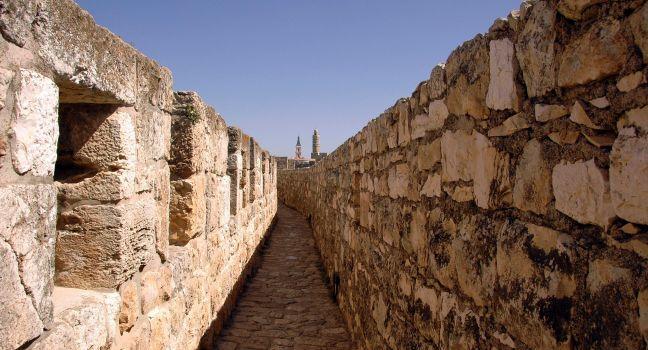
The narrow stone catwalks of the Old City walls provide great panoramic views and interesting perspectives of this intriguing city. But they also offer an innocent bit of voyeurism as you look down into gardens and courtyards and become, for a moment, a more intimate partner in the secret domestic life of the different quarters you pass. Across the rooftops, the domes and spires of the three religions that call Jerusalem holy compete for the skyline, just as their adherents jealously guard their territory down below. Peer through the shooting niches, just as watchmen and snipers did in the not-so-distant past. The hotels and high-rises of the new city dominate the skyline to the west; Mount Zion is immediately to the south; the bustle of East Jerusalem is almost tangible to the north; and the churches and cemeteries quietly cling to the Mount of Olives to the east.
There are many high steps on this route; the railings are secure, but small children or the elderly should not walk alone; good footwear, a hat, and water (you'll be in direct sunlight) are recommended.
The two sections of the walk are separated by Jaffa Gate, though the same ticket covers both (available from the commercial tourist services office just inside Jaffa Gate and at the entrance to the southern route). The shorter southern section is accessible only from the end of the seemingly dead-end terrace outside Jaffa Gate at the exit of the Tower of David Museum. Descent is at Zion Gate or just before Dung Gate. The longer and more varied walk begins at Jaffa Gate (up the stairs immediately on the left as you enter the Old City), with descent at New, Damascus, Herod's, or Lions' Gates. Allow 30 to 40 minutes for the shorter section to Zion Gate, adding 10 to 15 minutes to get to Dung Gate. For the longer section, it takes 20 minutes to walk north-northeast to the New Gate, another 20 minutes east to Damascus Gate, 15 minutes from there to Herod's Gate, and about 20 minutes more to Lions' Gate.
Since much of the long northern route passes through or above Palestinian areas, it's advisable to end your walk at the New Gate during times of tension.


