10 Best Sights in Cape Town, South Africa

Background Illustration for Sights

Cape Town has grown as a city in a way that few others in the world have. Take a good look at the street names. Strand and Waterkant streets (meaning "beach" and "waterside," respectively) are now far from the sea. However, when they were named, they were right on the beach. An enormous program of dumping rubble into the ocean extended the city by a good few square miles (thanks to the Dutch obsession with reclaiming land from the sea). Almost all the city on the seaward side of Strand and Waterkant is part of the reclaimed area of the city known as the Foreshore. If you look at old paintings of the city, you will see that originally waves lapped at the very walls of the castle, now more than half a mile from the ocean.

Table Mountain

Fodor's Choice

Rising sharply to 1,086 meters (3,563 feet) and looming above the city center, flat-topped Table Mountain truly is one of the world's most beautiful and impressive natural wonders. Not only is it a sight to behold, but the top affords scintillating views stretching to distant horizons; it's said to be visible to sailors 65 km (40 miles) out to sea. Hiking to the summit’s wilderness via one of the trails, such as the popular stairway-like Plattekloof Gorge, up its rugged slopes requires two to three hours, depending on your fitness level, or you can zip to the top in 10 minutes with the cable car. Thrill seekers can abseil down a section of the mountain ( abseilafrica.co.za).

Apart from the stunning views from its summit, there's a world of unusual fynbos vegetation at the top and an atmosphere that's slightly surreal. If you hike up, be sure to take at least 2 liters (½ gallon) of water per person with you and exercise caution; it may be in the middle of a city, but it is a genuine wilderness. Many paths that look like good routes down the mountain end in treacherous cliffs. And, apart from the weather which can turn in an instant, you need to be mindful of the possibility of muggings and chances of losing your way. Hiking alone is never recommended, and engaging the services of a hiking or mountain guide is a great way to go beyond the obvious trails and also learn about the mountain's flora and fauna. However you choose to do the climb, wear sturdy shoes or hiking boots; always take warm clothes, including a windbreaker or fleece; take a mobile phone; and let someone know of your plans.  Do not underestimate this mountain: every year local and foreign visitors get lost, some falling off ledges, with fatal consequences.
Kirstenbosch National Botanical Garden

Fodor's Choice
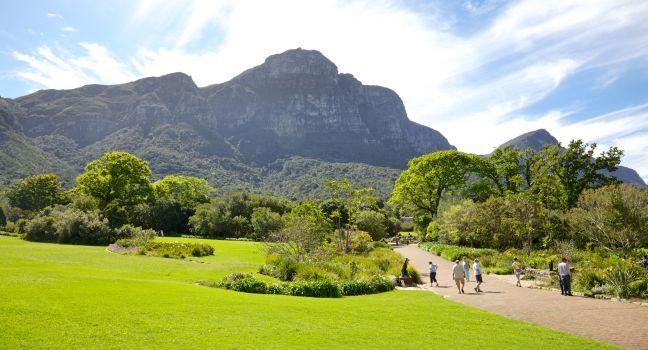
KIRSTENBOSCH, SOUTH AFRICA - SEPTEMBER 29: Visitors relaxing in Kirstenbosch National Botanical Garden on September 29, 2009. Kirstenbosch celebrated its centenary in July 2013.; Shutterstock ID 147156743; Project/Title: Top 100 Cape Town; Downloader: Fodo
David Steele / Shutterstock

Spectacular in every season, this renowned botanical garden was established in 1913, and was the first in the world to conserve and showcase a country's indigenous flora. With its magnificent setting extending up the eastern slopes of Table Mountain and overlooking the city and distant Hottentots Holland Mountains, these gardens are truly a national treasure. In addition to thousands of out-of-town visitors, Capetonians flock here on weekends to laze on the grassy lawns, picnicking and reading while children run riot. Walking trails meander through the plantings, and there's emphasis on the fynbos biome—the hardy, thin-leaved plants that proliferate in the Cape—so you will find plenty of proteas, ericas, and restios (reeds). Highlights include the Tree Canopy Walkway (aka "Boomslang," a large cycad garden), the Bird Bath (a beautiful stone pool built around a crystal clear spring), the fragrance garden (which is wheelchair-friendly and has a tapping rail), and the Sculpture Garden. Free 90-minute guided tours take place daily except Sunday. Those with difficulty walking can enjoy a comprehensive tour lasting one hour (R70, hourly 9–3) in seven-person (excluding the driver) golf carts. Concerts featuring top South African artists—from classical music to township jazz to indie rock—are held on summer Sundays at 5 and everyone rocks up with blankets and picnic hampers (arrive early to get a good spot), and the Galileo Outdoor Cinema ( thegalileo.co.za) screens movies on select weekday evenings an hour after sunset. The visitor center houses a restaurant, bookstore, and coffee shop. Several trails take you to the top of Table Mountain, from which point you can hike all the way to the cable car station.

Two Oceans Aquarium

Fodor's Choice
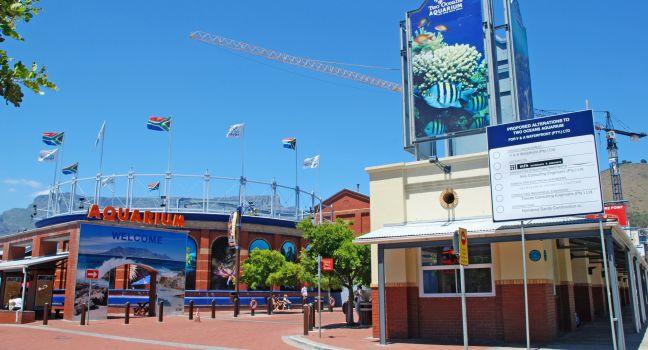
CAPE TOWN, SOUTH AFRICA - DECEMBER 30, 2007: Cityscape with The Two Oceans Aquarium located at the Victoria & Alfred Waterfront in Cape Town, Western Cape, South Africa. ; Shutterstock ID 216711187; Project/Title: Top 100 Cape Town; Downloader: Fodor's
InnaFelker / Shutterstock

This aquarium is widely considered one of the finest in the world. Stunning displays reveal the regional marine life of the warmer Indian Ocean and the icy Atlantic. It's a hands-on place, with a touch pool for children, opportunities to interact with penguins, and (for certified divers only) to dive in the vast, five-story ocean exhibit with shoals of fish, huge turtles, and stingrays. There's the shark exhibit, where you might share the water with large ragged-tooth sharks (Carcharias taurus) and enjoy a legal adrenaline rush (for an additional fee, of course). If you don't fancy getting wet, you can still watch daily feedings in either the ocean, penguin, or shark exhibits. But there's more to the aquarium than just snapping jaws. Look for the absolutely enchanting jellyfish display gallery, which looks like something from another universe, seek out the endangered Knysna seahorses, and don't miss the alien-like spider crabs.

If you really want a one-of-a-kind experience, book the "Penguin Experience" where you'll get to meet several of the aquarium's rockhoppers, all of which have either been rescued or were born at the facility. Rockhoppers aren't native to South Africa, but when they get stranded or injured here, they are rescued by aquarium conservationists who nurse them back to health. You learn about their personalities, photograph them up close, and then accompany them as they return to their beach-like enclosure within the aquarium just in time for feeding time. It may be one of the loveliest moments you ever get with human-habituated wild animals. It's for two people at a time, lasts about 45 minutes, costs R890 per person, and must be pre-booked.

Recommended Fodor's Video

Bakoven Beach

Bakoven Fodor's Choice

Bakoven's boulder-ensconced beaches—two separate coves in a tucked away little residential area—are quite tiny, but somehow everyone manages to squeeze in, provided they find parking. Somehow the water seems slightly more manageable here, even if it's just as cold as anywhere else; the views of the mountains, and the accompanying sense of being adrift from reality somehow motivate everyone to get in the water. The large rocky outcrops are the perfect perches to witness some of the most incredible sunsets on the planet; when the sun's rays hit the water it turns to molten lava and is absolute balm for the soul. Parking is limited, so take the MyCiTi bus, grab an Uber, walk from Camps Bay, or get here early to get a parking spot. There are no amenities, but Bootleggers coffee shop on Victoria Road is nearby, and it has bathrooms. Amenities: none. Best for: sunset; swimming.

Beta Rd., Cape Town, South Africa

Something incorrect in this review?

Blouberg Beach

Blouberg Fodor's Choice

A half-hour drive north of Cape Town, this is the beach from which all those iconic "sea with Table Mountain" postcards are shot. Blouberg is divided into two parts: Big Bay, which hosts surfing and windsurfing contests, and Little Bay, better suited to sunbathers, rock-pool explorers, and families. It can be windy here, which is great for kite flying and kite surfing. Kite surfing has become extremely popular along this side of Table Bay, and adrenaline junkies blow off work to come here and ride the waves. For safety, swim in front of the lifeguard club. Amenities: food and drink; lifeguards; parking; water sports. Best for: surfing; walking; windsurfing.

2 Marine Drive, Blouberg, Cape Town, 7441, South Africa

Something incorrect in this review?

Clifton Beach

Clifton Fodor's Choice

Almost always wind-free, these fantastic white-sand beaches—known as First, Second, Third, and Fourth Beaches—are naturally divided by huge granite outcroppings and voluptuous boulders. Fourth Beach is popular with families and teens, whereas the others support a strong social and singles scene. Dogs are technically allowed only on First Beach. Swimming is reasonably safe, although the undertow is strong and the water can be characterized as freezing for much of the year. Lifeguards are on duty on weekends and in peak season. Fairly steep staircases provide access to all four beaches, but once you arrive, you will find vendors with drinks, ice cream, and beach loungers for rent in summer. Amenities: food and drink; lifeguards; parking (fee); showers; toilets. Best for: partiers; sunset; surfing; walking. Parking is a nightmare in season; instead, take an Uber or the MyCiTi bus, which has stops here.

Off Victoria Rd., Cape Town, 8005, South Africa

Something incorrect in this review?

Desmond & Leah Tutu Legacy Foundation

Zonnebloem Fodor's Choice

The foundation highlights the life and accomplishments of South Africa’s famous cleric and his equally impressive wife, Leah, while continuing their message of courage, freedom, and equality. The exhibits are well-organized and present personal objects, including a set of Tutu's purple vestments, photos, quotes, and informative videos in an accessible way. The Truth to Power: Desmond Tutu & the Churches exhibit explores the multifaceted life of the cleric, humanitarian, activist, and Nobel Peace winner, while the 90 Voices HERstory exhibit celebrates the legacy and contributions of Mrs. Leah Tutu with the stories of 90 women who were all part of South Africa’s struggle for freedom. Programs and lectures are ongoing.

11 Buitenkant St., Cape Town, 8001, South Africa
021-552–7524
Sight Details
R100
Closed Sun. and Mon.

Something incorrect in this review?

Iziko Bo-Kaap Museum

Bo-Kaap Fodor's Choice

Most guided tours of the Malay quarter include a visit to this 18th-century home, which originally belonged to well-known Turkish scholar and prominent local Muslim leader, Abu Bakr Effendi. The museum showcases local Islamic heritage and culture, with highlights including “Who Built Cape Town?,” “Mapping Bo-Kaap: History, memories and spaces,” and the documentary “Viewing Bo-Kaap.”

Norval Foundation

Tokai Fodor's Choice

This strikingly modern, well-structured space has a huge exhibition gallery, gigantic walls, and proper lighting, all of which make it a pleasure to visit and take in what are usually the best exhibitions you'll see in Cape Town. Curation is exceptional, with descriptive information panels and no expense spared to showcase the depth of an artist's work, or to bring innovative and eye-opening new work to the public's attention. Unlike Zeitz MOCAA where the focus is often on conceptual work lacking emotional gravitas, here you will feel the soul of the artists speaking to you. There is also a beautiful garden that showcases a permanent collection of phenomenal large-scale sculptures, plus there are beautiful views of the mountain, and a children's playground, a research library, and a destination restaurant.

Zeitz Museum of Contemporary Art Africa

Fodor's Choice

Opened in 2017, Zeitz MOCAA is the first major museum dedicated to contemporary art from Africa and its diaspora. Inhabiting the massively renovated historic Grain Silo in what is now called the Silo District of the V&A Waterfront, the museum itself is a work of art, reimagined by British designer Thomas Heatherwick. In many ways, the building itself is the reason to visit; from the outside it's enchanting, while inside you get a sense of the strangeness of the transformation from one sort of building into another. Inside, it's worth staring up and then slowly exploring the levels, using the elevator and the spiral stairway to seek out different perspectives. The exhibits change fairly regularly and are a mixed bag, although it must be said that since the pandemic, the emphasis has turned altogether to more serious and conceptual work with fewer displays of emotionally engaging artworks than the museum kicked off with. Still, you never know what might be on the walls when you're in town, and there are always new things to discover, even if the white-wall exhibition spaces themselves are less interesting than the architectural framework that holds them all together. There's also a fabulous art-centric souvenir store on the ground floor, and in the basement, there are children's workshops that may be worth investigating if you have children in tow.