


Portobello Road Market
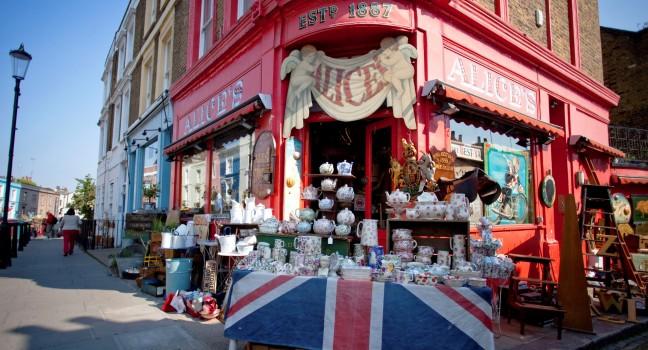
Looking for a 19th-century snuff spoon? Perhaps a Georgian salt cellar? What about a 1960s-era minidress? Then head to Portobello Road's famous Saturday market—and arrive at about 9 am to avoid the giant crowds. Stretching almost 2 miles from Notting Hill, the market is made up of four sections, each with a different emphasis: antiques, fresh produce, household goods, and a flea market. The antiques stalls are packed in between Chepstow Villas and Westbourne Grove, where you'll also find almost 100 antiques shops plus indoor markets, which are open on weekdays, when shopping is much less hectic. Where the road levels off, around Elgin Crescent, youth culture and a vibrant neighborhood life kicks in, with a variety of interesting small stores and food stalls interspersed with a fruit-and-vegetable market.
On Friday and Saturday, the section between Talbot Road and the Westway elevated highway becomes one of London's best flea markets, specializing in discounted new household goods, while north of the Westway, you'll find secondhand household goods and bric-a-brac. Scattered throughout, but especially under the Westway, are vendors selling a mishmash of designer, vintage, and secondhand clothing, together with jewelry, custom T-shirts, and assorted junk. There's a Trinidad-style Carnival centered on Portobello Road on the late August bank-holiday weekend, a tribute to the area's past as a center of the West Indian community.


