Get FREE email communications from Fodor's Travel, covering must-see travel destinations, expert
trip planning advice, and travel inspiration to fuel your passion.
We've compiled the best of the best in Piazza di Spagna - browse our top choices for the top
things to see or do during your stay.
Sorry! We don't have any recommendations for Piazza di Spagna right now.
Sights Filter
Ara Pacis Augustae
Piazza di Spagna
Fodor's Choice
Share This
(c) Archeofoto | Dreamstime.com
This pristine monument sits inside one of Rome's contemporary architectural landmarks: a gleaming, rectangular, glass-and-travertine structure designed by American architect Richard Meier. It overlooks the Tiber on one side and the ruins of the marble-clad Mausoleo di Augusto (Mausoleum of Augustus) on the other and is a serene, luminous oasis right in the center of Rome.
This altar itself dates from 13 BC and was commissioned to celebrate the Pax Romana, the era of peace ushered in by Augustus's military victories. When viewing it, keep in mind that the spectacular reliefs would have been painted in vibrant colors, now long gone. The reliefs on the short sides portray myths associated with Rome's founding and glory; those on the long sides display a procession of the imperial family. Although half of his body is missing, Augustus is identifiable as the first full figure at the procession's head on the south-side frieze; academics still argue over exact identifications of most of the figures. Be sure to check out the small downstairs museum, which hosts rotating exhibits on Italian culture, with themes ranging from design to film.
Palazzo Doria Pamphilj
Trevi
Fodor's Choice
Share This
(c) Kpapaioanno | Dreamstime.com
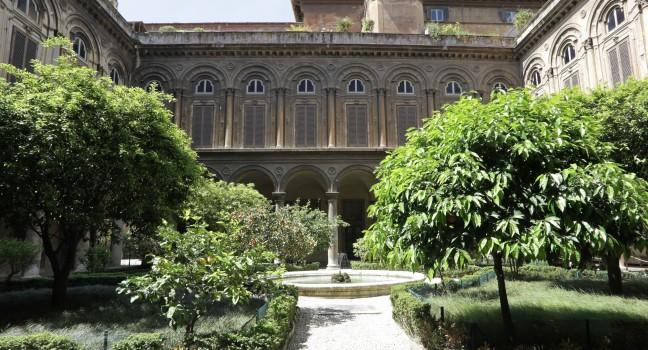
Like the Palazzo Colonna and the Galleria Borghese, this dazzling 15th-century palace provides a fantastic glimpse of aristocratic Rome. It passed through several hands before becoming the property of the Pamphilj family, who married into the famous seafaring Doria family of Genoa in the 18th century. The family still lives in part of the palace.
The understated beauty of the graceful facade, designed by Gabriele Valvassori in 1730 and best admired from the opposite side of the street, barely hints at the interior's opulent halls and gilded galleries, which are filled with Old Master works. The 550 paintings here include three by Caravaggio: St. John the Baptist, Mary Magdalene, and the breathtaking Rest on the Flight to Egypt. Off the eye-popping Galleria degli Specchi (Gallery of Mirrors)—a smaller version of the one at Versailles—are the famous Velázquez Pope Innocent X, considered by some historians to be the greatest portrait ever painted, and the Bernini bust of the same Pamphilj pope.
A delightful audio guide is included in the ticket price and is narrated by the current heir, Prince Jonathan Doria Pamphilj, who divulges intimate family history. Plan to stay for lunch, or at least pause for a coffee, at the fashionable Caffè Doria, with elegant tables set out in the palace's peaceful cloisters.
Sant'Ignazio
Trevi
Fodor's Choice
Share This
(c) Sedmak | Dreamstime.com
Rome's second Jesuit church, this 17th-century landmark set on a Rococo piazza harbors some of the city's most magnificent trompe l'oeils. To get the full effect of the illusionistic ceiling by priest-artist Andrea Pozzo, stand on the small yellow disk set into the floor of the nave. The heavenly vision that seems to extend upward almost indefinitely represents the Allegory of the Missionary Work of the Jesuits. It's part of Pozzo's cycle of works in this church exalting the early history of the Jesuit order, whose founder was the reformer Ignatius of Loyola. The saint soars heavenward, supported by a cast of thousands, creating a jaw-dropping effect that was fully intended to rival that of the glorious ceiling by Baciccia in the nearby mother church of Il Gesù. Be sure to have coins handy for the machine that switches on the lights so you can marvel at the false dome, which is actually a flat canvas—a trompe l'oeil trick Pozzo used when the architectural budget drained dry.
Scattered around the nave are several awe-inspiring altars; their soaring columns, gold-on-gold decoration, and gilded statues are pure splendor. Splendid, too, are the occasional sacred music concerts performed by choirs from all over the world. Look for posters by the main doors, or check the website for more information.
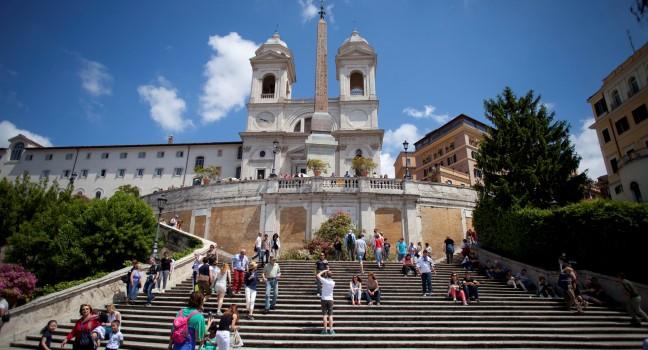
The iconic Spanish Steps (often called simply la scalinata, or "the staircase," by Italians) and the Piazza di Spagna from which they ascend both get their names from the Spanish Embassy to the Vatican on the piazza—even though the staircase was built with French funds by an Italian in 1723. In honor of a diplomatic visit by the King of Spain, the hillside was transformed by architect Francesco de Sanctis with a spectacular piece of urban planning to link the church of Trinità dei Monti at the top with the Via Condotti below.
In an allusion to the church, the staircase is divided by three landings (beautifully lined with potted azaleas from mid-April to mid-May). Bookending the bottom of the steps are beloved holdovers from the 18th century, when the area was known as the "English Ghetto": to the right, the Keats-Shelley House and to the left, Babington's Tea Rooms—both beautifully redolent of the era of the Grand Tour.
For weary sightseers who find the 135 steps too daunting, there is an elevator at Vicolo del Bottino 8, next to the Metro entrance. (Those with mobility problems should be aware that there is still a small flight of stairs after, however, and that the elevator is sporadically closed for repair.) At the bottom of the steps, Pietro Bernini's splendid 17th-century Barcaccia Fountain still spouts drinking water from the ancient aqueduct known as the Acqua Vergine.
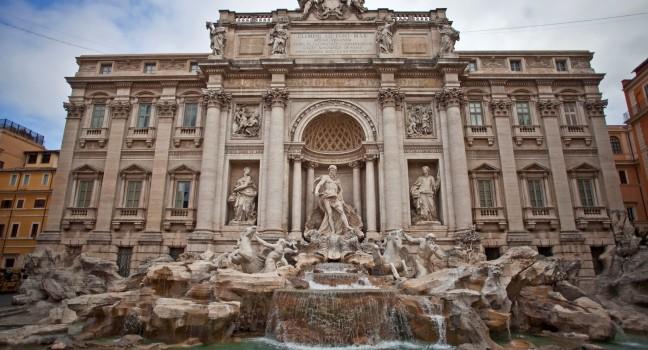
Alive with rushing waters commanded by an imperious sculpture of Oceanus, the Fontana di Trevi has been all about theatrical effects from the start; it is an aquatic marvel in a city filled with them. The fountain's unique drama is largely due to its location: its vast basin is squeezed into the tight confluence of three little streets (the tre vie, which may give the fountain its name), with cascades emerging as if from the wall of Palazzo Poli.
The dream of a fountain emerging full force from a palace was first envisioned by Bernini and Pietro da Cortona from Pope Urban VIII's plan to rebuild an older fountain, which had earlier marked the end point of the Acqua Vergine, an aqueduct created in 18 BC by Agrippa. Three popes later, under Pope Clement XIII, Nicola Salvi finally broke ground with his winning design. Unfortunately, Salvi did not live to see his masterpiece of sculpted seashells, roaring sea beasts, and diva-like mermaids completed; he caught a cold and died while working in the culverts of the aqueduct 11 years before the fountain was finished in 1762.
Everyone knows the famous legend that if you throw a coin into the Trevi Fountain you will ensure a return trip to the Eternal City, but not everyone knows how to do it the right way. You must toss a coin with your right hand over your left shoulder, with your back to the fountain. One coin means you'll return to Rome; two, you'll return and fall in love; three, you'll return, find love, and marry. The fountain grosses some €1,500,000 a year, with every cent going to the Catholic charity Caritas, which is why Fendi was willing to fully fund the Trevi's recent restoration.
Tucked away in a little nearby alley is the Vicus Caprarius (Vicolo del Puttarello, 25), a small museum where visitors can pay €8 for a guided tour that descends into a subterranean area that gives a glimpse at the water source that keeps the fountain running.
Monumento a Vittorio Emanuele II, or Altare della Patria
Trevi
Fodor's Choice
Share This
The huge white mass known as the "Vittoriano" is an inescapable landmark that has been likened to a giant wedding cake or an immense typewriter. Present-day Romans joke that you can only avoid looking at it if you are standing on it, but at the beginning of the 20th century, it was the source of great civic pride. Built to honor the unification of Italy and the nation's first king, Victor Emmanuel II, it also shelters the eternal flame at the tomb of Italy's Unknown Soldier, killed during World War I. Alas, to create this elaborate marble behemoth and the vast surrounding piazza, its architects blithely destroyed many ancient and medieval buildings and altered the slope of the Campidoglio (Capitoline Hill), which abuts it.
The underwhelming exhibit inside the building tells the history of the country's unification. The Vittoriano has a rooftop terrace, however, that offers some of the best panoramic views of Rome.
Palazzo Colonna
Trevi
Fodor's Choice
Share This
Rome's grandest private palace is a fusion of 17th- and 18th-century buildings that have been occupied by the Colonna family for more than 20 generations. The immense residence faces Piazza dei Santi Apostoli on one side and the Quirinale (Quirinal Hill) on the other—with a little bridge over Via della Pilotta linking to gardens on the hill—and contains an art gallery that's open to the public on Saturday morning or by guided tour on Friday morning.
The gallery is itself a setting of aristocratic grandeur; you might recognize the Sala Grande as the site where Audrey Hepburn meets the press in Roman Holiday. An ancient red marble colonna (column), which is the family's emblem, looms at one end, but the most spectacular feature is the ceiling fresco of the Battle of Lepanto painted by Giovanni Coli and Filippo Gherardi beginning in 1675. Adding to the opulence are works by Poussin, Tintoretto, and Veronese, as well as portraits of illustrious members of the family, such as Vittoria Colonna, Michelangelo's muse and longtime friend.
It's worth paying an extra fee to take the guided, English-language gallery tour, which will help you navigate through the array of madonnas, saints, goddesses, popes, and cardinals to see Annibale Carracci's lonely Beaneater, spoon at the ready and front teeth missing. The gallery also has a caffè with a pleasant terrace.
Basilica di Sant'Andrea delle Fratte
Piazza di Spagna
Share This
Two of Bernini's original angels that decorated the Ponte Sant'Angelo are found here, on either side of the high altar. The door in the right aisle leads into one of Rome's hidden gardens, where orange trees bloom in the cloister. Borromini's fantastic contributions—the dome and a curious bell tower with its droop-winged angels looking out over the city—are best seen from Via di Capo le Case, across Via dei Due Macelli.
Colonna di Marco Aurelio
Piazza di Spagna
Share This
Inspired by Trajan's Column, this 2nd-century-AD column is composed of 27 blocks of marble covered in reliefs recounting Marcus Aurelius's victory over the Germanic tribes. A bronze statue of St. Paul, which replaced the original effigy of the emperor and his wife, Faustina, in the 16th century, stands at the top. The column is the centerpiece of Piazza Colonna.
Fontana della Barcaccia
Piazza di Spagna
Share This
At the foot of the Spanish Steps, this curious, leaky boat fountain is fed by Rome's only surviving ancient aqueduct, the Acqua Vergine. The sinking ship design is a clever solution to low water pressure and was created by Pietro Bernini, with the help of his son, the prolific sculptor Gian Lorenzo Bernini. The project was commissioned by Barberini Pope Urban VIII, and the bees and suns on the boat are symbols of the Barberini family. Looking for more symbolism, some insist that the Berninis intended the fountain to be a reminder that this part of town was often flooded by the Tiber; others claim that it represents the Ship of the Church; and still others think that it marks the presumed site of the emperor Domitian's water stadium in which sea battles were reenacted in the glory days of the Roman Empire.
Gagosian Gallery
Piazza di Spagna
Share This
This is the Roman outpost of Larry Gagosian’s global art empire. Taking residence in a 1920s bank building, Gagosian brings an international crowd with highly anticipated exhibitions and blockbuster showcases of megastars such as Cy Twombly, Damien Hirst, and Jeff Koons.
Galleria d'Arte Moderna
Piazza di Spagna
Share This
Located in a former monastery, this small museum displays a capsule collection of modern art, with an emphasis on Italian artists. The permanent collection is too large to be displayed at once, so exhibitions rotate, displaying paintings, drawings, prints, and sculptures by artists of the 19th and 20th centuries, including Giorgio de Chirico, Mario Mafai, Scipione, Gino Severini, and Giorgio Morandi.
Keats-Shelley Memorial House
Piazza di Spagna
Share This
Sent to Rome in a last-ditch attempt to treat his consumptive condition, English Romantic poet John Keats—celebrated for such poems as "Ode to a Nightingale" and "Endymion"—lived in this house at the foot of the Spanish Steps. At the time, this was the heart of Rome's colorful bohemian quarter, an area favored by English expats. He took his last breath here on February 23, 1821, and is now buried in the Non-Catholic Cemetery in Testaccio. On a visit to his final home, you can see his death mask, though local authorities had all his furnishings burned after his death as a sanitary measure. You'll also find a quaint collection of memorabilia of other English literary figures of the period—Lord Byron, Percy Bysshe Shelley, Joseph Severn, and Leigh Hun—and an exhaustive library of works on the Romantics.
Palazzo Bonaparte
Trevi
Share This
First designed by Giovanni Antonio De' Rossi for the Marquis of Aste in the 17th century, this Renaissance palace is better known as the home of Letizia Bonaparte, who purchased the elegant building in 1818. Napoleon's mother, who lived here until her death in 1836, was fond of sitting on the curious covered green balcony that wraps around a corner of the first floor. The stately home overlooks the Vittoriano and Palazzo Venezia, as well as the nonstop motion of Rome's busiest piazza. Palazzo Bonaparte is open for temporary exhibits and has hosted the works of blockbuster artists like Vincent Van Gogh and M. C. Escher, among others.
Palazzo Venezia
Trevi
Share This
Rome's first great Renaissance palace, the centerpiece of an eponymous piazza, was originally built for Venetian cardinal Pietro Barbo (who eventually became Pope Paul II), but it was repurposed in the 20th century by Mussolini, who harangued crowds with speeches from the balcony over its finely carved door. Lights were left on through the night during his reign to suggest that the fascist leader worked without pause.
The palace is now open to the public, and highlights include frescoes by Giorgio Vasari, an Algardi sculpture of Pope Innocent X, and decorative art exhibits. The loggia has a pleasant view over the tranquil garden courtyard, which seems a million miles away from the chaos of Piazza Venezia on the other side of the building. The ticket price includes an audio guide.
Palazzo Zuccari
Piazza di Spagna
Share This
This amusing palazzo was designed in 1591 by noted painter Federico Zuccari (1540–1609), who frescoed the first floor of his custom-built home. Typical of the outré Mannerist style of the period, the two windows and the main door are designed to look like monsters with mouths gaping wide. Zuccari—whose frescoes adorn many Roman churches, including Trinità dei Monti just up the block—sank all his money into his new home, dying in debt before his curious memorial, as it turned out, was completed.
Today, it is home to the German state-run Bibliotheca Hertziana, a prestigious fine-arts library. Access is reserved for scholars, but the pristine facade can be admired for free. Leading up to the quaint Piazza della Trinità del Monti, the nearby Via Gregoriana is quite charming and has long been one of Rome's most elegant addresses, home to such residents as 19th-century French painter Ingres; Valentino also had his first couture salon here.
Piazza Venezia
Trevi
Share This
Piazza Venezia stands at what was the beginning of the ancient Via Flaminia, a historic Roman road leading northeast across Italy to the Adriatic Sea. From this square, Rome's geographic heart, all distances from the city are calculated.
The piazza was transformed at the turn of the 20th century when much older ruins were destroyed to make way for a modern capital city (and a massive monument to unified Italy's first king). The female bust near the church of San Marco in the southwest corner of the piazza is a fragment of a statue of Isis, now known to the Romans as Madama Lucrezia. It is one of the city's "talking statues" on which anonymous poets hung verses pungent with political satire.
The Via Flaminia remains a vital artery. The part leading from Piazza Venezia to Piazza del Popolo is now known as Via del Corso, after the horse races (corse) that were run here during the wild Roman carnival celebrations of the 17th and 18th centuries. It also happens to be one of Rome's busiest shopping streets.
Trinità dei Monti
Piazza di Spagna
Share This
Standing high above the Spanish Steps, this 16th-century church has a rare double-tower facade, suggestive of late–French Gothic style; in fact, the French crown paid for the church's construction. Today, it is known primarily for its dramatic location and magnificent views. The obelisk in front is from the 2nd or 3rd century AD and was originally a centerpiece to an imperial villa.
Not finding what you're looking for?
We've got a few suggestions for nearby spots.
Villa Borghese, Piazza del Popolo, and Flaminio Fodor's Choice
Villa Medici0.3 miles away
Viale della Trinità dei Monti, 1, Rome, Latium, 00187, Italy
I want emails from Fodor's Travel with travel information and promotions. I can unsubscribe
any time using the unsubscribe link at the end of all emails.
Thank you for your interest!
Look out for our newsletters with travel tips and special offers.
Sign up for Travel Tips & News
By signing up for the
newsletter, I agree to the Privacy Policy. You must check the box to subscribe
Thank you for your interest!
Look out for our newsletters with travel tips and special offers.