17 Best Sights in Repubblica and Quirinale, Rome

Background Illustration for Sights

We've compiled the best of the best in Repubblica and Quirinale - browse our top choices for the top things to see or do during your stay.

Palazzo Massimo alle Terme

Repubblica Fodor's Choice
Representation of the lupercal: Romulus and Remus fed by a she-wolf, surrounded by representations of the Tiber and the Palatine. Panel from an alter dedicated to the divine couple of Mars and Venus. Marble, Roman artwork of the end of the reign of Trajan
By Marie-Lan Nguyen (2006) [Public domain], via Wikimedia Commons

The Museo Nazionale Romano, with items ranging from striking classical Roman paintings to marble bric-a-brac, has four locations: Palazzo Altemps, Crypta Balbi, the Museo delle Terme di Diocleziano, and this, the Palazzo Massimo alle Terme—a vast structure containing the great ancient treasures of the archaeological collection and also the coin collection. Highlights include the Dying Niobid, the famous bronze Boxer at Rest, and the Discobolus Lancellotti.

Among the museum's most intriguing attractions, however, are the ancient frescoes on view on the top floor. They're stunningly set up to "recreate" the look of the homes they once decorated, and their colors are remarkably preserved. You'll see stuccoes and wall paintings found in the area of the Villa Farnesina (in Trastevere), as well as those depicting a garden in bloom and an orchard alive with birds that once covered the walls of cool sunken rooms at Empress Livia's villa in Prima Porta, just outside the city.
Largo di Villa Peretti, 2, Rome, 00185, Italy
06-39967700
Sight Details
€8, or €12 for a combined ticket including access to Crypta Balbi, Museo delle Terme di Diocleziano, and Palazzo Altemps (valid for 1 wk)
Closed Mon.

Something incorrect in this review?

Santa Maria della Vittoria

Repubblica Fodor's Choice
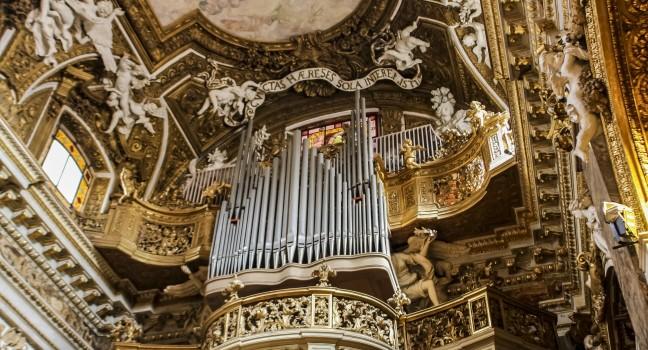
ROME, ITALY - JUNE 4: Cantoria of the Santa Maria della Vittoria church in Rome, Italy at June 4, 2012. Church was opened at 1620 and cantoria was decorated by Mattia de Rossi.
Goran Bogicevic/Shutterstock

Designed by Carlo Maderno, this church is best known for Bernini's sumptuous Baroque decoration of the Cappella Cornaro (Cornaro Chapel, the last on the left as you face the altar), which houses his interpretation of divine love in the Ecstasy of St. Teresa. Bernini's masterly fusion of sculpture, light, architecture, painting, and relief is a multimedia extravaganza, with the chapel modeled as a theater, and one of the key examples of the Roman High Baroque. The members of the Cornaro family meditate on the communal vision of the great moment of divine love before them: the swooning saint's robes appear to be on fire, quivering with life, and the white marble group seems suspended in the heavens as golden rays illuminate the scene. An angel assists as Teresa abandons herself to the joys of heavenly love. To modern eyes, Bernini's representation of the saint's experience may seem more earthly than mystical. As the visiting French dignitary Charles de Brosses put it in the 18th century, "If this is divine love, I know all about it." 

Via XX Settembre, 17, Rome, 00187, Italy
06-42740571

Something incorrect in this review?

MACRO

Repubblica Fodor's Choice

Formerly known as Rome's Modern and Contemporary Art Gallery, and before that as the Peroni beer factory, this redesigned industrial space has brought new life to the gallery and museum scene of a city hitherto hailed for its "then," not its "now." The collection here covers Italian contemporary artists from the 1960s through today. The goal is to bring current art to the public in innovative spaces and, not incidentally, to support and recognize Rome's contemporary art scene, which labors in the shadow of the city's artistic heritage. After a few days—or millennia—of dusty marble, it's a breath of fresh air.  Check the website for occasional late-night openings and events.

Recommended Fodor's Video

Palazzo Barberini/Galleria Nazionale d'Arte Antica

Quirinale Fodor's Choice

One of Rome's most splendid 17th-century buildings is a Baroque landmark. The grand facade was designed by Carlo Maderno (aided by his nephew, Francesco Borromini), but when Maderno died, Borromini was passed over in favor of his great rival, Gian Lorenzo Bernini. The palazzo is now home to the Galleria Nazionale d'Arte Antica, with a collection that includes Raphael's La Fornarina, a luminous portrait of the artist's lover (a resident of Trastevere, she was reputedly a baker's daughter). Also noteworthy are Guido Reni's portrait of the doomed Beatrice Cenci (beheaded in Rome for patricide in 1599)—Nathaniel Hawthorne called it "the saddest picture ever painted" in his Rome-based novel, The Marble Faun—and Caravaggio's dramatic Judith Beheading Holofernes.

The showstopper here is the palace's Gran Salone, a vast ballroom with a ceiling painted in 1630 by the third (and too-often-neglected) master of the Roman Baroque Pietro da Cortona. It depicts the Glorification of Urban VIII's Reign and has the spectacular conceit of glorifying Urban VIII as the agent of Divine Providence, escorted by a "bomber squadron" (to quote art historian Sir Michael Levey) of huge Barberini bees, the heraldic symbol of the family.

Capuchin Museum

Quirinale
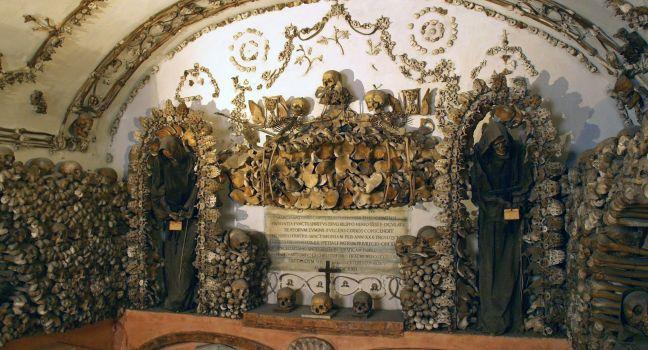
The Capuchin Crypt is a small space comprising several tiny chapels located beneath the church of Santa Maria della Concezione dei Cappuccini on the Via Veneto near Piazza Barberini in Rome, Italy. It contains the skeletal remains of 4,000 bodies believed
Luigi Roscia | Dreamstime.com

Devoted to teaching visitors about the Capuchin order, this museum is mainly notable for its strangely touching and beautiful crypt under the church of Santa Maria della Concezione. The bones of some 4,000 friars are arranged in odd decorative designs around the shriveled and decayed remains of their kinsmen, a macabre reminder of the impermanence of earthly life. As one sign proclaims: "What you are, we once were. What we are, you someday will be."

Upstairs in the church, the first chapel on the right contains Guido Reni's mid-17th-century Archangel St. Michael Trampling the Devil. The painting caused great scandal after an astute contemporary observer remarked that the face of the devil bore a surprising resemblance to Pope Innocent X, archenemy of Reni's Barberini patrons. Compare the devil with the bust of the pope that you saw in the Palazzo Doria Pamphilj and judge for yourself.

San Carlo alle Quattro Fontane

Quirinale
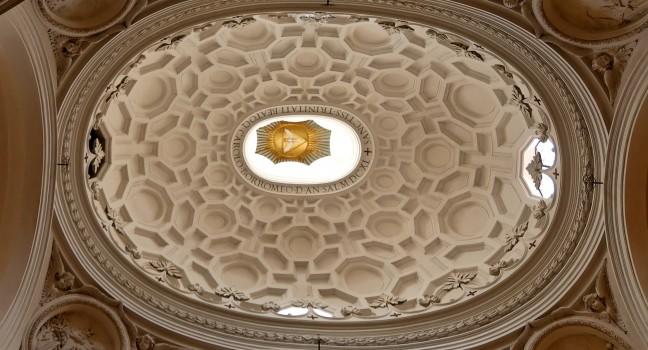
Elliptic dome of San Carlo alle Quattro Fontane (1638-1641) in Rome, designed by Francesco Borromini.
Marie-Lan Nguyen [public domain], via Wikimedia Commons

Sometimes known as San Carlino because of its tiny size, this is one of Borromini's masterpieces. In a space no larger than the base of one of the piers of St. Peter's Basilica, he created a church that is an intricate exercise in geometric perfection, with a coffered dome that seems to float above the curves of the walls. Borromini's work is often bizarre, definitely intellectual, and intensely concerned with pure form. In San Carlo, he invented an original treatment of space that creates an effect of rippling movement, especially evident in the double-S curves of the facade. Characteristically, the interior decoration is subdued, in white stucco with no more than a few touches of gilding, so as not to distract from the form. Don't miss the cloister: a tiny, understated Baroque jewel, with a graceful portico and loggia above, echoing the lines of the church.

Via del Quirinale, 23, Rome, 00187, Italy
06-48907729
Sight Details
Closed Sun.

Something incorrect in this review?

Fontana dell'Acqua Felice

Repubblica

When Pope Sixtus V (Felice Peretti) completed the restoration of the Acqua Felice aqueduct toward the end of the 16th century, Domenico Fontana was commissioned to design its monumental fountain. Sculptors Leonardo Sormani and Prospero da Brescia had the unhappy task of executing the central figure of Moses; the comparison with Michelangelo's magnificent Moses in the church of San Pietro in Vincoli was inevitable, and the giant sculpture was widely criticized. But the new fountain served to position the formerly rustic Quirinale neighborhood as a thriving urban center.

Piazza di San Bernardo, Rome, 00187, Italy

Something incorrect in this review?

Fontana delle Api

Quirinale

The upper shell and inscription of this fountain, which is decorated with the famous heraldic bees of the Barberini family, are from a fountain that Bernini designed for Pope Urban VIII; the rest was lost when the fountain was moved to make way for a new street. The inscription caused considerable uproar when the fountain was first built in 1644. It said that the fountain had been erected in the 22nd year of the pontiff's reign, although, in fact, the 21st anniversary of Urban's election to the papacy was still some weeks away. The last numeral was hurriedly erased, but to no avail—Urban died eight days before the beginning of his 22nd year as pope. The superstitious Romans, who had regarded the inscription as a foolhardy tempting of fate, were vindicated.

Piazza Barberini, Rome, 00187, Italy

Something incorrect in this review?

Museo delle Terme di Diocleziano

Repubblica

Though part of this ancient bath complex (the largest in the Roman world) is now the church of Santa Maria degli Angeli, and other parts were transformed into a Carthusian monastery or razed to make room for later urban development, a visit still gives you a sense of the scale and grandeur of this complex, which included a gymnasium, library, and public baths. Upon entering the church, you see the major structures of the baths, partly covered by 16th- and 17th-century overlay, some of which is by Michelangelo. The calm monastery cloister is filled with the Museo Nazionale Romano's collection of inscriptions; other rooms have pieces associated especially with remote Roman antiquity (think: huts), as well as archaeological finds from Rome's Republican and imperial periods, including a rare painted relief of the god Mithras.

Viale Enrico de Nicola, 78, Rome, 00185, Italy
06-39967700
Sight Details
€8, or €12 for a combined ticket including access to Crypta Balbi, Palazzo Massimo alle Terme, and Palazzo Altemps (valid for 1 wk)
Closed Mon.

Something incorrect in this review?

Palazzo del Quirinale

Quirinale

Pope Gregory XIII started building this spectacular palace, now the official residence of Italy's president, in 1574. He planned to use it as a summer home, but less than 20 years later, Pope Clement VIII made the palace—safely elevated above the malarial miasmas shrouding the low-lying location of the Vatican—the permanent papal residence, which it remained until 1870. The palace underwent various expansions and alterations over time.

In 1870, when Italian troops under Garibaldi stormed Rome, making it the capital of the newly united Italy, the popes moved back to the Vatican, and the Palazzo del Quirinale became the official residence of the kings of Italy. After the Italian people voted out the monarchy in 1946, the palazzo passed to the presidency of the Italian Republic.

To go inside, you must prebook a guided tour (in Italian only, although materials in English can be purchased) and present an ID on entry. Outside the gates, you can see the changing of the military guard at 4 pm on Sunday (at 6 pm June through August). You might also glimpse the impressive presidential guard.

Piazza del Quirinale, Rome, 00187, Italy
06-42012191
Sight Details
By tour only: €2.50 booking fee
Closed Mon. and Thurs.
Reservations must be made at least 5 days prior

Something incorrect in this review?

Piazza del Quirinale

Quirinale

This strategic location atop the Quirinale has long been important. Indeed, it served as home of the Sabines in the 7th century BC—when they were deadly enemies of the Romans, who lived on the Campidoglio and Palatino (all of 1 km [½ mile] away). Today, it's the foreground for the presidential residence, Palazzo del Quirinale, and home to the Palazzo della Consulta, where Italy's Constitutional Court sits.

The open side of the piazza has a vista over the rooftops and domes of central Rome and St. Peter's. The Fontana di Montecavallo, or Fontana dei Dioscuri, has a statuary group of Dioscuri trying to tame two massive marble steeds that was found in the Baths of Constantine, which once occupied part of the Quirinale's summit. Unlike many ancient statues in Rome, this group survived the Dark Ages intact, becoming one of the city's great sights during the Middle Ages. The obelisk next to the figures is from the Mausoleo di Augusto (Tomb of Augustus) and was put here by Pope Pius VI in the late 18th century.

Piazza del Quirinale, Rome, 00187, Italy

Something incorrect in this review?

Piazza della Repubblica

Repubblica

Often the first view that spells "Rome" to weary travelers walking from Termini station, this round piazza was laid out in the late 1800s and follows the line of the caldarium of the vast ancient public baths, the Terme di Diocleziano. At its center, the exuberant Fontana delle Naiadi (Fountain of the Naiads) teems with voluptuous bronze ladies happily wrestling with marine monsters. The nudes weren't there when the pope unveiled the fountain in 1888—sparing him any embarrassment—but when the figures were added in 1901, they caused a scandal. It's said that the sculptor, Mario Rutelli, modeled them on the ample figures of two musical-comedy stars of the day. The colonnades now house the luxe hotel Anantara Palazzo Naiadi and various shops and caffès.

Rome, 00185, Italy

Something incorrect in this review?

Quattro Fontane

Quirinale

This intersection takes its name from its four Baroque fountains, which represent the Tiber (on the San Carlo corner), the Arno, Juno, and Diana. Despite the nearby traffic and the tightness of the sidewalk, it's worth taking in the views in all four directions from this point: to the southwest, as far as the obelisk in Piazza del Quirinale; to the northeast, along Via XX Settembre to the Porta Pia; to the northwest, across Piazza Barberini to the obelisk of Trinità dei Monti; and to the southeast, as far as the obelisk and apse of Santa Maria Maggiore. The prospect is a highlight of Pope Sixtus V's campaign of urban beautification and an example of Baroque influence on city planning.

Intersection of Via Quattro Fontane, Via XX Settembre, and Via del Quirinale, Rome, 00187, Italy

Something incorrect in this review?

Sant'Andrea al Quirinale

Quirinale

Designed by Bernini, this small church is one of the triumphs of the Roman Baroque period. His son wrote that Bernini considered it his best work and that he used to come here occasionally, just to sit and contemplate. Bernini's simple oval plan, a classic form in Baroque architecture, is given drama and movement by the decoration, which depicts St. Andrew's martyrdom and ascension into heaven and starts with the painting over the high altar, up past the figure of the saint above, to the angels at the base of the lantern and the dove of the Holy Spirit that awaits on high.

Via del Quirinale, 30, Rome, 00187, Italy
06-4819399
Sight Details
Closed Mon.

Something incorrect in this review?

Santa Maria degli Angeli e dei Martiri

Repubblica

The curving brick facade on the northeast side of Piazza della Repubblica is one small remnant of the colossal Terme di Diocleziano, the largest and most impressive of the baths of ancient Rome. A gift to the city from Emperor Diocletian, the complex was completed in AD 306. In 1561 Michelangelo was commissioned to convert the vast frigidarium, the central hall of the baths, into a church. His work was later altered by Vanvitelli in the 18th century, but the huge transept, which formed the nave in Michelangelo's plan, has remained. The eight enormous monolithic columns of red granite that support the great beams are the original columns of the tepidarium, 45 feet high and more than 5 feet in diameter. The great hall is 92 feet high.

Villa Carlo Alberto al Quirinale

Repubblica

This small, verdant park across the street from the Piazza del Quirinale is a good spot to stop and take a break. In the center sits an equestrian statue of King Carlo Alberto, the king of Piedmont-Sardinia during the turbulent period of the Reunification of Italy. There are benches to sit and kids often play on the grass. If you happen to be in the area at sunset, cross the street to see the spectacular sunset over Piazza del Quirinale and the rooftops of Rome.

Villa Torlonia

Repubblica

Built for aristocrats-come-lately, the Torlonia family—the Italian Rockefellers of the 19th century—this villa became Mussolini's residence and now serves as a public park. The Casino Nobile, the main palace designed by architect Giuseppe Valadier, is a grand, Neoclassical edifice, replete with a gigantic ballroom, frescoed salons, and a soaring temple-like facade. While denuded of nearly all their furnishings and art treasures, some salons have important remnants of decor, including the reliefs once fashioned by the father of Italian Neoclassical sculpture, Antonio Canova.

A complete contrast is offered by the Casina delle Civette (Little House of Owls), a hyper-charming example of the Liberty (art nouveau) style of the early 1900s. The gabled, fairy tale–like cottage-palace now displays majolica and stained-glass decorations, including windows with owl motifs—a stunning, oft-overlooked find for lovers of 19th-century decorative arts. Temporary exhibitions are held in the small and elegant Il Casino dei Principi (The House of Princes), designed in part by Valadier.

Via Nomentana, 70, Rome, 00161, Italy
06-0608
Sight Details
€11 Casina delle Civette with exhibit, €13 Casino Nobile, Casino dei Principe and Casina delle Civette (with exhibit)
Closed Mon.

Something incorrect in this review?

Not finding what you're looking for?

We've got a few suggestions for nearby spots.
Piazza di Spagna

Gagosian Gallery0.2 miles away

Via Francesco Crispi, 16, Rome, Latium, 00187, Italy
We recommend 18 Sights in Piazza di Spagna
Piazza di Spagna

Galleria d'Arte Moderna0.2 miles away

Via Francesco Crispi, 24, Rome, Latium, 00187, Italy
We recommend 18 Sights in Piazza di Spagna
Ancient Rome

Palazzo delle Esposizioni0.2 miles away

Via Nazionale, 194, Rome, Latium, 00184, Italy
We recommend 55 Sights in Ancient Rome
Piazza di Spagna

Basilica di Sant'Andrea delle Fratte0.3 miles away

Via di Sant'Andrea delle Fratte, 1, Rome, Latium, 00187, Italy
We recommend 18 Sights in Piazza di Spagna
Piazza di Spagna Fodor's Choice

Trevi Fountain0.3 miles away

Piazza di Trevi, Rome, Latium, 00187, Italy
We recommend 18 Sights in Piazza di Spagna