3 Best Sights in Big Island, Hawaii

Background Illustration for Sights

Nicknamed "The Big Island," Hawaii Island is a microcosm of Hawaii the state. From long white-sand beaches and crystal-clear bays to rain forests, waterfalls, valleys, exotic flowers, and birds, all things quintessentially Hawaii are well represented here.

An assortment of happy surprises also distinguishes the Big Island from the rest of Hawaii—an active volcano (Kilauea) oozing red lava and creating new earth every day, the clearest place in the world to view stars in the night sky (Maunakea), and some seriously good coffee from the famous Kona district, and also from neighboring Kau.

Home to eight of the world’s 13 sub-climate zones, this is the land of fire (thanks to active Kilauea volcano) and ice (compliments of not-so-active Maunakea, topped with snow and expensive telescopes). At just under a million years old, Hawaii is the youngest of the main Hawaiian Islands. Three of its five volcanoes are considered active: Mauna Loa, Hualalai, and Kilauea. The Southeast Rift Zone of Kilauea has been spewing lava regularly since January 3, 1983; another eruption began at Kilauea's summit caldera in March 2008, the first since 1982. Back in 1984, Mauna Loa's eruptions crept almost to Hilo, and it could fire up again any minute—or not for years. Hualalai last erupted in 1801, and geologists say it will definitely do so again within 100 years. Maunakea is currently considered dormant but may very well erupt again. Kohala, which last erupted some 120,000 years ago, is inactive, but on volatile Hawaii Island, you can never be sure.

Akaka Falls State Park

Fodor's Choice
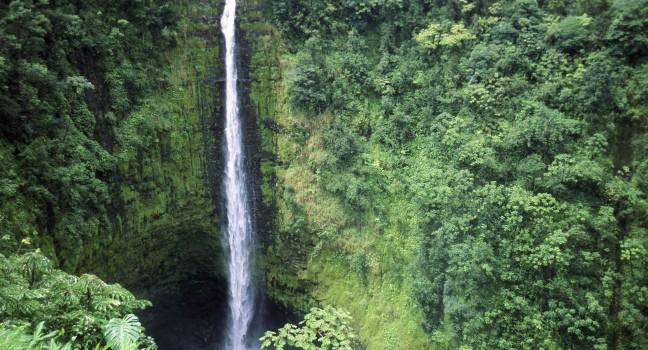
Akaka Falls State Park, Big Island, Hawaii
© Peter Guttman/PeterGuttman.com

A paved, 10-minute loop trail (approximately ½ mile) takes you to the best spots to see the spectacular cascades of Akaka, including the majestic upper Akaka Falls, which drops more than 442 feet. It tumbles far below into a pool drained by Kolekole Stream amid a profusion of fragrant white, yellow, and red torch ginger and other tropical foliage. Another 400-foot falls is on the lower end of the trail. Restroom facilities are available but no drinking water. The park is 4 miles inland, and vehicle parking closes at 6. Visitors are encouraged to reserve parking online in advance at this popular spot. A series of steps along parts of the trail may prove challenging for some visitors, and they are not wheelchair accessible.

875 Akaka Falls Rd., Honomu, HI, 96728, USA
808-974–6200
Sight Details
$5 per vehicle; parking $10

Something incorrect in this review?

Boiling Pots

Four separate streams fall into a series of circular pools here, fed by Peepee Falls just above, and the resulting turbulent action—best seen after a good rain—has earned this scenic stretch of the Wailuku River the nickname Boiling Pots. Swimming is not allowed at Boiling Pots or anywhere in the Wailuku River, due to extremely dangerous currents and undertows. The falls are 3 miles northwest of downtown Hilo off Waianuenue Avenue; keep to the right when the road splits and look for the sign. The gate opens at 7 am and closes at 6 pm. You may want to combine a drive to this site with a visit to Rainbow Falls, a bit closer to downtown.  You may be tempted, as you watch others ignore the signs and climb over guardrails, to jump in, but resist. Swimming is prohibited and unsafe, and people have died here.

Rainbow Falls

After a hard rain, these impressive falls thunder into the Wailuku River gorge, often creating magical rainbows in the mist. Rainbow Falls, sometimes known as the Hilo Town Falls, are located just above downtown Hilo at Wailuku River State Park. Take Waianuenue Avenue west for a mile; when the road forks, stay right and look for the Hawaiian warrior marker sign. The falls remain open during daylight. If you're visiting the falls, drive up to Boiling Pots, also inside the park but a bit farther up the road. At Boiling Pots, four streams fall into turbulent pools that resemble cauldrons.

Recommended Fodor's Video