21 Best Sights in Kauai, Hawaii

Background Illustration for Sights

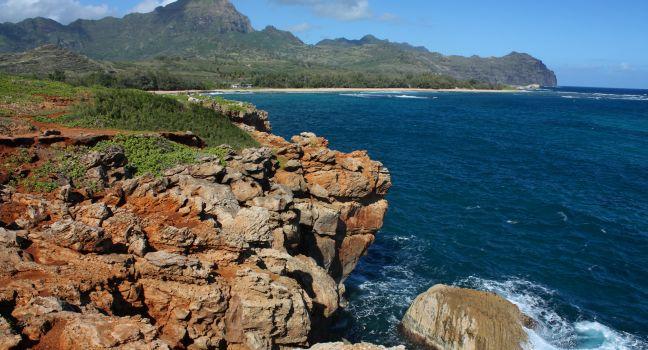
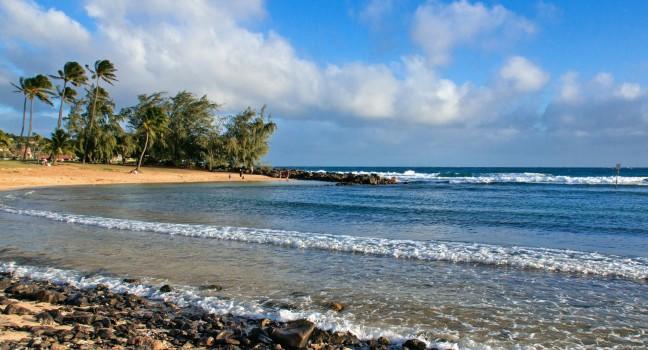
Even a nickname like "The Garden Island" fails to do justice to Kauai's beauty. Verdant trees grow canopies over the few roads, and brooding mountains are framed by long, sandy beaches, coral reefs, and sheer sea cliffs. Pristine trade winds moderate warm daily temperatures while offering comfort for deep, refreshing sleep through gentle nights.

The main road tracing Kauai's perimeter takes you past much more scenery than would seem possible on one small island. Chiseled mountains, thundering waterfalls, misty hillsides, dreamy beaches, lush vegetation, and small towns make up the physical landscape. Perhaps the most stunning piece of scenery is a place no road will take you—breathtakingly beautiful Napali Coast, which runs along the northwest side of the island.

For adventure seekers, Kauai offers everything from difficult hikes to helicopter tours. The island has top-notch spas and golf courses, and its beaches are known to be some of the most beautiful in the world. Even after you've spent days lazing around drinking mai tais or kayaking your way down a river, there's still plenty to do, as well as see: plantation villages, a historic lighthouse, wildlife refuges, a fern grotto, a colorful canyon, and deep rivers are all easily explored.

While exploring the island, try to take advantage of the many roadside scenic overlooks and pull over to take in the constantly changing view. Don't try to pack too much into one day. Kauai is small, but travel is slow. The island's sights are divided into four geographic areas, in clockwise order: the North Shore, the East Side, the South Shore, and the West Side.

Haena Beach Park

Fodor's Choice
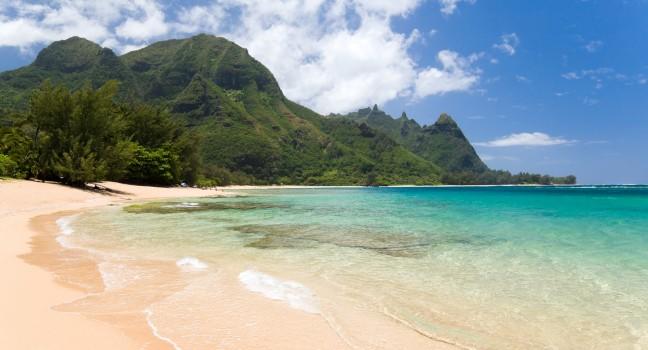
tropical exotic secluded beach in haena kauai hawaii.
tropicdreams / Shutterstock

This drive-up beach park favored by campers year-round has a wide bay named Makua bordered by two large reef systems, creating favorable waves for skilled surfers during peak winter conditions. Entering the water can be dangerous in winter when the big swells roll in. In July and August, waters at this same beach are usually as calm as a lake, and throughout summer this is a premier snorkeling site. It's not unusual to find a food vendor parked here, selling sandwiches and drinks out of a converted bread van. Adjacent to this beach is Tunnels Beach.  This is not the same beach as Kee Beach, which is located in Haena State Park.

Parking is extremely limited (the lot typically fills up by 8:30 am), and all vehicles illegally parked outside of designated parking zones are subject to fines and towing. You can also park your car in the shuttle parking lot in Waipa, west of Hanalei Town, and board the North Shore Shuttle for a ride to the beach park ($40 round-trip with seven stops); see  gohaena.com for details and reservations. Amenities: food and drink; lifeguards; parking (no fee); showers; toilets. Best for: snorkeling; surfing; walking.
Rte. 560, Haena, HI, 96714, USA
Sight Details
Free

Something incorrect in this review?

Hanalei Bay

Fodor's Choice
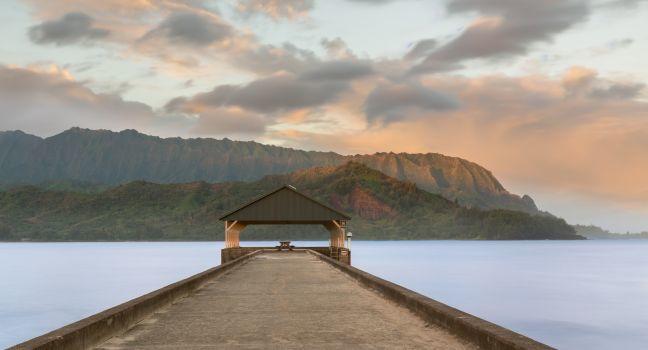
Rising sun illuminates the peaks of Na Pali mountains over the calm bay and Hanalei Pier in long exposure photo.
Steve Heap / Shutterstock

This 2-mile crescent beach cradles a wide bay in a setting that is quintessential Hawaii: the sea is on one side, and behind you are the mountains, often ribboned with waterfalls and changing color in the shifting light. In winter, Hanalei Bay boasts some of the biggest onshore surf breaks in the state, attracting world-class surfers, and the beach is plenty wide enough for sunbathing and strolling. In summer, the bay is transformed—calm waters lap the beach, sailboats moor in the bay, and outrigger-canoe paddlers ply the sea. Pack the cooler, haul out the beach umbrellas, and don't forget the beach toys because Hanalei Bay is worth scheduling for an entire day, maybe two. Several county beach parks—some with pavilions, and all with ample facilities—can be found along the bay: Black Pot (east bay, between the pier and the river mouth, named for the large cookpot used for traditional communal gatherings here), Hanalei Pavilion (west of Black Pot), and Waioli (west of Hanalei Pavilion, with three parking lots accessed off Weke Road). Amenities: lifeguards; parking (no fee); showers; toilets. Best for: sunset; surfing; swimming; walking.

Weke Rd., Hanalei, HI, 96714, USA
Sight Details
Free

Something incorrect in this review?

Kalalau Beach

Fodor's Choice
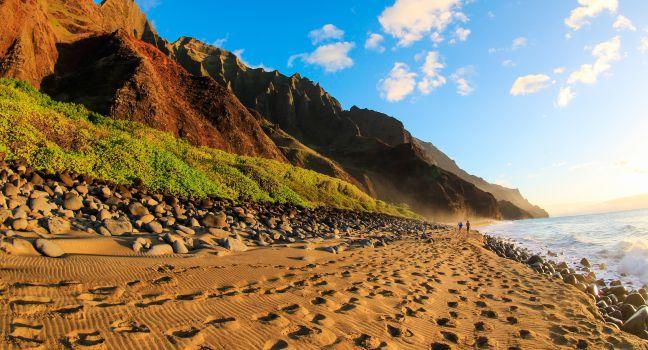
Sunset on Kalalau beach Kauai.
(c) Nainoac | Dreamstime.com

Located at the end of the trail with the same name, Kalalau is a remote beach in the spectacular Napali Coast State Wilderness Park. Reaching it requires an arduous 11-mile hike along sea-cliff faces (permit required), through steaming tropical valleys, and across sometimes-raging streams. The trail has zero-to-limited cell phone service and is recommended for experienced hikers only. Another option is to paddle a kayak to the beach—summer only, though, or else the surf is way too big. All boat and kayak tours must be through a permitted guided company. The beach is anchored by a heiau on one end and a waterfall on the other.

The safest time to come is summer, when the trail is dry and the beach is wide, cupped by low vegetated sand dunes and a large walk-in cave on the western edge. Day hikes into the valley offer waterfalls, freshwater swimming pools, and wild tropical fruits. Though state camping permits are required, the valley often has a significant illegal crowd, which has strained park facilities and degraded much of its former peaceful solitude. Helicopter overflights are near-constant in good weather. Amenities: none. Best for: solitude; sunset; walking.

Recommended Fodor's Video

Mahaulepu Beach and Makauwahi Cave

Fodor's Choice
mahaulepu beach, poipu, kauai.
Nina B / Shutterstock

This 2-mile stretch of coast, with its sand dunes, limestone hills, sinkholes, and the Makauwahi Cave, is unlike any other on Kauai. Remains of a large ancient settlement, evidence of great battles, and the discovery of a now-underwater petroglyph field indicate that Hawaiians lived in this area as early as AD 700. Mahaulepu's coastline is unprotected and rocky, which makes venturing into the ocean hazardous. There are three beach areas with bits of sandy-bottom swimming; however, the best way to experience Mahaulepu is simply to roam, on foot or horseback along the sand or trails. Pack water and sun protection. Access to this beach is via private property. Before driving or hiking here, check current gate hours and conditions as the unpaved road can be closed due to weather, grading, or movie filming. Access is during daylight hours only, so be sure to depart before sunset or risk getting locked in for the night. Amenities: parking (no fee). Best for: solitude; sunrise; walking.

Na Aina Kai Botanical Gardens & Sculpture Park

Fodor's Choice
Na Aina Kai
IMG_7400 by Jeff Muceus

Joyce and Ed Doty's love for plants and art spans the 240 acres here and includes many different gardens, a hardwood plantation, an ahupuaa (a Hawaiian land division), a re-created Navajo compound, an Athabascan village, a Japanese teahouse, a hedge maze, a waterfall, and access to a sandy beach. Throughout the grounds are more than 200 bronze sculptures, one of the nation's largest collections. One popular feature is a children's garden with a 16-foot-tall Jack and the Beanstalk bronze sculpture, gecko maze, tree house, kid-size train, and, of course, a tropical jungle. Located in a residential neighborhood and hoping to maintain good neighborly relations, the nonprofit organization limits tours. Tour lengths vary from 1½ to 5 hours. Reservations are required for all tours, including the self-guided stroll.

4101 Wailapa Rd., Kilauea, HI, 96754, USA
808-828–0525
Sight Details
Tours from $20
Closed weekends
Reservations required for all tours

Something incorrect in this review?

Poipu Beach Park

Fodor's Choice
poipu beach park on the island of Kauai, Hawaii.
cleanfotos / Shutterstock

At the most popular beach on the South Shore, the snorkeling and swimming are good during calm seas; when the surf's up, the bodyboarding and surfing are good, too. Frequent sunshine, grassy lawns, play equipment, and easy access add to the appeal, especially with families. The endangered Hawaiian monk seal often makes an appearance, and if you stop by just after sunset, you're likely to witness record numbers of protected green sea turtles coming ashore to sleep. (Please stay at least 10 feet away and do not photograph with flash.) Take a walk west on a path fronting numerous resorts. Note that at the time of writing, this beach is one of a few on Kauai that may institute a parking fee for nonresidents. Amenities: food and drink; lifeguards; parking (no fee); showers; toilets. Best for: snorkeling; sunbathing; swimming.

Hoone Rd., HI, 96756, USA
808-742–7444
Sight Details
Free

Something incorrect in this review?

Polihale State Park

Fodor's Choice
View of the Napali coast from Polihale beach in Kauai, Hawaii Islands.
Nickolay Stanev / Shutterstock

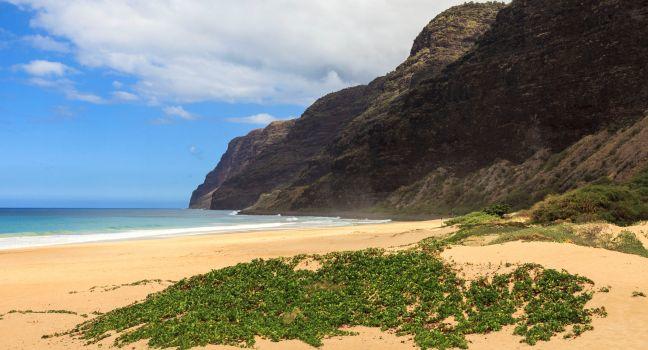
The longest stretch of beach in Hawaii starts in Kekaha and ends about 15 miles west at the start of Napali Coast. On the far west end is the 5-mile-long, 140-acre Polihale State Park, a remote beach accessed via a rough, rutted, potholed, 5-mile road at the end of Route 50 in Mana. (Four-wheel drive is recommended, and rental car companies may prohibit use of their vehicles here.) In addition to being long, this beach is 300 feet wide in places and backed by sand dunes 50 to 100 feet tall. Cultural sites, including burial sites, are located within the sensitive dune system. It is frequently very hot, with almost no shade and scorching sand. Start the day with a full tank of gas and a cooler filled with food and drink.  Though it's a popular beach, the ocean here has dangerous currents and is not recommended for recreation. No driving is allowed on the beach. The U.S. Navy's Pacific Missile Range Facility is adjacent, so access to the coastline in front of the base is monitored and restricted. The park is open for day use until sunset; permits are required for overnight camping. Amenities: parking (no fee); showers; toilets. Best for: solitude; sunset; walking.

Alekoko (Menehune) Fishpond

Fodor's Choice

No one knows just who built this large, intricate, almost 1,000-year-old aquaculture structure in the Huleia River, but legend attributes it to the Menehune, a mythical—or real, depending on who you ask—ancient race of people known for their small stature, industrious nature, and superb stone-working skills. Volcanic rock was cut and skillfully fit together into massive walls 4 feet thick and 5 feet high, forming a centuries-old enclosure for raising mullet and other freshwater fish. Volunteers removed invasive mangroves and restored the pond to its original condition. You can view it from an overlook about 4 miles from downtown Lihue.

Hanalei Valley Overlook

Fodor's Choice

Dramatic mountains and a patchwork of neat taro farms bisected by the wide Hanalei River make this one of Hawaii's loveliest views, even with the flood damage it sustained in 2018. The fertile Hanalei Valley has been planted with taro since perhaps AD 700, save for an 80-year-long foray into rice that ended in 1960. (The historic Haraguchi Rice Mill is all that remains of that era.) Many taro farmers lease land within the 900-acre Hanalei National Wildlife Refuge, helping to provide wetland habitat for four species of endangered Hawaiian waterbirds.

Kauai Coffee Estate Visitor Center

Fodor's Choice

Two restored camp houses, dating from the days when sugar was the main agricultural crop on the Islands, have been converted into a museum, visitor center, snack bar, and gift shop. About 3,100 acres of McBryde sugar land have become Hawaii's largest coffee plantation, with its 4 million trees producing more than half of the state's beans. You can walk among the trees; view old grinders and roasters; watch a video to learn how coffee is grown, harvested, and processed; sample various estate roasts; and check out the gift store.

The center offers free self-guided tours through a small coffee grove (about 20 minutes); a personalized one-hour "Coffee on the Brain" tour for $25; and a "seed-to-cup" farm tour in an open-air truck for $45. From Kalaheo, take Route 50 in the direction of Waimea Canyon (west) and veer left onto Route 540. It's 2½ miles from the Route 50 turnoff.

870 Halewili Rd., HI, 96741, USA
808-335–0813-for visitor center
Sight Details
Free; $25 for "Coffee on the Brain" tour; $45 for farm tour (fee discounted for children)

Something incorrect in this review?

Kauai Museum

Fodor's Choice

Maintaining a stately presence on Rice Street, the historical museum building is easy to find and features a permanent display, "The Story of Kauai," that provides a competent overview of the Garden Island and Niihau. Local artists are represented in changing exhibits in the second-floor Mezzanine Gallery. Weekly cultural classes on hula, lei making, and other topics are offered. The gift shop alone is worth a visit, with a fine collection of authentic Niihau shell lei, hand-turned wooden bowls, reference books, and other quality arts, crafts, and gifts—many of them locally made.

Ke Ala Hele Makalae

Fodor's Choice

Running from the southern end of Lydgate Park north to Donkey Beach, just south of Anahola, this 8-mile seaside path is a favorite of visitors and locals alike. Sea breezes, gorgeous ocean views, smooth pavement, and friendly smiles from everyone as they bike, walk, skate, and run add to the pleasures of the trail. The path has many entry points from public beaches and private resorts, with some bike shops just off the trail.

Kee Beach

Fodor's Choice

Highway 560 on the North Shore literally dead-ends at this beach, pronounced kay-eh, which is also the start of the challenging, permit-required 11-mile Kalalau Trail on Napali Coast and a culturally significant area to Native Hawaiians, who still use an ancient heiau (a stone platform used as a place of worship) dedicated to hula. (It's not appropriate to hang out on the platform or leave offerings there; stay at a respectful distance.) The setting is gorgeous, with Makana (a prominent peak that Hollywood dubbed "Bali Hai" in the blockbuster musical South Pacific) imposing itself on the lovely coastline and lots of lush tropical vegetation.

The small beach is protected by a reef—except during high surf—creating a small sandy-bottom lagoon that's a popular snorkeling spot. There can be a strong current in winter. A mandatory permit system limits guests and prevents overcrowding. Unless you are a Hawaii resident with identification, you must reserve a spot online (reservations open 30 days prior); the prized spaces sell out weeks in advance. Alternatively, you can buy a ticket for the shuttle service that transports visitors from the commuter lot in Waipa (west of Hanalei Town), which includes entrance to Haena State Park and Kee Beach. See  gohaena.com for reservations. Parking passes are valid during specified time periods. The parking area is ⅓ mile from the beach on a path partially on a boardwalk, so be prepared to lug your beach gear. Kee Beach is a great place to watch the sunset lighting up Napali Coast. Amenities: lifeguards; parking (fee); showers; toilets. Best for: snorkeling; sunset; swimming; walking.

Rte. 560, HI, 96714, USA
Sight Details
$5 per person nonresident entry fee; $10 for nonresident vehicle parking

Something incorrect in this review?

Kilauea Point National Wildlife Refuge and Kilauea Lighthouse

Fodor's Choice

A beacon for sea traffic since it was dedicated in 1913, this National Historic Landmark has the world's largest clamshell lens in a lighthouse and stands within a wildlife refuge where thousands of seabirds soar on the trade winds and nest on the steep ocean cliffs. It's well worth the site's modest entry fee to see nene geese (the state bird, a threatened species), white- and red-tailed tropic birds, and more (identifiable by educational signboards), as well as native plants, dolphins, humpback whales (in season), the huge winter surf, and gorgeous North Shore views. The gift shop has a great selection of books about the island's natural history and an array of unique merchandise, with all proceeds benefiting education and preservation efforts. Advance reservations are required via  recreation.gov.

Limahuli Garden and Preserve

Fodor's Choice

Narrow Limahuli Valley, with its fluted mountain peaks and ancient stone taro terraces, creates an unparalleled setting for this botanical garden and nature preserve, one of the most gorgeous spots on Kauai and the crown jewel of the National Tropical Botanical Garden. Dedicated to protecting native plants and unusual varieties of taro, it represents the principles of conservation and stewardship held by its founder, Juliet Rice Wichman. Limahuli's primordial beauty and strong mana (spiritual power) eclipse the extensive botanical collection. Call ahead to check if guided tours are being offered, or tour on your own. A reservation is required to park here, though North Shore Shuttle riders are exempt. Check out the quality gift shop and revolutionary compost toilet, and be prepared to walk a somewhat steep hillside.

5--8291 Kuhio Hwy., Hanalei, HI, 96714, USA
808-826–1053
Sight Details
$30 for self-guided tour; $60 for guided tour (when available); $5 discount if arriving via shuttle
Closed Sun. and Mon.

Something incorrect in this review?

National Tropical Botanical Garden

Fodor's Choice

Tucked away in Lawai Valley, this collection of gardens includes lands and a cottage once used by Hawaii's Queen Emma (1836–85) for a summer retreat. Trams depart frequently to transport people from the visitor center to the gardens. The rambling 252-acre McBryde Garden has exhibits and easy trails to help visitors learn about biodiversity and plants collected throughout the tropics, including a Canoe Garden that features plants introduced to Hawaii by early Polynesian voyagers.  The biodiversity path in McBryde is accessible for people with mobility issues. The 100-acre Allerton Garden, which can be visited only on a guided tour, artfully displays statues and water features originally developed as part of a private estate. A famous scene in Jurassic Park was filmed here.

Reservations and closed-toe shoes are required for all tours. The visitor center has a high-quality gift shop and grab-and-go refreshments. Besides propagating rare and endangered plants from Hawaii and elsewhere, NTBG functions as a scientific research and education center. The organization also operates gardens in Limahuli, on Kauai's North Shore; in Hana, on Maui's East Shore; and in Florida.

4425 Lawai Rd., HI, 96756, USA
808-742–2623
Sight Details
$30 for McBryde self-guided tour; $65 for Allerton guided tour
Reservations required for tours

Something incorrect in this review?

Old Koloa Town

Fodor's Choice

Koloa’s first sugar plantation opened in 1835, ushering in an era of sugar production throughout the Islands, with more than 100 plantations established by 1885. Many of the workers came from the Philippines, Japan, China, Korea, and Portugal, creating Hawaii’s multiethnic mélange. Today, many of Koloa’s historic buildings, beneath the shade of stately old monkeypod trees, have been converted into fun shops, galleries, and places to eat. Even the newer developments mimic quaint plantation-camp architecture. You’ll just want to stroll and take it all in. Indulge in a sweet treat like a shave ice, freshly roasted gourmet nuts, or a healthy smoothie after a food-truck lunch taken to nearby Knudsen Park. Be sure to approach Old Koloa Town via the Tree Tunnel, a romantic canopy of eucalyptus trees planted more than a century ago along a stretch of Maluhia Road.

Poliahu Heiau

Fodor's Choice

Storyboards near this ancient heiau (sacred site) recount the significance of the many sacred structures found along the Wailua River. It's unknown exactly how the ancient Hawaiians used Poliahu Heiau—one of the largest pre-Christian temples on the island—but legend says it was created by the Menehune, the legendary race of little people who were quick builders, because of the unusual stonework found in its walled enclosures. From this site, drive downhill toward the ocean to pohaku hoohanau, a two-piece birthing stone said to confer special blessings on all children born there, and pohaku piko, whose crevices were a repository for umbilical cords left by parents seeking a clue to their child's destiny, which reportedly was foretold by how the cord fared in the rock. Some Hawaiians feel these sacred stones shouldn't be viewed as tourist attractions, so always treat them with respect. Never stand or sit on the rocks or leave any offerings.

Spouting Horn

Fodor's Choice

When conditions are right, a natural blowhole in the rocky shoreline behaves like Old Faithful, shooting salt water high into the air and making a hollow echoing sound. It's most dramatic during big summer swells, which jam large quantities of water through the ancient lava tube with great force. Most sidewalk vendors hawk inexpensive souvenirs, but a few carry locally set South Sea pearls or rare Niihau-shell creations, with prices ranging from affordable to several thousand dollars. Look for green sea turtles bobbing in the adjacent cove.

Wailua Falls

Fodor's Choice

Kauai has plenty of noteworthy waterfalls, but this one is especially gorgeous, easy to find, and easy to photograph from the road. You may recognize the impressive cascade from the opening sequences of the Fantasy Island television series. To reach it, drive north from Lihue following Maalo Road in Hanamaulu, then travel uphill for 3 miles.  Do not hike down to the base of the falls to access the water.

Waimea Canyon

Fodor's Choice

Carved over countless centuries by the Waimea River and the forces of wind and rain, Waimea Canyon is a dramatic gorge nicknamed the "Grand Canyon of the Pacific"—but not by Mark Twain, as many people mistakenly think. Hiking and hunting trails wind through the canyon, which is more than 3,600 feet deep, 1 mile wide, and about 14 miles long. The cliff sides have been sharply eroded, exposing swatches of colorful soil. The deep red, brown, and green hues are constantly changing in the sun, and frequent rainbows and waterfalls enhance the natural beauty. This is one of Kauai's prettiest spots, and it's worth stopping at both the Puu ka Pele and Puu Hinahina lookouts within the state park.

Public restrooms and parking are at most proper lookouts, and the main one has ramps for strollers and wheelchairs. If you stop at small pullouts, park completely off the highway and look for cyclists before opening car doors.

Rte. 550 (Kokee Rd.), HI, 96752, USA
808-274–3444
Sight Details
$10 for parking; $5 per person daily fee for nonresidents at main park lookouts

Something incorrect in this review?