23 Best Sights in The Loop, including the West Loop and South Loop, Chicago

Background Illustration for Sights

We've compiled the best of the best in The Loop, including the West Loop and South Loop - browse our top choices for the top things to see or do during your stay.

Millennium Park

Chicago Loop Fodor's Choice
CHICAGO, ILLINOIS AUGUST 21: The popular Jay Pritzker Pavilion in Millennium Park on a beautiful summer day in downtown on August 21, 2011 in Chicago.
Fotoluminate LLC / Shutterstock

With Anish Kapoor's giant, polished-steel Cloud Gate sculpture (affectionately known as "The Bean"), the fun fountains, and a Disney-esque music pavilion, this park quickly stole the hearts of Chicagoans and visitors alike when it opened in 2004. The showstopper is Frank Gehry's stunning Jay Pritzker Pavilion. Dramatic ribbons of stainless steel stretching 40 feet into the sky look like petals wrapping the music stage. The 1,525-seat Harris Theater for Music and Dance provides an indoor alternative for fans of the performing arts.

In the park's southwest corner, the Crown Fountain features dozens of Chicagoans' faces rotating through on two 50-foot-high glass block–tower fountains. When a face purses its lips, water shoots out its "mouth." Kids love it, and adults feel like kids watching it. More conventional park perks include the lovely Lurie Garden (a four-season delight) and the seasonal McCormick Tribune Ice Rink, which opens for public skating each winter.
Chicago Cultural Center

Chicago Loop Fodor's Choice

Built in 1897 as the city's original public library, this huge building houses the Chicago Office of Tourism Visitor Information Center, as well as a gift shop, galleries, and a concert hall. Designed by the Boston firm Shepley, Rutan & Coolidge—the team behind the Art Institute of Chicago—it's a palatial affair notable for its Carrara marble, mosaics, gold leaf, and the world's largest Tiffany glass dome.

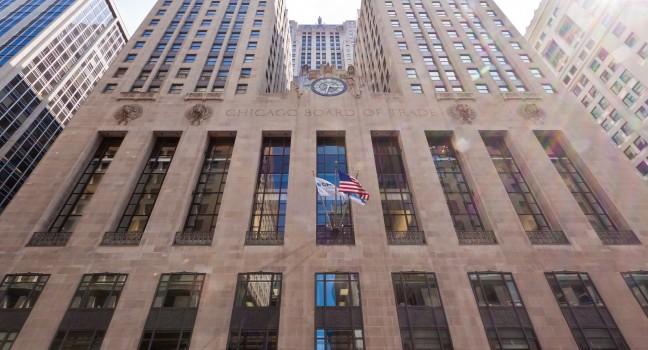
Chicago Board of Trade

Chicago Loop
The facade of the famous building with its clock. Chicago Board of Trade at downtown, Illinois state, United States.
(c) Afagundes | Dreamstime.com

Home of the thriving financial district, relatively narrow LaSalle Street earned the moniker "The Canyon" (and it feels like one) because of the large buildings that flank either end. This one was designed by Holabird & Root and completed in 1930. The streamlined, 45-story giant recalls the days when art deco was all the rage. The artfully lighted marble lobby soars three stories, and Ceres (the Roman goddess of agriculture) stands atop its roof. Trading is no longer done here, but it's worth a look at what was the city's tallest skyscraper until 1955, when the Prudential Center topped it.

Recommended Fodor's Video

150 North Michigan Avenue

Chicago Loop

Some wags have pointed out that this building, with its diamond-shaped top, looks like a giant pencil sharpener. Built in 1984 as the Smurfit-Stone Building and later known as the Crain Communications Building, it has a slanted top that carves through the top 10 of its floors. In the plaza is Yaacov Agam's Communication X9, a painted, folded aluminum sculpture that was restored (to some controversy) and reinstalled in 2008. You'll see different patterns in the sculpture depending on your vantage point.

190 South LaSalle Street

Chicago Loop

This 40-story postmodern office building, resembling a supersized château, was designed by John Burgee and Philip Johnson in the mid-1980s. The grand, gold-leaf vaulted lobby is spectacular.

224 South Michigan Avenue

Chicago Loop

This structure, designed in 1904 by Daniel Burnham, who later moved his office here, was once known as the Railway Exchange Building and the Santa Fe Building, for a "Santa Fe" sign on its roof that has since been removed. The Chicago Architecture Foundation uses the building's atrium for rotating exhibits about the changing landscape of Chicago and other cities. The organization also offers a variety of tours via foot, bus, and boat.

224 S. Michigan Ave., Chicago, IL, 60604, USA

Something incorrect in this review?

Aon Center

Chicago Loop

With the open space of Millennium Park at its doorstep, the Aon Center really stands out. Originally built as the Standard Oil Building, the 83-story skyscraper (first referred to as Big Stan) has changed names and appearances twice. Not long after the building went up in 1972, its marble cladding came crashing down, and the whole thing was resheathed in granite.

200 E. Randolph Dr., Chicago, IL, 60601, USA
312-381–1000

Something incorrect in this review?

Carbide and Carbon Building

Chicago Loop

Designed in 1929 by Daniel and Hubert Burnham, sons of the renowned architect Daniel Burnham, this is arguably the jazziest skyscraper in town. A deep-green terra-cotta tower rising from a black-granite base, its upper reaches are embellished with gold leaf. The original public spaces are a luxurious composition in marble and bronze. The story goes that the brothers Burnham got their inspiration from a gold-foiled bottle of champagne. The building is now home to the swanky Pendry Chicago hotel.

Chase Tower

Chicago Loop

This building's graceful swoop—a novelty when it went up—continues to offer an eye-pleasing respite from all the surrounding right angles, and its spacious, sunken bi-level plaza, with Marc Chagall's mosaic The Four Seasons, is one of the most enjoyable public spaces in the neighborhood. Designed by Perkins & Will and C.F. Murphy Associates in 1969, Chase Tower has been home to a succession of financial institutions. Name changes aside, it remains one of the more distinctive buildings around, not to mention one of the highest in the heart of the Loop.

10 S. Dearborn St., Chicago, IL, 60602, USA

Something incorrect in this review?

Chicago Temple

Chicago Loop

The Gothic-inspired headquarters of the First United Methodist Church of Chicago, built in 1923 by Holabird & Roche, comes complete with a first-floor sanctuary, 21 floors of office space, a sky-high chapel (free tours are available), and an eight-story spire, which is best viewed from the bridge across the Chicago River at Dearborn Street. Outside, along the building's east wall at ground level, stained-glass windows relate the history of Methodism in Chicago. Joan Miró's sculpture Chicago (1981) is in the small plaza just east of the church.

Dearborn Station

South Loop

Part of Printers Row, this is Chicago's oldest-standing passenger train station, designed in the Romanesque Revival style in 1885 by New York architect Cyrus L.W. Eidlitz. Now filled with offices and stores, it has a wonderful 12-story clock tower and a red-sandstone and redbrick facade ornamented with terra-cotta. Striking features inside are the marble floor, wraparound brass walkway, and arching wood-frame doorways.

Federal Center and Plaza

Chicago Loop

This center is spread over three separate buildings: the Everett McKinley Dirksen Building; the John C. Kluczynski Building ( 230 S. Dearborn), which includes the Loop's post office; and the Metcalfe Building ( 77 W. Jackson). Designed in 1959, but not completed until 1974, the severe constellation of buildings around a sweeping plaza was Mies van der Rohe's first mixed-use urban project. Fans of the International Style will groove on this pocket of pure modernism, while others can take comfort in the presence of the Marquette Building, which marks the north side of the site. In contrast to this dark ensemble are the great red arches of Alexander Calder's Flamingo.

219 S. Dearborn St., Chicago, IL, 60604, USA
312-353–6996

Something incorrect in this review?

Inland Steel Building

Chicago Loop

A runt compared to today's tall buildings, this sparkling 19-story high-rise from Skidmore, Owings & Merrill was a trailblazer when it was built in the late 1950s. It was the first skyscraper erected with external supports (allowing for wide-open, unobstructed floors within), the first to employ steel pilings (driven 85 feet down to bedrock), the first in the Loop to be fully air-conditioned, and the first to feature underground parking.

Macy's

Chicago Loop

This neoclassical building, designed by Daniel Burnham, opened in 1907 as one of the world's earliest department stores, Marshall Field's. Macy's acquired the chain in 2005 and changed the store's name. An uproar ensued, and many Chicagoans still refer to the flagship as Marshall Field's. A visit is as much an architectural experience as a retail one. The building has distinct courtyards (one resembling an Italian palazzo), a striking Tiffany dome of mosaic glass, a calming fountain, and gilded pillars. Its green clock at the State and Randolph entrance is a Chicago landmark. For lunch, try the Walnut Room, and make sure to sample Frango mints—the store's specialty, they were once made on the 13th floor.

111 N. State St., Chicago, IL, 60602, USA
312-781–1000

Something incorrect in this review?

Maggie Daley Park

Chicago Loop

Named after former Mayor Richard M. Daley's late wife, this park offers a place to play between Lake Michigan and the city's skyline. Opened in late 2014, it includes 40-foot-high rock-climbing sculptures, an Enchanted Forest with a kaleidoscope and mirrored maze, a Slide Crater, a Wave Lawn, and an area strictly for toddlers. A skating ribbon winds around the park, with ice skates available to rent in the winter months, and rollerblades and scooters in the summer.

Marquette Building

Chicago Loop

Like a slipcover over a sofa, the clean, geometric facade of this 1895 building expresses what lies beneath: in this case, a structural steel frame. Sure, the base is marked with roughly cut stone and a fancy cornice crowns the top, but the bulk of the Marquette Building mirrors the cage around which it is built. Inside is another story. The intimate lobby is a jewel box of a space, where a single Doric column stands surrounded by a Tiffany glass mosaic depicting the exploits of French Jesuit missionary Jacques Marquette, an early explorer of Illinois and the Upper Midwest. From its steel skeleton to the terra-cotta ornamentation, this Holabird & Roche structure is a clear example of the Chicago style.

Monadnock Building

Chicago Loop

Built in two segments a few years apart, the Monadnock captures the turning point in high-rise construction. Its northern half, designed in 1891 by Burnham & Root, was erected with traditional load-bearing masonry walls (6 feet deep at the base). In 1893 Holabird & Roche designed its southern half, which rose around the soon-to-be-common steel skeleton. The building's stone-and-brick exterior, shockingly unornamented for its time, led one critic to liken it to a chimney. The lobby is equally spartan; lined on either side with windowed shops, it's essentially a corridor, but one well worth traveling. Walk it from end to end and you'll feel as if you're stepping back in time.

Museum of Contemporary Photography at Columbia College Chicago

South Loop

"Contemporary" is generally defined here as work made in the past two or three decades. Curators constantly seek out new talent and underappreciated established photographers, which means that there are artists here you probably won't see elsewhere. Rotating exhibits have included explorations of infrastructure, crime, and American identity.

600 S. Michigan Ave., Chicago, IL, 60605, USA
312-663–5554
Sight Details
Free

Something incorrect in this review?

Prudential Plaza

Chicago Loop

There are two architecturally notable buildings at the plaza. Directly west of the Aon Center and across from Millennium Park is One Prudential Plaza. Designed by Alfonso Iannelli and completed in 1955, this limestone-and-ridged-aluminum structure was once the city's tallest building (barring the statue of Ceres atop the Board of Trade). At the time, it had the world's fastest elevators and an observation deck that became passé once some of the city's other behemoths were completed. Attached to One Prudential is its sibling Two Prudential Plaza, nicknamed "Two Pru," a towering glass-and-granite giant with an address of 180 North Stetson Avenue. Along with their neighbors they form a block-long business-oriented minicity. Two Prudential is the tallest reinforced concrete building in the city, and its blue detailing and beveled roof are instantly recognizable from afar.

Reliance Building

Chicago Loop

The clearly expressed, gleaming verticality that characterizes the modern skyscraper was first and most eloquently articulated in this trailblazing steel-frame tower, built by Burnham, Root, and Charles Atwood. Completed in 1895 and now home to the stylish Staypineapple Hotel, the building was a crumbling eyesore until the late 1990s, when the city initiated a major restoration. In the early and mid-1900s, it was a mixed-use office building. Al Capone's dentist reportedly worked out of what's now Room 809. Don't be misled when you go looking for this masterpiece—a block away, at State and Randolph streets, a dormitory for the School of the Art Institute of Chicago shamelessly mimics it. Once you've found the real thing, admire the mosaic floor and ironwork in the reconstructed elevator lobby. The building boasts early examples of the Chicago Window, which define the entire facade by adding a shimmer and glimmer to the surrounding white terra-cotta.

Richard J. Daley Center

Chicago Loop

Named for late mayor Richard J. Daley, this boldly plain high-rise is the headquarters of the Cook County court system, but it's best known as the site of a sculpture by Picasso. Simply dubbed the Picasso, this monumental piece provoked an outcry when it was installed in 1967; baffled Chicagoans tried to determine whether it represented a woman or an Afghan hound. In the end, they gave up guessing and simply embraced it as a unique symbol of the city. The building itself was constructed in 1965 of Cor-Ten steel, which weathers naturally to an attractive bronze. In summer, its plaza is the site of concerts, political rallies, and a Thursday farmers' market. In December, Christkindlmarket (a traditional German market selling food and gifts) takes over the area.

Sullivan Center

Chicago Loop

From 1899 to 2007 this was the flagship location for the department store Carson, Pirie, Scott & Co. The work of one of Chicago's most renowned architects, it combines Louis H. Sullivan's visionary expression of modern design with intricate cast-iron ornamentation. The eye-catching rotunda and the 11 stories above it are actually an addition Sullivan made to his original building. In later years D.H. Burnham & Co. and Holabird & Root extended Sullivan's smooth, horizontal scheme farther down State Street. The ground floor now houses a Target, with office tenants occupying the floors above.

1 S. State St., Chicago, IL, 60603, USA

Something incorrect in this review?

Wabash Arts Corridor

Chicago Loop

Running along both sides of Wabash Avenue from Ida B. Wells Drive south to 16th Street, this mile-long stretch is an outdoor gallery of murals and street art. There are nearly 40 permanent installations and an evolving set of temporary exhibitions. Chicago artists including Shepard Fairey, Hebru Brantley, and Sam Kirk have had work shown here.