14 Best Sights in Taos, New Mexico

Background Illustration for Sights

For a town its size, Taos contains an impressive collection of fine art museums and other historic sites of note. Most of these are in the center of town and within an easy walk of Taos Plaza, but you'll need a car to visit the Millicent Rogers Museum, Rancho de Taos, and a few other notable sites.

Taos Pueblo

Fodor's Choice
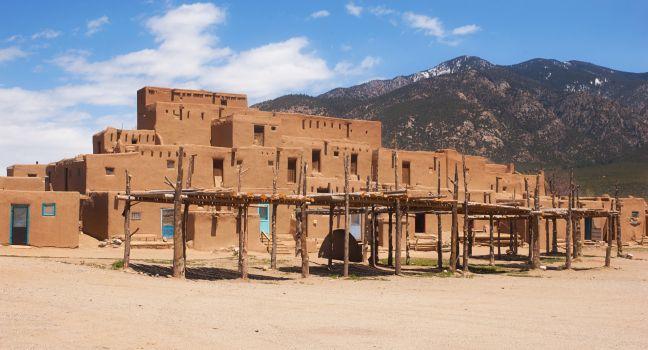
UNESCO World Heritage Site Taos Pueblo outside of Taos, New Mexico, continuously inhabited for over 1000 years.
photogal / Shutterstock

For nearly 1,000 years, the mud-and-straw adobe walls of Taos Pueblo have sheltered Tiwa-speaking Native Americans. A United Nations World Heritage Site, the multistory Pueblo is the largest of its kind. The pueblo's main buildings, a north house and a south house, are separated by the Rio Pueblo de Taos, a river that originates high in the mountains at the sacred Blue Lake, the primary source of Taos Pueblo’s drinking and irrigation water. These two structures are believed to have been built between 1000 and 1450. The mica-flecked adobe walls are maintained by continuously refinishing them with new plaster and clay washes. Some walls are several feet thick in places. The roofs of each of the five-story structures are supported by large timbers, or vigas, hauled down from the mountain forests, with smaller pieces of pine or aspen latillas placed between the vigas. To finish the roof, it is packed full of dirt.

Taos Pueblo has retained 95,000 acres of its original homeland. Forty-eight thousand acres of this was won back from the U.S. government through Taos Pueblo’s historic legal fight for the return of Blue Lake. Tribal custom allows no electricity or running water in the two houses of the ancient Pueblo, where varying members (roughly 150) of Taos Pueblo live full-time. An additional 1,900 or so live in homes outside of the ancient pueblo. The pueblo also has schools, cemeteries, a health center, farms and fields, buffalo pastures, powwow grounds, and many religious dwellings including traditional kivas and the Catholic Church of San Geronimo.

Although the population is predominantly Catholic, the people of Taos Pueblo also maintain their original religious traditions. The public is invited to certain ceremonial and social dances held throughout the year: highlights include the Feast of Santa Cruz (May 3); Taos Pueblo Pow Wow (mid-July); Santiago and Santa Ana Feast Days (July 25 and 26); San Geronimo Days (September 29 and 30); Procession of the Virgin Mary (December 24); and Deer Dance or Matachines Dance (December 25). While you're at the pueblo, respect all rules and customs, which are posted prominently. There are some restrictions on personal photography. Guided tours are available daily and are the best way to start your visit. Tours are led Taos Pueblo community members and provide insight into both the history and present-day life of the Pueblo.

Harwood Museum of Art

Fodor's Choice

Just two blocks from Taos Plaza, the Harwood Museum of Art is an essential destination for all art lovers. The beautifully renovated Pueblo Revival-style adobe compound has served as a center for the arts and culture in New Mexico for more than 100 years and once housed the town’s library. With nine galleries and a collection of more than 6,500 objects, the Harwood exhibits works that range from colonial Hispanic artists and the Taos Society of Artists to post-World War II modernists and cutting-edge contemporary artists. The Harwood is also home to the world-famous Agnes Martin Gallery and an impressive collection by renowned santero (religious icon artist) Patrociño Barela, not to mention robust educational programming with outstanding films, lectures, and concerts in its state-of-the-art auditorium.

Historic Taos Plaza

Fodor's Choice

The bustling center of downtown Taos, the Plaza is also filled with some of the town's most important history. The first European explorers of the Taos Valley came here with Captain Hernando de Alvarado, a member of Francisco Vásquez de Coronado’s expedition of 1540. Basque explorer Don Juan de Oñate later arrived in Taos in July 1598 and Spanish settlements began to be established in the 1600s. In 1796, the King of Spain gave the Don Fernando de Taos land grant to 63 Hispanic families—the most significant settlement in the area second only to Taos Pueblo. It was then developed into two plazas: one was a thriving business district for the early colony, while the second, a walled residential plaza, was constructed a few hundred yards behind it. The plaza was guarded by sentries and the only way in or out was through a large gate. At night, livestock were brought into the enclosed space for security. Some ditches from the original hand-dug acequia system that brought water from nearby rivers through town for agricultural irrigation can still be seen in the downtown area. A gruesome, but important, historic chapter took place at Taos Plaza in 1847, during the Mexican-American War. The Taos Rebellion, or Taos Revolt, was an effort by the Indo-Hispano and Taos Pueblo communities to resist the American invasion of Northern New Mexico. This resulted in the murder of newly-appointed Governor Charles Bent and other Americans and a massacre at Taos Pueblo by the U.S. Army who killed women and children as well as men. Following a jury trial at the Taos County Courthouse weighted to favor the American view, a number of local men were declared guilty and publicly executed by hanging on Taos Plaza. The scars of that event still mark the people who live here, many of them descendants of those killed. Be sure to visit the recently renovated historic old Taos County Courthouse on the north side of the Plaza, the site of these convictions. A series of dramatic murals depicting the use and misuse of the law were painted on its walls in the 1930s by Taos artists. The initiative, a project of the Works Progress Administration, was led by Emil Bisttram who studied fresco techniques under Mexican artist Diego Rivera. Luckily for modern-day visitors, today’s plaza is the home to summer fiestas, family-friendly concerts, and other community events, and houses gift shops, galleries, and restaurants.

Recommended Fodor's Video

La Hacienda de los Martínez

Fodor's Choice

One of the most impressive surviving Spanish Colonial houses in the Southwest, the Hacienda was built between 1804 and 1820 on the west bank of the Rio Pueblo and served as a community refuge during Comanche and Apache raids. Its thick walls, which have few windows, surround two central courtyards. Don Antonio Severino Martínez was a farmer and trader; his hacienda was the final stop along El Camino Real (the Royal Road), the trade route the Spanish established between Mexico City and New Mexico. The restored period rooms here contain textiles, spiritual art, and fine handcrafted pieces from the early 19th century. Be sure to stop in the gift shop, which features many renowned Taos artists, books on the region, and more. Visit in June for the hacienda's American mountain man event, or in September for their well-loved trading fair.

Millicent Rogers Museum

El Prado Fodor's Choice

More than 7,000 pieces of spectacular Native American and Hispanic art, many of them from the private collection of the late Standard Oil heiress Millicent Rogers, are on display here. Among the pieces are baskets, blankets, rugs, kachina dolls, carvings, tinwork, paintings, rare religious artifacts, and, most significantly, jewelry (Rogers, a fashion icon in her day, had a deep appreciation for the turquoise-and-silver artistry of Native American jewelers). Other important works include the pottery and ceramics of Maria Martinez and other potters from San Ildefonso Pueblo (north of Santa Fe). Docents conduct guided tours by appointment, and the museum hosts lectures, films, workshops, and demonstrations. The two-room gift shop has exceptional jewelry, rugs, books, and pottery.

Rio Grande Gorge Bridge

Fodor's Choice

It's a dizzying experience to see the Rio Grande 650 feet underfoot, where it flows at the bottom of an immense, steep rock canyon. In summer the reddish rocks dotted with green scrub contrast brilliantly with the blue sky, where you might see a hawk lazily floating in circles. The bridge is one of the highest suspension bridges in the country. Hold on to your camera and eyeglasses when looking down. Many days just after daybreak, hot-air balloons fly above and even inside the gorge. There's a campground with picnic shelters and basic restrooms on the west side of the bridge.

U.S. 64, Taos, NM, 87529, USA

Something incorrect in this review?

San Francisco de Asís Church

Fodor's Choice

A National Historic Landmark, this is a beloved destination among the faithful, as well as for artists, photographers, and architectural buffs. The active Catholic church regularly celebrates Mass, contains numerous Hispanic religious artifacts, and is open to the public for visiting. Be sure to show respect for house of worship norms. The building's shape is a surprise with rounded, sculpted buttresses. Construction began in 1772 and today its mud-and-straw adobe walls are replastered by hand every year in an annual event. The "Ranchos Church" with its massive earthen walls and undulating lines is an awe-inspiring sight that Georgia O’Keeffe painted and Ansel Adams photographed many times. Group tours provided by the church historian can be scheduled in advance. The famous Shadow of the Cross painting is preserved in a nearby building and is also worth seeing.

Taos Art Museum at Fechin House

Fodor's Choice

The interiors of this extraordinary adobe house and studio, built between 1927 and 1933 by Russian émigré and artist Nicolai Fechin, are a marvel of carved Russian-style woodwork and furniture as well as Southwest architecture. Fechin constructed them to showcase his daringly colorful paintings, intricate wood carvings and cabinetry, and coppersmith work on fixtures. The house now contains the Taos Art Museum, which exhibits a rotating collection of some 600 paintings by more than 50 Taos artists, including founders of the original Taos Society of Artists, among them Joseph Sharp, Ernest Blumenschein, Bert Phillips, E. I. Couse, and Oscar Berninghaus. Be sure to take a stroll through the lovely gardens, and a peek in the gift shop which houses exquisite pieces by contemporary jewelers among many attractive items.

Church of San Geronimo

Taos Pueblo

The Church of San Geronimo, or St. Jerome (the patron saint of Taos Pueblo), was completed in 1850 and is the fourth church to stand at Taos Pueblo. The original church, built in 1627, was destroyed in 1640 by the Pueblo people in protest of Spanish attempts to missionize them. After this, the Taos people left their village and did not return until 1660, when they were persuaded by Governor Lopez de Mendizibal to come back. The second church was then built, but it was destroyed in 1680 during the Pueblo Revolt when Pueblo Natives throughout the region united in a successful effort to force the Spanish to leave the area. A third church was begun by Spanish Franciscans after they returned to Taos twelve years later. This church, finished by 1726, stood until 1847. At that point, during the Taos Rebellion (aka Taos Revolt), U.S. soldiers attacked what they believed were the men who had killed Governor Bent and other Americans. In reality, most of these men had fled to the mountains and the people inside the church were mainly women and children. The ruins of this third church can be seen today, and have become a cemetery site to the left of the Pueblo’s public entrance. The fourth church that stands today on the Pueblo’s plaza was built in 1850. With its smooth symmetry, stepped portal, and twin bell towers, the church is a popular subject for photographers and artists.

Taos Pueblo, Taos, NM, USA
575-758–9208

Something incorrect in this review?

E. L. Blumenschein Home and Museum

For an introduction to the history of the Taos Society of Artists, visit the residence of Ernest L. Blumenschein, one of the founding members. One of the rooms in the adobe-style structure dates from 1797. On display are the art, antiques, and other personal possessions of Blumenschein and his wife, Mary Greene Blumenschein, who also painted, as did their daughter Helen. Several of Ernest Blumenschein's vivid oil paintings hang in his former studio, and works by other early Taos artists are also on display.

Earthship Visitor Center

Now found all over the world, the unique off-grid design of an Earthship home got its start in Taos. Local architect Michael Reynolds started the movement in 1969, motivated to create affordable housing that utilized waste materials such as tires, soda cans, and beer bottles that would otherwise end up in the landfill. Reynolds fought to create and establish the Sustainable Testing Site Act in the New Mexico state legislature in 2007. Learn about this fascinating architecture and its potential at the Earthship Visitor Center. The informative, self-guided tour is highly recommended. Guided tours are available for those seeking a more in-depth understanding, as are overnight stays in an Earthship rental. There is also an Earthship Academy with online and in-person educational opportunities.

Inger Jirby Gallery

Plaza and Vicinity

This popular gallery displays Jirby's whimsical, brightly colored landscape paintings. Her work is bold and colorful, and largely dedicated to her favorite subject: the Taos landscape. She was born in Kiruna, Sweden (north of the Arctic Circle), and it was there she learned to paint, influenced by Swedish artists who had studied with Impressionists. Be sure to stroll through the lovely sculpture garden.

207 Ledoux St., Taos, NM, 87571, USA
575-758–7333

Something incorrect in this review?

Kit Carson Park & Cemetery

This centrally located town park is a good place to rest or get active. Landscaped with mature trees and lilacs that bloom in the springtime, it has facilities for baseball, soccer, basketball, tennis, and a .75-mile track towards the east of the park as well as trails throughout for walking and jogging. The perfect site for summer concerts and outdoor family films and other events, the 19-acre park also holds the Kit Carson Cemetery, the final resting place for many famous (and infamous) Taos characters including Kit Carson, Padre Martinez, and Mabel Dodge Luhan.

211 Paseo del Pueblo Norte, Taos, NM, 87571, USA
575-737–2626
Sight Details
Free

Something incorrect in this review?

Ranchos de Taos Plaza

On the south end of Taos, the Ranchos de Taos Plaza is the site of the oldest Spanish village in Taos Valley. Built as a fortified settlement for protection, it was finished in the late 1770s. The famous adobe San Francisco de Asis church sits in the center of the plaza, and around its perimeter are adobe buildings that once housed the earliest Spanish settlers of the area. Some of these historic residences have been converted into shops, galleries, and restaurants that can be visited by the public. Others are returning back to the earth from which they were formed. The Ranchos Plaza lies within a larger area that was designated as a Traditional Historic Community in 2022, under the official name "Las Comunidades del Valle de los Ranchos."

The area is made up of a 35-square-mile district encompassing the five historic agricultural communities of Ranchos de Taos, Talpa, La Cordillera, Los Cordovas, and Llano Quemado. This newly designated traditional historic community consists of parts of two Spanish land grants and several interconnected acequia systems. Acequia systems are made of hand-dug irrigation channels that route river water into agricultural fields, and they have been used in all five communities for centuries. However, acequia systems are not just physical irrigation ditches. They include important political and social components that dictate the intricate system of water-sharing that takes place among community members. Acequia systems are still in use today and are recognized in New Mexico law. This historic district has been utilized by many Native American communities, including Ute, Comanche, and Jicarilla Apache as well as nearby Taos and Picuris Pueblos. The Spanish who moved into the area mixed with these peoples, and their descendants are the Genízaro, the holders of unique traditions that are still alive and well in the Ranchos area today.

Not finding what you're looking for?

We've got a few suggestions for nearby spots.
Chimayo Fodor's Choice

High Road Art Tour28.4 miles away

Chimayo, New Mexico, 87522, USA
We recommend 2 Sights in Chimayo
Chimayo Fodor's Choice

El Santuario de Chimayó35.1 miles away

15 Santuario Dr., Chimayo, New Mexico, 87522, USA
We recommend 2 Sights in Chimayo