12 Best Sights in Ancient Rome, Rome

Background Illustration for Sights

We've compiled the best of the best in Ancient Rome - browse our top choices for the top things to see or do during your stay.

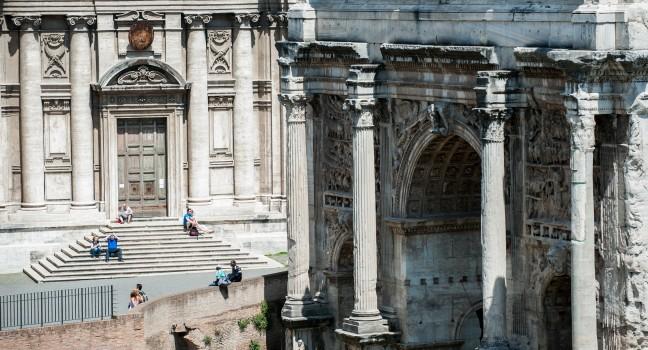
Arco di Settimio Severo

Campitelli Fodor's Choice
Arco di Settimio Severo, Rome, Italy
© Ross Brinkerhoff / Fodor’s Travel

One of the grandest triumphal arches erected by a Roman emperor, this richly decorated monument was built in AD 203 to celebrate Severus's victory over the Parthians. It was once topped by a bronze statuary group depicting a chariot drawn by four (or perhaps as many as six) life-size horses. Masterpieces of Roman statuary, the stone reliefs on the arch were probably based on huge painted panels depicting the event, a kind of visual report on his foreign campaigns that would have been displayed during the emperor's triumphal parade in Rome to impress his subjects (and, like much statuary then, were originally painted in florid, lifelike colors).

West end of Foro Romano, Rome, 00186, Italy
Sight Details
€18 24-hr ticket required

Something incorrect in this review?

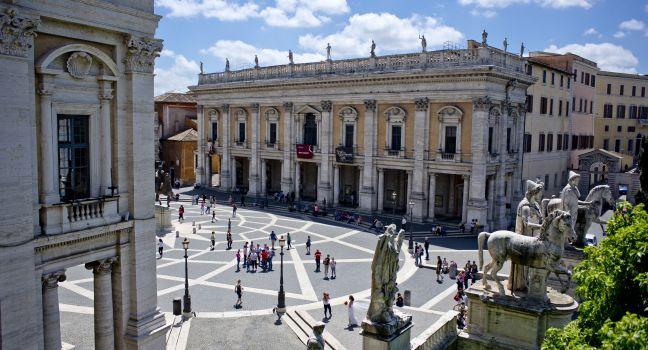
The Campidoglio

Piazza Venezia Fodor's Choice
The Campidoglio, Campidoglio, Ancient Rome, Italy.
© Zach Nelson / Fodors Travel

Spectacularly transformed by Michelangelo's late-Renaissance designs, the Campidoglio was once the epicenter of the Roman Empire, the place where the city's first shrines stood, including its most sacred, the Temple of Jupiter. The Capitoline Hill originally consisted of two peaks: the Capitolium and the Arx (where Santa Maria in Aracoeli now stands). The hollow between them was known as the Asylum. Here, prospective settlers once came to seek the protection of Romulus, legendary first king of Rome—hence the term "asylum." Later, during the Republic, in 78 BC, the Tabularium, or Hall of Records, was erected here.

By the Middle Ages, however, the Capitoline had become an unkempt hill strewn with ancient rubble. In preparation for the impending visit of Charles V in 1536, triumphant after the empire's victory over the Moors, his host, Pope Paul III Farnese, decided that the Holy Roman Emperor should follow the route of the emperors, finishing triumphantly at the Campidoglio. The pope was embarrassed by the decrepit goat pasture the hill had become and so commissioned Michelangelo to restore the site to glory. The resulting design added a third palace along with Renaissance-style facades and a grand paved piazza. Newly excavated ancient sculptures, designed to impress the visiting emperor, were installed in the palaces, and the piazza was ornamented with the giant stone figures of the Discouri and the ancient Roman equestrian statue of Emperor Marcus Aurelius. A copy of this extraordinary statue is still the piazza's centerpiece (the 2nd-century original has been housed in the neighbouring Musei Capitolini since 1999).

While there are great views of the Roman Forum from the terrace balconies to either side of the Palazzo Senatorio, the best view is from the 1st century BC Tabularium, now part of the Musei Capitolini. The museum café is on the Terrazza Caffarelli, with a magical view toward Trastevere and St. Peter's, and is accessible without a museum ticket.

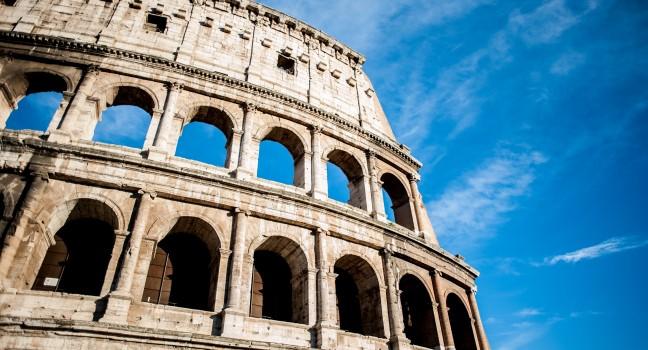
Colosseum

Colosseo Fodor's Choice
Colosseum, Rome, Italy
© Ross Brinkerhoff / Fodor’s Travel

The most spectacular extant edifice of ancient Rome, the Colosseum has a history that is half gore, half glory. Once able to house 50,000 spectators, it was built to impress Romans with its spectacles involving wild animals and fearsome gladiators from the farthest reaches of the empire. Senators had marble seats up front, the vestal virgins took the ringside position, the plebs sat in wooden tiers at the back, and the masses watched from the top tier. Looming over all was the amazing velarium, an ingenious system of sail-like awnings rigged on ropes and maneuvered by sailors from the imperial fleet, who would unfurl them to protect the arena's occupants from sun or rain.

From the second floor, you can get a bird's-eye view of the hypogeum—the subterranean passageways that were the architectural engine rooms that made the slaughter above proceed like clockwork. In a scene prefiguring something from Dante's Inferno, hundreds of beasts would wait to be launched via a series of slave-powered hoists and lifts into the bloodthirsty sand of the arena above.

Designed by order of the emperor Vespasian in AD 72 and completed by his son Titus in AD 80, the arena has a circumference of 573 yards, and its external walls were built with travertine from nearby Tivoli. Its construction was a remarkable feat of engineering, for it stands on marshy terrain reclaimed by draining an artificial lake that formed part of the vast palace of Nero. Originally known as the Flavian amphitheater (Vespasian's and Titus's family name was Flavius), it came to be known as the Colosseum thanks to a colossal gilded bronze statue that once stood nearby.

The legend made famous by the Venerable Bede says that as long as the Colosseum stands, Rome will stand; and when Rome falls, so will the world . . . not that the prophecy deterred medieval and Renaissance princes and popes from using the Colosseum as a quarry. In the 19th century, poets came to view the arena by moonlight; today, mellow golden spotlights make the arena a spectacular sight at night, and evening visits are possible with guided tours from May through October. To enter, book a combination ticket (with the Roman Forum and Palatine Hill) in advance online, though if you have a Roma Pass, you can use it.

Tickets cost €18. Aim for early or late slots to minimize lines, as even the preferential lanes get busy in the middle of the day. Alternatively, you can book a tour online with a company (do your research to make sure it's reputable) that lets you skip the line. Avoid the tours sold on the spot around the Colosseum; although you can skip the lines, the tour guides tend to be dry, the tour groups huge, and the tour itself rushed. To see the arena or the underground, you must purchase a special timed-entry ticket with those features, though the arena is included if you buy the Roman Forum–Palatine complex €24 two-day Full Experience ticket.

Piazza del Colosseo, Rome, 00184, Italy
Sight Details
Requires either the €18 24-hr ticket or the €24 Full Experience ticket (can include the arena, the underground, and/or the attic for no additional fee, but it must be specified during the purchase)

Something incorrect in this review?

Recommended Fodor's Video

Musei Capitolini

Campitelli Fodor's Choice
Inside one of the rooms of the Capitoline Museums in Rome, Italy  The museum was opened to the public at the wish of Pope Clement XII in 1734.
Chanclos/Shutterstock

Surpassed in size and richness only by the Musei Vaticani, the world's first public museum—with the greatest hits of Roman art through the ages, from the ancients to the Baroque—is housed in the Palazzo dei Conservatori and the Palazzo Nuovo, which mirror one another across Michelangelo's famous piazza. The collection was begun by Pope Sixtus IV (the man who built the Sistine Chapel) in 1473, when he donated a room of ancient statuary to the people of the city. This core of the collection includes the She Wolf, which is the symbol of Rome, and the piercing gaze of the Capitoline Brutus.

Buy your ticket and enter the Palazzo dei Conservatori, where in the first courtyard, you'll see the giant head, foot, elbow, and imperially raised finger of the fabled seated statue of Constantine, which once dominated the Basilica of Maxentius in the Forum. Upstairs is the resplendent Sala degli Orazi e Curiazi (Hall of the Horatii and Curatii), decorated with a magnificent gilt ceiling, carved wooden doors, and 16th-century frescoes depicting the history of Rome's legendary origins. At each end of the hall are statues of two of the most important popes of the Baroque era, Urban VIII and Innocent X.

The heart of the museum is the modern Exedra of Marcus Aurelius (Esedra di Marco Aurelio), which displays the spectacular original bronze statue of the Roman emperor whose copy dominates the piazza outside. To the right, the room segues into the area of the Temple of Jupiter, with the ruins of part of its vast base rising organically into the museum space. A reconstruction of the temple and the Capitoline Hill from the Bronze Age to the present day makes for a fascinating glimpse through the ages. On the top floor, the museum's pinacoteca, or painting gallery, has some noted Baroque masterpieces, including Caravaggio's The Fortune Teller and St. John the Baptist.

To get to the Palazzo Nuovo section of the museum, take the stairs or elevator to the basement of the Palazzo dei Conservatori, where the corridor uniting the two contains the Epigraphic Collection, a poignant assembly of ancient gravestones. Just over halfway along the corridor, and before going up into the Palazzo Nuovo, be sure to take the staircase to the right to the Tabularium gallery and its unparalleled view over the Forum.

On the stairs inside the Palazzo Nuovo, you'll be immediately dwarfed by Mars in full military rig and lion-topped sandals. Upstairs is the noted Sala degli Imperatori, lined with busts of Roman emperors, and the Sala dei Filosofi, where busts of philosophers sit in judgment—a fascinating who's who of the ancient world. Within these serried ranks are 48 Roman emperors, ranging from Augustus to Theodosius. Nearby are rooms filled with sculptural masterpieces, including the famed Dying Gaul, the Red Faun from Hadrian's Villa, and a Cupid and Psyche.

Piazza del Campidoglio, 1, Rome, 00186, Italy
06-0608
Sight Details
€13 (€15.50 with exhibitions); €13.50 with access to Centrale Montemartini; €4 audio guide

Something incorrect in this review?

San Clemente

Celio Fodor's Choice
San Clemente church mosaic, Rome, Italy.
Vlad G/Shutterstock

One of the most impressive archaeological sites in Rome, San Clemente is a historical triple-decker. A 12th-century church was built on top of a 4th-century church, which had been built over a 2nd-century pagan temple to the god Mithras and 1st-century Roman apartments. The layers were uncovered in 1857, when a curious prior, Friar Joseph Mullooly, started excavations beneath the present basilica. Today, you can descend to explore all three.

The upper church (at street level) is a gem in its own right. In the apse, a glittering 12th-century mosaic shows Jesus on a cross that turns into a living tree. Green acanthus leaves swirl and teem with small scenes of everyday life. Early Christian symbols, including doves, vines, and fish, decorate the 4th-century marble choir screens. In the left nave, the Castiglioni chapel holds frescoes painted around 1400 by the Florentine artist Masolino da Panicale (1383–1440), a key figure in the introduction of realism and one-point perspective into Renaissance painting. Note the large Crucifixion and scenes from the lives of saints Catherine, Ambrose, and Christopher, plus the Annunciation (over the entrance).

To the right of the sacristy (and bookshop), descend the stairs to the 4th-century church, used until 1084, when it was damaged beyond repair during a siege of the area by the Norman prince Robert Guiscard. Still intact are some vibrant 11th-century frescoes depicting stories from the life of St. Clement. Don't miss the last fresco on the left, in what used to be the central nave. It includes a particularly colorful quote—including "Go on, you sons of harlots, pull!"—that's not only unusual for a religious painting, but also one of the earliest examples of written vernacular Italian.

Descend an additional set of stairs to the Mithraeum, a shrine dedicated to the god Mithras. His cult spread from Persia and gained a foothold in Rome during the 2nd and 3rd centuries AD. Mithras was believed to have been born in a cave and was thus worshipped in cavernous, underground chambers, where initiates into the all-male cult would share a meal while reclining on stone couches, some visible here along with the altar block. Most such pagan shrines in Rome were destroyed by Christians, who often built churches over their remains, as happened here.

Via Labicana, 95, Rome, 00184, Italy
06-7740021
Sight Details
Archaeological area €10
Reservations required

Something incorrect in this review?

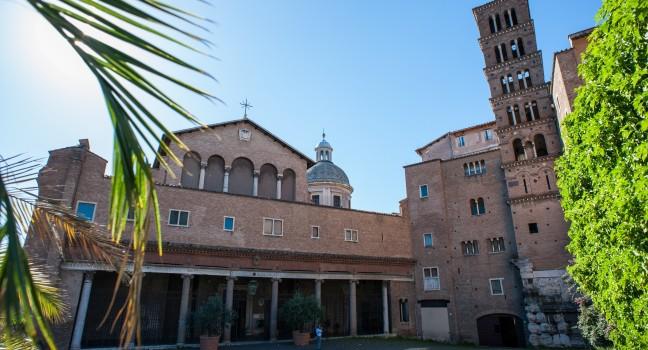
Santi Giovanni e Paolo

Celio Fodor's Choice
Santi Giovanni e Paolo, Rome, Italy
© Ross Brinkerhoff / Fodors Travel

Perched up the incline of the Clivio di Scauro—a magical time-machine of a street, where the dial seems to be stuck somewhere in the 13th century—Santi Giovanni e Paolo is an image that would tempt most landscape painters. Marked by one of Rome's finest Romanesque bell towers, it looms over a picturesque piazza. Underneath, however, are other treasures, whose excavations can be seen in the Case Romane del Celio museum.

A basilica erected on the spot was, like San Clemente, destroyed in 1084 by attacking Normans. Its half-buried columns, near the current church entrance, are visible through misty glass. The current church's origins date to the start of the 12th century, but most of the interior dates to the 17th century and later. The lovely, incongruous chandeliers are hand-me-downs from New York's Waldorf-Astoria hotel, a gift arranged by the late Cardinal Francis Spellman of New York, whose titular church this was. Spellman also initiated the excavations here in 1949.

Casa di Augustus

Campitelli Fodor's Choice

First discovered in the 1970s and open to the public only since 2006, this was the residence of Octavian Augustus (27 BC–AD 14) after his victory at Actium. (Archaeologists have recently found two courtyards rather than one, though, in the style of Rome's ancient Greek kings, suggesting Augustus maintained this house after his ascension to prominence.) Four rooms have exquisite examples of decorative frescoes on the walls; startlingly vivid and detailed are the depictions of a narrow stage with side doors, as well as some striking comic theater masks. An exquisitely painted upper room has been identified as the Emperor's study.

Northwest crest of Palatine Hill, Rome, 00184, Italy
Sight Details
€22 2-day Full Experience ticket required
Closed Mon.

Something incorrect in this review?

Palatine Hill

Monti Fodor's Choice

Just beyond the Arco di Tito, the Clivus Palatinus—the road connecting the Forum and the Palatine Hill—gently rises to the heights of the Colle Palatino (Palatine Hill), the oldest inhabited site in Rome. Now charmingly bucolic, with pines and olive trees providing shade in summer, this is where Romulus is said to have founded the city that bears his name, and despite its location overlooking the Forum's traffic and attendant noise, the Palatine was the most coveted address for ancient Rome's rich and famous. During the Roman Republic it was home to wealthy patrician families—Cicero, Catiline, Crassus, and Agrippa all had homes here—and when Augustus (who had himself been born on the hill) came to power, declaring himself to be the new Romulus, it would thereafter become the home of emperors. The Houses of Livia and Augustus (which you can visit with the S.U.P.E.R. ticket, for the same price as the Roman Forum admission) are today the hill's best-preserved structures, replete with fabulous frescoes. If you only have time for one, the House of Augustus is the more spectacular of the two. After Augustus's relatively modest residence, Tiberius extended the palace and other structures followed, notably the gigantic extravaganza constructed for Emperor Domitian which makes up much of what we see today.

Entrances at Piazza del Colosseo and Via di San Gregorio 30, Rome, 00184, Italy
06-39967700
Sight Details
€16 combined ticket, includes single entry to Palatine Hill–Forum site and single entry to Colosseum (if used within 2 days); S.U.P.E.R. ticket €16 (€18 with online reservation) includes access to the Houses of Augustus and Livia, the Palatine Museum, Aula Isiaca, Santa Maria Antiqua, and Temple of Romulus
Jan.–Feb. 15, daily 8:30–4:30; Feb. 16–Mar. 15, daily 8:30–5; Mar. 16–last Sat. in Mar., daily 8:30–5:30; last Sun. in Mar.–Aug., daily 8:30–7:15; Sept., daily 8:30–7; Oct. 1–last Sat. in Oct., daily 8:30–6:30; last Sun. in Oct.–Dec., daily 8:30–4:30

Something incorrect in this review?

The Roman Forum

Monti Fodor's Choice

Whether it's from the main entrance on Via dei Fori Imperali or by the entrance at the Arch of Titus, descend into the extraordinary archaeological complex that is the Foro Romano and the Palatine Hill, once the very heart of the Roman world. The Forum began life as a marshy valley between the Capitoline and Palatine hills—a valley crossed by a mud track and used as a cemetery by Iron Age settlers. Over the years, a market center and some huts were established here, and after the land was drained in the 6th century BC, the site eventually became a political, religious, and commercial center: the Forum.

Hundreds of years of plunder reduced the Forum to its current desolate state. But this enormous area was once Rome's pulsating hub, filled with stately and extravagant temples, palaces, and shops and crowded with people from all corners of the empire. Adding to today's confusion is the fact that the Forum developed over many centuries; what you see today are not the ruins from just one period but from a span of almost 900 years, from about 500 BC to AD 400. Nonetheless, the enduring romance of the place, with its lonely columns and great broken fragments of sculpted marble and stone, makes for a quintessential Roman experience.

There is always a line at the Colosseum ticket office for the combined Colosseum/Palatine/Forum ticket, but in high season, lines sometimes also form at the Forum and Palatine entrances. Those who don't want to risk waiting in line can book their tickets online in advance, for a €2 surcharge. Choose the print-at-home option (a PDF on a smartphone works, too) and avoid the line to pick up tickets. Your ticket is valid for one entrance to the Roman Forum and the Palatine Hill which are part of a single continuous complex. Certain sites within the Forum require a S.U.P.E.R. ticket .

Entrance at Via dei Fori Imperiali, Rome, 00186, Italy
06-39967700
Sight Details
€16 (combined ticket with the Colosseum and Palatine Hill, if used within 2 days); audio guide €5
Jan.–Feb. 15, daily 8:30–4:30; Feb. 16–Mar. 15, daily 8:30–5; Mar. 16–last Sat. in Mar., daily 8:30–5:30; last Sun. in Mar.–Aug., 8:30–7:15; Sept., daily 8:30–7; Oct. 1–last Sat. in Oct., daily 8:30–6:30; last Sun. in Oct.–Dec., 8:30–4:30

Something incorrect in this review?

San Pietro in Vincoli

Monti Fodor's Choice

Michelangelo's Moses, carved in the early 16th century for the never-completed tomb of Pope Julius II, has put this church on the map. The tomb was to include dozens of statues and stand nearly 40 feet tall when installed in St. Peter's Basilica. But only three statues—Moses and the two that flank it here, Leah and Rachel—had been completed when Julius died. Julius's successor as pope, from the rival Medici family, had other plans for Michelangelo, and the tomb was abandoned unfinished.

The fierce power of this remarkable sculpture dominates its setting. People say that you can see the sculptor's profile in the lock of Moses's beard right under his lip and that the pope's profile can also be seen. As for the rest of the church, St. Peter takes second billing to Moses. The reputed sets of chains (vincoli) that bound St. Peter during his imprisonment by the Romans in both Jerusalem and Rome are in a bronze and crystal urn under the main altar. Other treasures include a 7th-century mosaic of St. Sebastian, in front of the second altar to the left of the main altar, and, by the door, the tomb of the Pollaiuolo brothers, two 15th-century Florentine artists.

Piazza di San Pietro in Vincoli, 4/A, Rome, 00184, Italy
06-97844952

Something incorrect in this review?

Santa Maria Maggiore

Monti Fodor's Choice

Despite its florid 18th-century facade, Santa Maria Maggiore is one of the city's oldest churches, built around 440 by Pope Sixtus III. One of Rome's four great pilgrimage churches, it's also the city center's best example of an early Christian basilica—one of the immense, hall-like structures derived from ancient Roman civic buildings and divided into thirds by two great rows of columns marching up the nave. The other three major basilicas in Rome (San Giovanni in Laterano, St. Peter's, and St. Paul Outside the Walls) have largely been rebuilt. Paradoxically, the major reason why this church is such a striking example of early Christian design is that the same man who built the undulating exteriors circa 1740, Ferdinando Fuga, also conscientiously restored the interior, throwing out later additions and, crucially, replacing a number of the great columns.

Precious 5th-century mosaics high on the nave walls and on the triumphal arch in front of the main altar bear splendid testimony to the basilica's venerable age. Those along the nave show 36 scenes from the Old Testament (unfortunately, tough to see clearly without binoculars), and those on the arch illustrate the Annunciation and the Youth of Christ. The resplendent carved-wood ceiling dates from the early 16th century; it's supposed to have been gilded with the first gold brought from the New World. The inlaid marble pavement (called cosmatesque, after the family of master artisans who developed the technique) in the central nave is even older, dating from the 12th century.

The Cappella Sistina (Sistine Chapel), in the right-hand transept, was created by architect Domenico Fontana for Pope Sixtus V in 1585. Elaborately decorated with precious marbles "liberated" from the monuments of ancient Rome, the chapel includes a lower-level museum in which some 13th-century sculptures by Arnolfo da Cambio are all that's left of what was the once richly endowed chapel of the presepio (Christmas crèche), looted during the Sack of Rome in 1527.

Directly opposite, on the church's other side, stands the Cappella Paolina (Pauline Chapel), a rich Baroque setting for the tombs of the Borghese popes Paul V—who commissioned the chapel in 1611 with the declared intention of outdoing Sixtus's chapel across the nave—and Clement VIII. The Cappella Sforza (Sforza Chapel) next door was designed by Michelangelo and completed by Della Porta. Just right of the altar, next to his father, lies Gian Lorenzo Bernini; his monument is an engraved slab, as humble as the tombs of his patrons are grand. Above the loggia, the outside mosaic of Christ raising his hand in blessing is one of Rome's most beautiful sights, especially when lighted at night.

Santi Cosma e Damiano

Campitelli Fodor's Choice

Home to one of the most striking early Christian mosaics, this church was adapted in the 6th century from two ancient buildings: the library in Vespasian's Forum of Peace and a hall of the Temple of Romulus (dedicated to the son of Maxentius, who had been named for Rome's founder). In the apse is the famous AD 530 mosaic of Christ in Glory. It reveals how popes at the time strove to recreate the splendor of imperial audience halls into Christian churches: Christ wears a gold, Roman-style toga, and his pose recalls that of an emperor addressing his subjects. He floats on a blue sky streaked with a flaming sunset—a miracle of tesserae mosaic work. To his side are the figures of Saint Peter and Saint Paul, who represent Cosmas and Damian (patron saints of doctors), two Syrian benefactors whose charity was such that they were branded Christians and condemned to death. Beneath this awe-inspiring work is an enchanting mosaic frieze of holy lambs.