11 Best Sights in Ancient Rome, Rome

Background Illustration for Sights

We've compiled the best of the best in Ancient Rome - browse our top choices for the top things to see or do during your stay.

The Campidoglio

Piazza Venezia Fodor's Choice
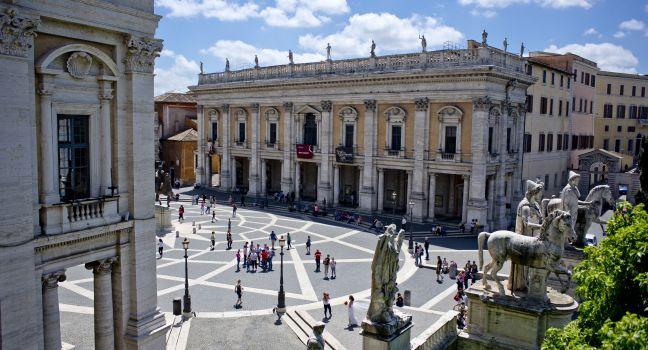
The Campidoglio, Campidoglio, Ancient Rome, Italy.
© Zach Nelson / Fodors Travel

Spectacularly transformed by Michelangelo's late-Renaissance designs, the Campidoglio was once the epicenter of the Roman Empire, the place where the city's first shrines stood, including its most sacred, the Temple of Jupiter. The Capitoline Hill originally consisted of two peaks: the Capitolium and the Arx (where Santa Maria in Aracoeli now stands). The hollow between them was known as the Asylum. Here, prospective settlers once came to seek the protection of Romulus, legendary first king of Rome—hence the term "asylum." Later, during the Republic, in 78 BC, the Tabularium, or Hall of Records, was erected here.

By the Middle Ages, however, the Capitoline had become an unkempt hill strewn with ancient rubble. In preparation for the impending visit of Charles V in 1536, triumphant after the empire's victory over the Moors, his host, Pope Paul III Farnese, decided that the Holy Roman Emperor should follow the route of the emperors, finishing triumphantly at the Campidoglio. The pope was embarrassed by the decrepit goat pasture the hill had become and so commissioned Michelangelo to restore the site to glory. The resulting design added a third palace along with Renaissance-style facades and a grand paved piazza. Newly excavated ancient sculptures, designed to impress the visiting emperor, were installed in the palaces, and the piazza was ornamented with the giant stone figures of the Discouri and the ancient Roman equestrian statue of Emperor Marcus Aurelius. A copy of this extraordinary statue is still the piazza's centerpiece (the 2nd-century original has been housed in the neighbouring Musei Capitolini since 1999).

While there are great views of the Roman Forum from the terrace balconies to either side of the Palazzo Senatorio, the best view is from the 1st century BC Tabularium, now part of the Musei Capitolini. The museum café is on the Terrazza Caffarelli, with a magical view toward Trastevere and St. Peter's, and is accessible without a museum ticket.
Santi Giovanni e Paolo

Celio Fodor's Choice
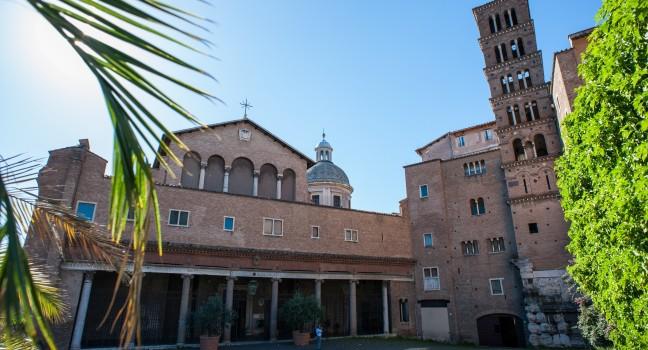
Santi Giovanni e Paolo, Rome, Italy
© Ross Brinkerhoff / Fodors Travel

Perched up the incline of the Clivio di Scauro—a magical time-machine of a street, where the dial seems to be stuck somewhere in the 13th century—Santi Giovanni e Paolo is an image that would tempt most landscape painters. Marked by one of Rome's finest Romanesque bell towers, it looms over a picturesque piazza. Underneath, however, are other treasures, whose excavations can be seen in the Case Romane del Celio museum.

A basilica erected on the spot was, like San Clemente, destroyed in 1084 by attacking Normans. Its half-buried columns, near the current church entrance, are visible through misty glass. The current church's origins date to the start of the 12th century, but most of the interior dates to the 17th century and later. The lovely, incongruous chandeliers are hand-me-downs from New York's Waldorf-Astoria hotel, a gift arranged by the late Cardinal Francis Spellman of New York, whose titular church this was. Spellman also initiated the excavations here in 1949.

Santa Maria Maggiore

Monti Fodor's Choice

Despite its florid 18th-century facade, Santa Maria Maggiore is one of the city's oldest churches, built around 440 by Pope Sixtus III. One of Rome's four great pilgrimage churches, it's also the city center's best example of an early Christian basilica—one of the immense, hall-like structures derived from ancient Roman civic buildings and divided into thirds by two great rows of columns marching up the nave. The other three major basilicas in Rome (San Giovanni in Laterano, St. Peter's, and St. Paul Outside the Walls) have largely been rebuilt. Paradoxically, the major reason why this church is such a striking example of early Christian design is that the same man who built the undulating exteriors circa 1740, Ferdinando Fuga, also conscientiously restored the interior, throwing out later additions and, crucially, replacing a number of the great columns.

Precious 5th-century mosaics high on the nave walls and on the triumphal arch in front of the main altar bear splendid testimony to the basilica's venerable age. Those along the nave show 36 scenes from the Old Testament (unfortunately, tough to see clearly without binoculars), and those on the arch illustrate the Annunciation and the Youth of Christ. The resplendent carved-wood ceiling dates from the early 16th century; it's supposed to have been gilded with the first gold brought from the New World. The inlaid marble pavement (called cosmatesque, after the family of master artisans who developed the technique) in the central nave is even older, dating from the 12th century.

The Cappella Sistina (Sistine Chapel), in the right-hand transept, was created by architect Domenico Fontana for Pope Sixtus V in 1585. Elaborately decorated with precious marbles "liberated" from the monuments of ancient Rome, the chapel includes a lower-level museum in which some 13th-century sculptures by Arnolfo da Cambio are all that's left of what was the once richly endowed chapel of the presepio (Christmas crèche), looted during the Sack of Rome in 1527.

Directly opposite, on the church's other side, stands the Cappella Paolina (Pauline Chapel), a rich Baroque setting for the tombs of the Borghese popes Paul V—who commissioned the chapel in 1611 with the declared intention of outdoing Sixtus's chapel across the nave—and Clement VIII. The Cappella Sforza (Sforza Chapel) next door was designed by Michelangelo and completed by Della Porta. Just right of the altar, next to his father, lies Gian Lorenzo Bernini; his monument is an engraved slab, as humble as the tombs of his patrons are grand. Above the loggia, the outside mosaic of Christ raising his hand in blessing is one of Rome's most beautiful sights, especially when lighted at night.

Recommended Fodor's Video

Basilica di Santa Maria in Aracoeli

Campitelli
Santa Maria di Aracoeli, Campidoglio, Ancient Rome, Rome, Italy.
© Zach Nelson / Fodors Travel

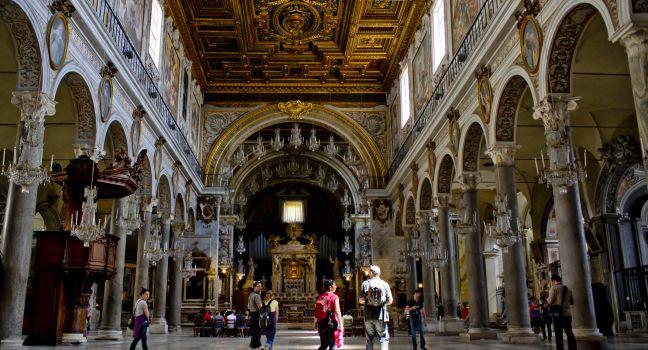
Perched atop 124 steps, on the north slope of the Capitoline Hill, Santa Maria in Aracoeli occupies the site of the temple of Juno Moneta (Admonishing Juno), which also housed the Roman mint. According to legend, it was here that the Sibyl, a prophetess, predicted to Augustus the coming of a Redeemer. Augustus responded by erecting an altar, the Ara Coeli (Altar of Heaven). This was eventually replaced by a Benedictine monastery and then by a church, which was passed in 1250 to the Franciscans, who restored and enlarged it in Romanesque-Gothic style.

Today, the Aracoeli is best known for the Santo Bambino, a much-revered olivewood figure of the Christ Child (a copy of the 15th-century original, which was stolen in 1994). At Christmas, everyone pays homage to the "Bambinello" as children recite poems from a miniature pulpit. In true Roman style, the church interior is a historical hodgepodge, with classical columns and large marble fragments from pagan buildings, as well as a 13th-century cosmatesque pavement. The richly gilded Renaissance ceiling commemorates the naval victory at Lepanto in 1571 over the Turks. The first chapel on the right is noteworthy for Pinturicchio's frescoes of St. Bernardino of Siena (1486).

Scala dell'Arce Capitolina 14, Rome, 00186, Italy
06-69763839

Something incorrect in this review?

Santa Pudenziana

Monti
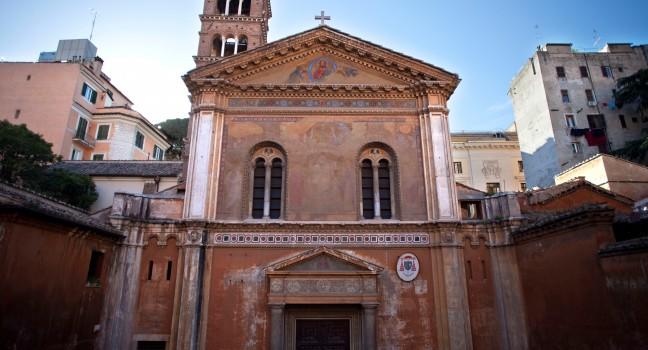
Santa Pudenziana, Rome, Italy
© Halie Cousineau/ Fodors Travel

Apart from Ravenna, Rome has some of Italy's most opulent mosaics, and this church has the earliest example. Commissioned during the papacy of Innocent I, its early 5th-century apse mosaic, depicting Christ teaching the apostles, sits above a Baroque altarpiece surrounded by a bevy of florid 18th-century paintings. The mosaic is remarkable for its iconography; at the center sits Christ Enthroned, shown as an emperor or as a philosopher holding court, surrounded by his apostles. Each apostle faces the spectator, literally rubbing shoulders with his companion (unlike later hieratic styles in which each figure is isolated) and bears an individualized expression. Above these figures and a landscape symbolizing Heavenly Jerusalem float the signs of the four evangelists in a blue sky flecked with the orange of sunset, made from thousands of tesserae (mosaic tiles).

To either side of Christ, saints Praxedes and Pudentiana hold wreaths over the heads of saints Peter and Paul. These two women were actually daughters of the Roman senator Pudens (probably the one mentioned in 2 Timothy 4:21), whose family befriended both apostles. During the persecutions of Nero, both sisters collected the blood of many martyrs before suffering their fate. Pudentiana transformed her house into a church, but her namesake church was constructed over a 2nd-century bathhouse. Beyond the sheer beauty of the mosaic work, the size, rich detail, and number of figures make this both the last gasp of ancient Roman art and one of the first major works of Early Christian art.

Via Urbana, 160, Rome, 00184, Italy
06-4817292
Sight Details
Closed Sun.

Something incorrect in this review?

Santi Quattro Coronati

Celio
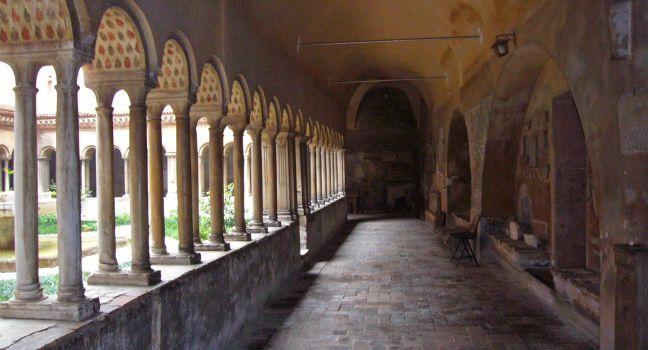
Roma, Santi Quattro Coronati: chiostro
Lalupa (CC BY-SA 3.0), via Wikimedia Commons

Situated on one of those evocative cul-de-sacs in Rome where history seems to be holding its breath, this quiet citadel has resisted the tides of time and traffic. The church—which is both strongly imbued with the sanctity of the Romanesque era and marvelously redolent of the Middle Ages—dates from the 4th century and honors the Four Crowned Saints: the four brothers Severus, Severianus, Carpophorus, and Victorinus, all Roman officials who were whipped to death for their faith by Emperor Diocletian (284–305).

After its 9th-century reconstruction, the church was twice as large as it is now; the abbey was partially destroyed during the Normans' sack of Rome in 1084 but reconstructed about 30 years later. This explains the inordinate size of the apse in relation to the small nave. Don't miss the cloister, with its well-tended gardens and 12th-century fountain. The entrance is the door in the left nave; ring the bell if it's not open.

There's another medieval gem hidden away off the courtyard at the church entrance: the Chapel of San Silvestro. The chapel has remained, for the most part, as it was when consecrated in 1246. Some of the best-preserved medieval frescoes in Rome decorate the walls, telling the story of the Christian emperor Constantine's recovery from leprosy thanks to Pope Sylvester I. Note, too, the delightful Last Judgment fresco above the door, in which the angel on the left neatly rolls up sky and stars like a backdrop, signaling the end of the world.

Arco di Costantino

Colosseo

This majestic arch was erected in AD 315 to commemorate Constantine's victory over Maxentius at the Milvian Bridge. It was just before this battle, in AD 312, that Constantine—the emperor who converted Rome to Christianity—legendarily had a vision of a cross and heard the words "In this sign thou shalt conquer." Many of the costly marble decorations for the arch were scavenged from earlier monuments, both saving money and placing Constantine in line with the great emperors of the past. It is easy to picture ranks of Roman centurions marching under the great barrel vault.

Piazza del Colosseo, Rome, 00184, Italy

Something incorrect in this review?

Circo Massimo

Aventino

From the belvedere of the Domus Flavia on the Palatine Hill, you can see the Circus Maximus; there's also a great free view from Piazzale Ugo La Malfa on the Aventine Hill side. The giant space where 300,000 spectators once watched chariot races while the emperor looked on is ancient Rome's oldest and largest racetrack; it lies in a natural hollow between the two hills. The oval course stretches about 650 yards from end to end; on certain occasions, there were as many as 24 chariot races a day, and competitions could last for 15 days. The charioteers could amass fortunes rather like the sports stars of today. (The Portuguese Diocles is said to have totted up winnings of 35 million sestertii.)

The noise and the excitement of the crowd must have reached astonishing levels as the charioteers competed in teams, each with their own colors—the Reds, the Blues, etc. Betting also provided Rome's majority of unemployed with a potentially lucrative occupation. The central ridge was the site of two Egyptian obelisks (now in Piazza del Popolo and Piazza San Giovanni in Laterano). Picture the great chariot race scene from MGM's Ben-Hur and you have an inkling of what this was like.  The "Circo Massimo Experience," a 40-minute augmented and virtual reality experience through the stadium, costs €12.

Between Palatine and Aventine Hills, Rome, 00153, Italy
06-0608
Sight Details
Free

Something incorrect in this review?

Colonna di Traiano

Monti

The remarkable series of reliefs spiraling up this column, which has stood in this spot since AD 113, celebrate the emperor's victories over the Dacians in today's Romania. The scenes on the column are an important primary source for information on the Roman army and its tactics. An inscription on the base declares that the column was erected in Trajan's honor and that its height corresponds to the height of the hill that was razed to create a level area for the grandiose Foro di Traiano. The emperor's ashes, no longer here, were kept in a golden urn in a chamber at the column's base; his statue stood atop the column until 1587, when the pope had it replaced with a statue of St. Peter.

Via del Foro di Traiano, Rome, 00186, Italy

Something incorrect in this review?

San Gregorio Magno

Celio

Set amid the greenery of the Celian Hill, this church wears its Baroque facade proudly. Dedicated to St. Gregory the Great (who served as pope 590–604), it was built about 750 by Pope Gregory II to commemorate his predecessor and namesake. The church of San Gregorio itself has the appearance of a typical Baroque structure, the result of remodeling in the 17th and 18th centuries. But you can still see what's said to be the stone slab on which the pious St. Gregory the Great slept; it's in the far right-hand chapel.

Outside are three chapels. The right chapel is dedicated to Gregory's mother, Saint Sylvia, and contains a Guido Reni fresco of the Concert of Angels. The chapel in the center, dedicated to Saint Andrew, contains two monumental frescoes showing scenes from the saint's life. They were painted at the beginning of the 17th century by Domenichino (The Flagellation of St. Andrew) and Guido Reni (The Execution of St. Andrew). It's a striking juxtaposition of the sturdy, if sometimes stiff, classicism of Domenichino with the more flamboyant and heroic Baroque manner of Guido Reni.

Santo Stefano Rotondo

Celio

This 5th-century church is thought to have been inspired by the design of the Church of the Holy Sepulchre in Jerusalem. Its unusual round plan and timbered ceiling set it apart from most other Roman churches. So do the frescoes, which lovingly depict 34 of the goriest martyrdoms in Catholicism—a catalog, above the names of different emperors, of every type of violent death conceivable. (You've been warned: these are not for the fainthearted.)