8 Best Sights in Piazza Navona, Campo de' Fiori, and the Jewish Ghetto, Rome

Background Illustration for Sights

We've compiled the best of the best in Piazza Navona, Campo de' Fiori, and the Jewish Ghetto - browse our top choices for the top things to see or do during your stay.

Palazzo Altemps

Piazza Navona Fodor's Choice
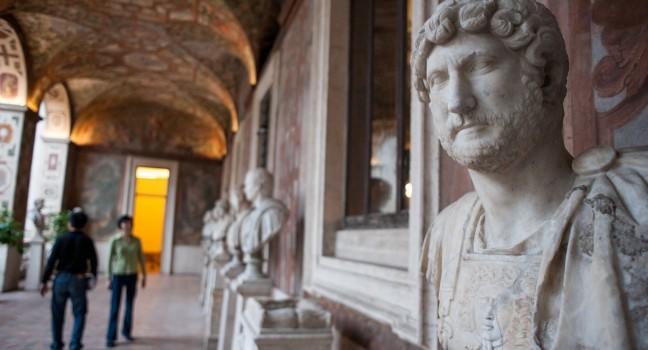
Bust, Hall, Palazzo Altemps, Rome, Italy
© Ross Brinkerhoff / Fodors Travel

Containing some of the world's finest ancient Roman marbles, Palazzo Altemps is part of the Museo Nazionale Romano. The palace's sober exterior belies a magnificence that appears as soon as you walk into the majestic courtyard, studded with statues and covered in part by a retractable awning. The restored interior hints at the Roman lifestyle of the 16th–18th centuries while showcasing the most illustrious pieces from the Museo Nazionale, including the collection of the Ludovisi noble family.

In the frescoed salons you can see the Galata Suicida, a poignant sculptural work portraying a barbarian warrior who chooses death for himself and his wife rather than humiliation by the enemy. Another highlight is the large Ludovisi sarcophagus, magnificently carved from marble. In a place of honor is the Ludovisi Throne, which shows a goddess emerging from the sea and being helped by her acolytes. For centuries this was heralded as one of the most sublime Greek sculptures, but today at least one authoritative art historian considers it a colossally overrated fake. Look for the framed explanations of the exhibits that detail (in English) how and exactly where Renaissance sculptors, Bernini among them, added missing pieces to the classical works.

In the lavishly frescoed loggia stand busts of the Caesars. In the wing once occupied by early-20th-century poet Gabriele d'Annunzio (who married into the Altemps family), three rooms host the museum's Egyptian collection.

Piazza di Sant'Apollinare, 46, Rome, 00186, Italy
Sight Details
€8; €16 combined ticket includes 3 other Museo Nazionale Romano sites over 1 wk (Crypta Balbi, Palazzo Massimo alle Terme, and Museo delle Terme di Diocleziano)
Closed Mon.

Something incorrect in this review?

Palazzo Farnese

Campo de' Fiori Fodor's Choice
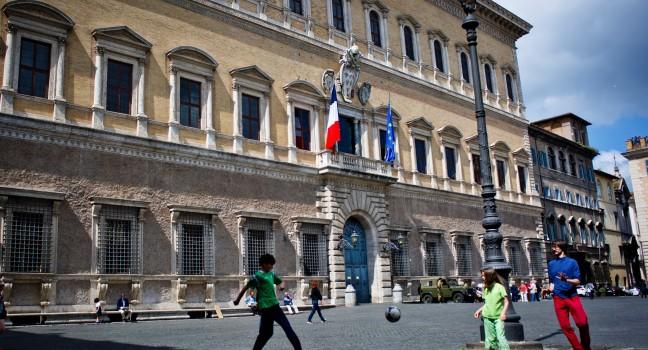
Soccer, Palazzo Farnese, Rome, Italy
© Zach Nelson / Fodors Travel

Rome's most beautiful Renaissance palace is fabled for its Galleria Carracci, whose ceiling is to the Baroque age what the Sistine Chapel ceiling is to the Renaissance. The Farnese family rose to great power and wealth during the Renaissance, in part because of the favor Pope Alexander VI showed to the beautiful Giulia Farnese. The massive palace was begun when, with Alexander's aid, Giulia's brother became cardinal; it was further enlarged on his election as Pope Paul III in 1534.

The uppermost frieze decorations and main window overlooking the piazza are the work of Michelangelo, who also designed part of the courtyard, as well as the graceful arch over Via Giulia at the back. The facade on Piazza Farnese has geometrical brick configurations that have long been thought to hold some occult meaning. When looking up at the palace, try to catch a glimpse of the splendid frescoed ceilings, including the Galleria Carracci vault painted by Annibale Carracci between 1597 and 1604. 

The Carracci gallery depicts the loves of the gods, a supremely pagan theme that the artist painted in a swirling style that announced the birth of the Baroque. Other opulent salons are among the largest in Rome, including the Salon of Hercules, which has an impressive replica of the ancient Farnese Hercules. The French Embassy, which occupies the palace, offers tours (in English) on Monday, Wednesday, and Friday; book at least a few weeks (and up to eight months) in advance through the website and bring a photo ID.

Pantheon

Piazza Navona Fodor's Choice
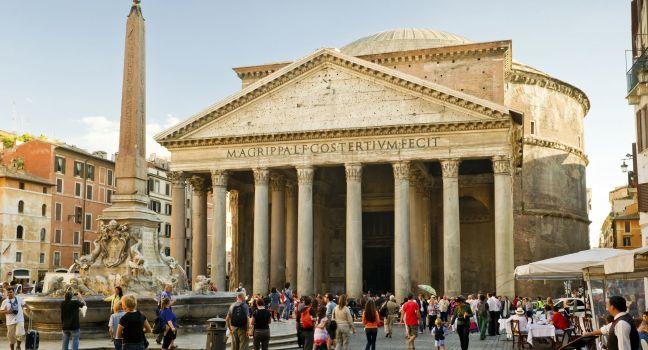
ROME - OCTOBER 2: Tourists visit the Pantheon on October 2, 2012 in Rome, Italy. Pantheon is a famous monument of ancient Roman culture, the temple of all the gods, built in the 2nd century.;
Viacheslav Lopatin/Shutterstock

The city's best-preserved ancient building, this former Roman temple is a marvel of architectural harmony and proportion. It was entirely rebuilt by the emperor Hadrian around AD 120 on the site of a Pantheon (from the Greek: pan, all, and theon, gods) erected in 27 BC by Augustus's right-hand man and son-in-law, Agrippa.

The most striking thing about the Pantheon is not its size, immense though it is, nor even the phenomenal technical difficulties posed by so massive a construction; rather, it's the remarkable unity of the building. The diameter described by the dome is exactly equal to its height. It's the use of such simple mathematical balance that gives classical architecture its characteristic sense of proportion and its nobility. The opening at the apex of the dome, the oculus, is nearly 30 feet in diameter and was intended to symbolize the "all-seeing eye of the heavens." On a practical note, this means when it rains, it rains inside: look out for the drainage holes in the floor.

Although little is known for sure about the Pantheon's origins or purpose, it's worth noting that the five levels of trapezoidal coffers (sunken panels in the ceiling) represent the course of the five then-known planets and their concentric spheres. Ruling over them is the sun, represented symbolically and literally by the 30-foot-wide eye at the top. The heavenly symmetry is further paralleled by the coffers: 28 to each row, the number of lunar cycles. In the center of each would have shone a small bronze star. Down below, the seven large niches were occupied not by saints, but, it's thought, by statues of Mars, Venus, the deified Caesar, and the other "astral deities," including the moon and sun, the "sol invictus." (Academics still argue, however, about which gods were most probably worshipped here.)

One of the reasons the Pantheon is so well preserved is that it was consecrated as a church in AD 608. (It's still a working church today.) No building, church or not, though, escaped some degree of plundering through the turbulent centuries of Rome's history after the fall of the empire. In 655, for example, the gilded bronze covering the dome was stripped. The Pantheon is also one of the city's important burial places. Its most famous tomb is that of Raphael (between the second and third chapels on the left as you enter). Mass takes place on Sunday and on religious holidays at 10:30; it's open to the public, but you are expected to arrive before the beginning and stay until the end. General access usually resumes at about 11:30.

You can buy tickets in person via cash or credit card, or online (which requires registering for an account). If you plan on purchasing tickets in person, coming prepared with both cash and a credit card will allow you to select the faster-moving line that day.  On the first Sunday of every month, visitors can enter for free.

Recommended Fodor's Video

Piazza Navona

Piazza Navona Fodor's Choice
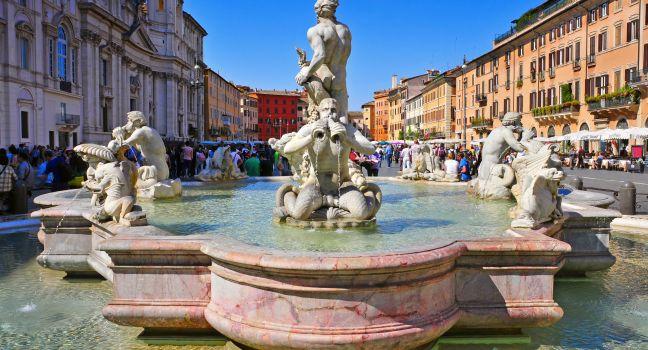
ROME, ITALY - APRIL 18: View of Fontana del Moro, in Piazza Navona, looking northwards on April 18, 2013 in Rome, Italy. This popular city square is the largest in Rome; Shutterstock ID 137683064; Project/Title: Fodor's Essential Europe insert; Downloader:
nito/Shutterstock

Always camera-ready, this beautiful plaza has Bernini sculptures, three gorgeous fountains, and a magnificently Baroque church (Sant'Agnese in Agone), all built atop the remains of a Roman athletics track. Pieces of the arena are still visible near the adjacent Piazza Sant'Apollinare, and the ancient spirit of entertainment lives on in the buskers and artists who populate the piazza today.

The piazza took on its current look during the 17th century, after Pope Innocent X of the Pamphilj family decided to make over his family palace (now the Brazilian embassy and an ultraluxe hotel) and its surroundings. Center stage is the Fontana dei Quattro Fiumi, created for Innocent by Bernini in 1651. Bernini's powerful figures of the four rivers represent the longest rivers of the known continents at the time: the Nile (his head covered because the source was unknown); the Ganges; the Danube; and the Plata (the length of the Amazon was then unknown). Popular legend has it that the figure of the Plata—the figure closest to Sant'Agnese in Agone—raises his hand before his eyes because he can't bear to look upon the church's "inferior" facade designed by Francesco Borromini, Bernini's rival.

If you want to sip a coffee with one of the most beautiful, if pricey, views in Rome, grab a seat at Piazza Navona. Just be aware that all the restaurants here are heavily geared toward tourists, so while it's a beautiful place for a drink, you can find cheaper, more authentic, and far better meals elsewhere. 

Via Giulia

Campo de' Fiori Fodor's Choice
Street, Via Giulia, Rome, Italy
© Ross Brinkerhoff / Fodors Travel

Straight as a die and still something of a Renaissance-era diorama, Via Giulia was the first street in Rome since ancient times to be deliberately planned. It was named for Pope Julius II (of Sistine Chapel fame), who commissioned it in the early 1500s as part of a scheme to open up a grandiose approach to St. Peter's Basilica. Although the pope's plans were only partially completed, Via Giulia became an important thoroughfare in Renaissance Rome. It's still, after more than four centuries, the address of choice for Roman aristocrats, despite a recent, controversial addition: a large parking lot along one side of the street (creating it meant steamrolling through ancient and medieval ruins underneath).

A stroll around and along Via Giulia reveals elegant palaces and churches, including one, San Eligio, on the little side street Via di Sant'Eligio, that was designed by Raphael himself. Note also the Palazzo Sacchetti ( Via Giulia, 66), with an imposing stone portal and an interior containing some of Rome's grandest staterooms; it remains, after 300 years, the private quarters of the Marchesi Sacchetti. The forbidding brick building that housed the Carceri Nuove (New Prison) ( Via Giulia, 52), Rome's prison for more than two centuries, now contains the offices of the Direzione Nazionale Antimafia. Near the bridge that arches over Via Giulia's southern end is the church of Santa Maria dell'Orazione e Morte (Holy Mary of Prayer and Death), with stone skulls on its door. These are a symbol of a confraternity that was charged with burying the bodies of the unidentified dead found in the city streets.

Designed by Borromini and home, since 1927, to the Hungarian Academy, the Palazzo Falconieri ( Via Giulia, 1 06/68896700) has Borromini-designed salons and loggia that are sporadically open as part of guided tours; call for information. The falcon statues atop its belvedere are best viewed from around the block, along the Tiber embankment. Remnant of a master plan by Michelangelo, the arch over the street was meant to link massive Palazzo Farnese, on the east side of Via Giulia, with the building across the street and a bridge to the Villa Farnesina, directly across the river. Finally, on the right and rather green with age, dribbles that star of many a postcard, the Fontana del Mascherone.

Via Giulia, Rome, 00186, Italy

Something incorrect in this review?

San Luigi dei Francesi

Piazza Navona Fodor's Choice

San Luigi's Contarelli Chapel (the fifth and last chapel on the left, toward the main altar) is adorned with three stunningly dramatic works by Caravaggio (1571–1610), the Baroque master of the heightened approach to light and dark. They were commissioned for the tomb of Mattheiu Cointerel in one of Rome's French churches (San Luigi is St. Louis, patron saint of France). The inevitable coin machine will light up his Calling of Saint Matthew, Saint Matthew and the Angel, and Martyrdom of Saint Matthew (seen from left to right), and Caravaggio's mastery of light takes it from there.

When painted, they caused considerable consternation among the clergy of San Luigi, who thought the artist's dramatically realistic approach was scandalously disrespectful. A first version of the altarpiece was rejected; the priests were not particularly happy with the other two, either. Time has fully vindicated Caravaggio's patron, Cardinal Francesco del Monte, who secured the commission for these works and staunchly defended them. This church regularly enforces the rule of covered knees and shoulders, and turns away those who do not abide.

Sant'Agostino

Piazza Navona Fodor's Choice

This basilica set atop a steep staircase between Piazza Navona and the Pantheon houses several treasures. In the first chapel on the left is Caravaggio's celebrated Madonna of the Pilgrims, which scandalized all of Rome for depicting a kneeling pilgrim all too realistically for the era's tastes, with dirt on the soles of his feet and the Madonna standing in a less-than-majestic pose in a dilapidated doorway. Pause at the third column on the left of the nave to admire Raphael's blue-robed Isaiah, said to be inspired by Michelangelo's prophets on the Sistine ceiling (Raphael, with the help of Bramante, had taken the odd peek at the master's original against strict orders of secrecy). Directly below is Sansovino's Leonardo-influenced sculpture, St. Anne and the Madonna with Child.

As you leave, in a niche just inside the door, is the sculpted Madonna and Child, known to the Romans as the "Madonna del Parto" (of Childbirth) and piled high with ex-voto offerings giving thanks for the safe deliveries of children. The artist was Jacopo Tatti, also sometimes confusingly known as Sansovino after his master.

Santa Maria sopra Minerva

Piazza Navona Fodor's Choice

The name of the church reveals that it was built sopra (over) the ruins of a temple of Minerva, the ancient goddess of wisdom. Erected in 1280 by Dominicans along severe Italian Gothic lines, it has undergone a number of more or less happy interior restorations. Certainly, as the city's major Gothic church, it provides a refreshing contrast to Baroque flamboyance. Have a €1 coin handy to illuminate the Cappella Carafa in the right transept; the small investment is worth it to better see Filippino Lippi's (1457–1504) glowing frescoes featuring a deep azure expanse of sky and musical angels hovering around the Virgin.

Under the main altar is the tomb of St. Catherine of Siena, one of Italy's patron saints and a major destination for faithful locals who drop written prayers on her final resting place. Left of the altar you'll find Michelangelo's Risen Christ and the tomb of the gentle artist Fra Angelico. Bernini's unusual and little-known monument to the Blessed Maria Raggi is on the fifth pier of the left-hand aisle.

In front of the church, Bernini's Elephant and Obelisk is perhaps the city's most charming sculpture. An inscription on the base references the church's ancient patroness, reading something to the effect that it takes a strong mind to sustain solid wisdom.