Get FREE email communications from Fodor's Travel, covering must-see travel destinations, expert
trip planning advice, and travel inspiration to fuel your passion.
21 Best Sights in Piazza Navona, Campo de' Fiori, and the Jewish Ghetto, Rome
We've compiled the best of the best in Piazza Navona, Campo de' Fiori, and the Jewish Ghetto - browse our top choices for the top
things to see or do during your stay.
Sorry! We don't have any recommendations for Piazza Navona, Campo de' Fiori, and the Jewish Ghetto right now.
Sights Filter
Piazza Navona
Piazza Navona
Fodor's Choice
Share This
nito/Shutterstock
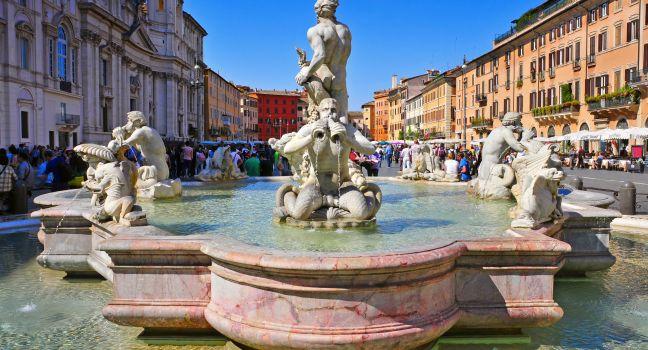
Always camera-ready, this beautiful plaza has Bernini sculptures, three gorgeous fountains, and a magnificently Baroque church (Sant'Agnese in Agone), all built atop the remains of a Roman athletics track. Pieces of the arena are still visible near the adjacent Piazza Sant'Apollinare, and the ancient spirit of entertainment lives on in the buskers and artists who populate the piazza today.
The piazza took on its current look during the 17th century, after Pope Innocent X of the Pamphilj family decided to make over his family palace (now the Brazilian embassy and an ultraluxe hotel) and its surroundings. Center stage is the Fontana dei Quattro Fiumi, created for Innocent by Bernini in 1651. Bernini's powerful figures of the four rivers represent the longest rivers of the known continents at the time: the Nile (his head covered because the source was unknown); the Ganges; the Danube; and the Plata (the length of the Amazon was then unknown). Popular legend has it that the figure of the Plata—the figure closest to Sant'Agnese in Agone—raises his hand before his eyes because he can't bear to look upon the church's "inferior" facade designed by Francesco Borromini, Bernini's rival.
If you want to sip a coffee with one of the most beautiful, if pricey, views in Rome, grab a seat at Piazza Navona. Just be aware that all the restaurants here are heavily geared toward tourists, so while it's a beautiful place for a drink, you can find cheaper, more authentic, and far better meals elsewhere.
Straight as a die and still something of a Renaissance-era diorama, Via Giulia was the first street in Rome since ancient times to be deliberately planned. It was named for Pope Julius II (of Sistine Chapel fame), who commissioned it in the early 1500s as part of a scheme to open up a grandiose approach to St. Peter's Basilica. Although the pope's plans were only partially completed, Via Giulia became an important thoroughfare in Renaissance Rome. It's still, after more than four centuries, the address of choice for Roman aristocrats, despite a recent, controversial addition: a large parking lot along one side of the street (creating it meant steamrolling through ancient and medieval ruins underneath).
A stroll around and along Via Giulia reveals elegant palaces and churches, including one, San Eligio, on the little side street Via di Sant'Eligio, that was designed by Raphael himself. Note also the Palazzo Sacchetti (Via Giulia, 66), with an imposing stone portal and an interior containing some of Rome's grandest staterooms; it remains, after 300 years, the private quarters of the Marchesi Sacchetti. The forbidding brick building that housed the Carceri Nuove (New Prison) (Via Giulia, 52), Rome's prison for more than two centuries, now contains the offices of the Direzione Nazionale Antimafia. Near the bridge that arches over Via Giulia's southern end is the church of Santa Maria dell'Orazione e Morte (Holy Mary of Prayer and Death), with stone skulls on its door. These are a symbol of a confraternity that was charged with burying the bodies of the unidentified dead found in the city streets.
Designed by Borromini and home, since 1927, to the Hungarian Academy, the Palazzo Falconieri (Via Giulia, 106/68896700) has Borromini-designed salons and loggia that are sporadically open as part of guided tours; call for information. The falcon statues atop its belvedere are best viewed from around the block, along the Tiber embankment. Remnant of a master plan by Michelangelo, the arch over the street was meant to link massive Palazzo Farnese, on the east side of Via Giulia, with the building across the street and a bridge to the Villa Farnesina, directly across the river. Finally, on the right and rather green with age, dribbles that star of many a postcard, the Fontana del Mascherone.
San Luigi dei Francesi
Piazza Navona
Fodor's Choice
Share This
San Luigi's Contarelli Chapel (the fifth and last chapel on the left, toward the main altar) is adorned with three stunningly dramatic works by Caravaggio (1571–1610), the Baroque master of the heightened approach to light and dark. They were commissioned for the tomb of Mattheiu Cointerel in one of Rome's French churches (San Luigi is St. Louis, patron saint of France). The inevitable coin machine will light up his Calling of Saint Matthew, Saint Matthew and the Angel, and Martyrdom of Saint Matthew (seen from left to right), and Caravaggio's mastery of light takes it from there.
When painted, they caused considerable consternation among the clergy of San Luigi, who thought the artist's dramatically realistic approach was scandalously disrespectful. A first version of the altarpiece was rejected; the priests were not particularly happy with the other two, either. Time has fully vindicated Caravaggio's patron, Cardinal Francesco del Monte, who secured the commission for these works and staunchly defended them. This church regularly enforces the rule of covered knees and shoulders, and turns away those who do not abide.
Recommended Fodor's Video
Sant'Agostino
Piazza Navona
Fodor's Choice
Share This
This basilica set atop a steep staircase between Piazza Navona and the Pantheon houses several treasures. In the first chapel on the left is Caravaggio's celebrated Madonna of the Pilgrims, which scandalized all of Rome for depicting a kneeling pilgrim all too realistically for the era's tastes, with dirt on the soles of his feet and the Madonna standing in a less-than-majestic pose in a dilapidated doorway. Pause at the third column on the left of the nave to admire Raphael's blue-robed Isaiah, said to be inspired by Michelangelo's prophets on the Sistine ceiling (Raphael, with the help of Bramante, had taken the odd peek at the master's original against strict orders of secrecy). Directly below is Sansovino's Leonardo-influenced sculpture, St. Anne and the Madonna with Child.
As you leave, in a niche just inside the door, is the sculpted Madonna and Child, known to the Romans as the "Madonna del Parto" (of Childbirth) and piled high with ex-voto offerings giving thanks for the safe deliveries of children. The artist was Jacopo Tatti, also sometimes confusingly known as Sansovino after his master.
Santa Maria sopra Minerva
Piazza Navona
Fodor's Choice
Share This
The name of the church reveals that it was built sopra (over) the ruins of a temple of Minerva, the ancient goddess of wisdom. Erected in 1280 by Dominicans along severe Italian Gothic lines, it has undergone a number of more or less happy interior restorations. Certainly, as the city's major Gothic church, it provides a refreshing contrast to Baroque flamboyance. Have a €1 coin handy to illuminate the Cappella Carafa in the right transept; the small investment is worth it to better see Filippino Lippi's (1457–1504) glowing frescoes featuring a deep azure expanse of sky and musical angels hovering around the Virgin.
Under the main altar is the tomb of St. Catherine of Siena, one of Italy's patron saints and a major destination for faithful locals who drop written prayers on her final resting place. Left of the altar you'll find Michelangelo's Risen Christ and the tomb of the gentle artist Fra Angelico. Bernini's unusual and little-known monument to the Blessed Maria Raggi is on the fifth pier of the left-hand aisle.
In front of the church, Bernini's Elephant and Obelisk is perhaps the city's most charming sculpture. An inscription on the base references the church's ancient patroness, reading something to the effect that it takes a strong mind to sustain solid wisdom.
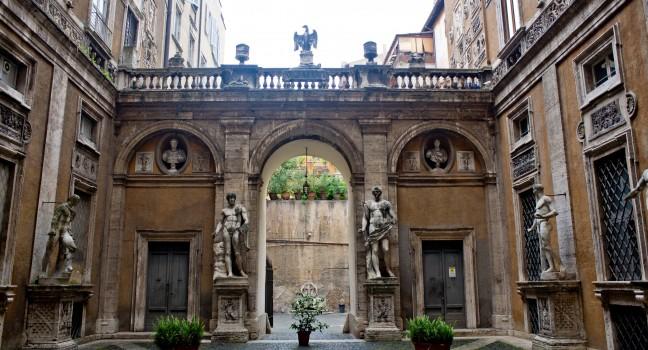
Graceful and opulent, the arcaded, multistory courtyard of this palazzo is a masterpiece of turn-of-the-17th-century style. Designed by Carlo Maderno, it is a veritable panoply of sculpted busts, heroic statues, sculpted reliefs, and Paleo-Christian epigrams, all collected by Marchese Asdrubale Mattei. Inside are various scholarly institutes, including the Centro Studi Americani (Center for American Studies), which also contains a library of American books. Salons in the palace (not usually open to visitors) are decorated with frescoes by Cortona, Lanfranco, and Domenichino.
Chiesa del Gesù
Campo de' Fiori
Share This
With an overall design by Vignola and a facade and dome by Della Porta, the first Jesuit church in Rome influenced the city’s ecclesiastical architecture for more than a century. Consecrated in 1584—after the Council of Trent (1545–63) solidified the determination of the Roman Catholic Church to push back against northern Europe's Reformed Protestants—Il Gesù also became the prototype for Counter-Reformation churches throughout not only Italy but also Europe and the Americas.
Although low lighting underplays the brilliance of everything, the inside of the church drips with gold and lapis lazuli, gold and precious marbles, and gold and more gold. The interior was initially left plain to the point of austerity; when it was finally fully embellished 100 years later, no expense was spared to inspire believers with pomp and majesty. The most striking element is the ceiling, where frescoes swirl down from on high and merge with painted stucco figures at the base. The artist Baciccia achieved extraordinary effects, especially over the nave in the Triumph of the Holy Name of Jesus. Here, the figures representing evil who are being cast out of heaven seem to hurtle down onto the observer.
The founder of the Jesuit order himself is buried in the Chapel of St. Ignatius, in the left-hand transept. This is surely one of the most sumptuous altars in Rome, though as is typical of Baroque decoration, which is renowned for its illusions, the enormous globe of lapis lazuli that crowns the altar is really only a shell of lapis over a stucco base. Note, too, architect Carlo Fontana’s heavy bronze altar rail, which is in keeping with the surrounding opulence.
Fontana delle Tartarughe
Jewish Ghetto
Share This
Designed by Giacomo della Porta in 1581 and sculpted by Taddeo Landini, this fountain, set in pretty Piazza Mattei, is one of Rome's most charming. Its focal point consists of four bronze boys, each grasping a dolphin spouting water into a marble shell. Bronze turtles just out of reach of the boys' hands drink from the upper basin. The turtles were added in the 17th century by Bernini.
Museo Napoleonico
Piazza Navona
Share This
Opulent, velvet-and-crystal salons in the Palazzo Primoli hauntingly capture the fragile charm of early-19th-century Rome and contain a specialized and rich collection of Napoléon memorabilia, including a bust by Canova of the general's sister, Pauline Borghese. You may well ask why this outpost of Napoléon is in Rome, but in 1798 the French emperor sent his troops to Rome, kidnapping Pope Pius VII and proclaiming his young son the King of Rome—though it all ultimately came to naught.
Oratorio dei Filippini
Piazza Navona
Share This
Housed in a Baroque masterwork by Borromini, this former religious residence named for Saint Philip Neri, founder in 1551 of the Congregation of the Oratorians, now contains Rome's Archivio Storico. Like the Jesuits, the Oratorians—or Filippini, as they were commonly known—were one of the religious orders established in the mid-16th century as part of the Counter-Reformation. Neri, a man of rare charm and wit, insisted that the members of the order—most of them young noblemen whom he had recruited personally—not only renounce their worldly goods, but also work as common laborers in the construction of Neri's great church of Santa Maria in Vallicella.
The Oratory itself, built between 1637 and 1662, has a gently curving facade that is typical of Borromini, who insisted on introducing movement into everything he designed. The inspiration here is that of arms extended in welcome to the poor. The building houses the Vallicelliana Library founded by Philip Neri, and the courtyard is usually accessible during the library's opening hours. Otherwise, guided visits, usually in the mornings, can be booked by email.
Palazzo Massimo alle Colonne
Piazza Navona
Share This
Following the shape of Emperor Domitian's Odeon arena, a curving, columned portico identifies this otherwise inconspicuous palace on a traffic-swept bend of Corso Vittorio Emanuele. In the 1530s, Renaissance architect Baldassare Peruzzi built this palace for the Massimo family, after their previous dwelling had been destroyed during the Sack of Rome. (High in the papal aristocracy, they claimed an ancestor who had been responsible for the defeat of Hannibal.)
If you visit on March 16, you'll be able to go upstairs to visit the family chapel in commemoration of a miracle performed here in 1583 by St. Philip Neri, who is said to have recalled a young member of the family, one Paolo Massimo, from the dead (expect a line). Any other day of the year, though, you'll only be able to view the private residence from the outside. The palazzo's name comes from the columns of the ancient Odeon; one is still visible in the square at the back of the palazzo.
Piazza Campo de' Fiori
Campo de' Fiori
Share This
A bustling marketplace in the morning (Monday through Saturday from 8 to 2) and a trendy meeting place the rest of the day and night, this piazza has plenty of down-to-earth charm. Just after lunchtime, all the fruit and vegetable vendors disappear, and this so-called piazza trasformista takes on another identity, becoming a circus of bars particularly favored by study-abroad students, tourists, and young expats. Brooding over the piazza is a hooded statue of the philosopher Giordano Bruno, who was burned at the stake here in 1600 for heresy, one of many victims of the Roman Inquisition.
Piazza di Pasquino
Piazza Navona
Share This
This tiny piazza takes its name from the figure in the corner, the remnant of an old Roman statue depicting Menelaus. The statue underwent a name change in the 16th century when Pasquino, a cobbler or barber (and part-time satirist), started writing comments around the base. The habit caught on; soon everyone was doing it. The most loquacious of Rome's "talking statues," its lack of arms or face is more than made up for with the modern-day commentary that is still anonymously posted on the wall behind the weathered figure.
Portico d'Ottavia
Jewish Ghetto
Share This
Looming over the Jewish Ghetto, this huge portico, with a few surviving columns, is one of the area's most picturesque set pieces, with the church of Sant'Angelo in Pescheria built right into its ruins. Named by Augustus in honor of his sister Octavia, it was originally 390 feet wide and 433 feet long; encompassed two temples, a meeting hall decorated with bronze statues, and a library; and served as a kind of grandiose entrance foyer for the adjacent Teatro di Marcello.
In the Middle Ages, the cool marble ruins of the portico became Rome's pescheria (fish market). A stone plaque on a pillar (it's a copy as the original is in the Musei Capitolini) states in Latin that the head of any fish surpassing the length of the plaque was to be cut off "up to the first fin" and given to the city fathers or else the vendor was to pay a fine of 10 gold florins. The heads, which were used to make fish soup, were considered a great delicacy.
San Giovanni Battista dei Fiorentini
Campo de' Fiori
Share This
Imbued with the supreme grace of the Renaissance, this often-overlooked church dedicated to Florence's patron saint, John the Baptist, stands in what was the heart of Rome's Florentine colony, where residents included the goldsmiths, bankers, and money changers who contributed to the building of the church. Talented goldsmith and sculptor Benvenuto Cellini of Florence, known for both his genius and his vindictive nature, lived nearby.
Although the church was designed by Sansovino, Raphael (yes, he was also an architect) was among those who competed for this commission. The interior is the perfect Renaissance space, one so harmonious that it seems to be a 3D Raphael painting. Borromini executed a splendid altar for the Falconieri family chapel in the choir. He's buried under the dome, despite the fact that those who committed suicide normally were refused a Christian burial.
Sant'Agnese in Agone
Piazza Navona
Share This
The quintessence of Baroque architecture, this church has a facade that is a wonderfully rich mélange of bell towers, concave spaces, and dovetailed stone and marble. It's the creation of Francesco Borromini (1599–1667), a contemporary and rival of Bernini. Next to his new Pamphilj family palace, Pope Innocent X had the adjacent chapel expanded into this full-fledged church. The work was first assigned to the architect Rainaldi. However, Donna Olimpia, the pope's famously domineering sister-in-law, became increasingly impatient with how the work was going and brought in Borromini, whose wonderful concave entrance has the magical effect of making the dome appear much larger than it actually is.
The name of this church comes from the Greek agones, the source of the word navona and a reference to the agonistic competitions held here in Roman times. The saint associated with the church is Agnes, who was martyred here in the piazza's forerunner, the Stadium of Domitian. As she was stripped nude before the crowd, her hair miraculously grew to maintain her modesty before she was killed. The interior is a marvel of modular Baroque space and is ornamented by giant marble reliefs sculpted by Raggi and Ferrata.
Sant'Andrea della Valle
Campo de' Fiori
Share This
Topped by the highest dome in Rome after St. Peter's (designed by Maderno), this imposing 17th-century church is remarkably balanced in design. Fortunately, its facade, which had turned a sooty gray from pollution, has been cleaned to a near-sparkling white. Use one of the handy mirrors to examine the early-17th-century frescoes by Domenichino in the choir vault and those by Lanfranco in the dome. One of the earliest ceilings done in full Baroque style, its upward vortex was influenced by Correggio's dome in Parma, of which Lanfranco was also a citizen. (Bring a few coins to light the paintings, which can be very dim.) The three massive paintings of St. Andrew's martyrdom are by Mattia Preti (1650–51). Richly marbled and decorated chapels flank the nave, and in such a space, Puccini set the first act of Tosca.
Sant'Ivo alla Sapienza
Piazza Navona
Share This
This eccentric Baroque church, probably Borromini's best, has one of Rome's most delightful "domes"—a dizzying spiral said to have been inspired by a bee's stinger. The apian symbol is a reminder that the church was commissioned by the Barberini pope Urban VIII (a swarm of bees figure on the Barberini family crest), although it was completed by Alexander VII. The interior, open only for two hours on Sunday morning, is worth a look, especially if you share Borromini's taste for complex mathematical architectural idiosyncrasies. "I didn't take up architecture solely to be a copyist," he once said. Sant'Ivo is certainly the proof.
Santa Maria della Pace
Piazza Navona
Share This
In 1656, Pietro da Cortona (1596–1669) was commissioned by Pope Alexander VII to enlarge the tiny Piazza della Pace in front of the 15th-century church of Santa Maria so that it could accommodate the carriages of its wealthy parishioners. His architectural solution was to design a new church facade complete with semicircular portico, demolish a few buildings here and there to create a more spacious approach, add arches to give architectural unity to the piazza, and then complete it with a series of bijou-size palaces. The result was one of Rome's most delightful little architectural set pieces.
Within are several great Renaissance treasures. Raphael's fresco above the first altar on your right depicts the Four Sibyls—almost exact replicas of Michelangelo's, if more relaxed. The fine decorations of the Cesi Chapel, second on the right, were designed in the mid-16th century by Sangallo. Opposite is Peruzzi's wonderful fresco of the Madonna and Child. The octagon below the dome is something of an art gallery in itself, with works by Cavalliere Arpino, Orazio Gentileschi, and others; Cozzo's Eternity fills the lantern above.
Behind the church is its cloister, designed by Bramante (architect of St. Peter's) as the very first expression of High Renaissance style in Rome. In addition to an exhibit space for contemporary art, the cloister has a lovely coffee bar.
Santa Maria in Vallicella/Chiesa Nuova
Piazza Navona
Share This
This church, sometimes known as Chiesa Nuova (New Church), is most famous for its three magnificent altarpieces by Rubens. It was built toward the end of the 16th century at the urging of Philip Neri and, like Il Gesù, is a product of the fervor of the Counter-Reformation. It has a sturdy Baroque interior, all white and gold, with ceiling frescoes by Pietro da Cortona depicting a miracle reputed to have occurred during the church's construction: the Virgin and strong-armed angels hold up the broken roof to prevent it from crashing down upon the congregation. Note that the church closes daily from 12 pm--5 pm.
Teatro di Marcello
Jewish Ghetto
Share This
Begun by Julius Caesar and completed by the emperor Augustus in 13 BC, this theater could house around 14,000 spectators. Like other ancient monuments, it was transformed into a fortress during the Middle Ages. During the Renaissance, it was converted into a residence by the Savelli, one of the city's noble families. Today, only the archaeological park around the theater is open to the public, with its picturesque walkway that curves past the ruins and links to the Portico d'Ottavia. In summer, the small park becomes a magical venue for open-air classical music concerts.
Subscribe to Newsletter
Sign up for Travel Tips & News
I want emails from Fodor's Travel with travel information and promotions. I can unsubscribe
any time using the unsubscribe link at the end of all emails.
Thank you for your interest!
Look out for our newsletters with travel tips and special offers.
Sign up for Travel Tips & News
By signing up for the
newsletter, I agree to the Privacy Policy. You must check the box to subscribe
Thank you for your interest!
Look out for our newsletters with travel tips and special offers.