


Santa Maria della Vittoria
Get FREE email communications from Fodor's Travel, covering must-see travel destinations, expert trip planning advice, and travel inspiration to fuel your passion.

We've compiled the best of the best in Repubblica and Quirinale - browse our top choices for the top things to see or do during your stay.
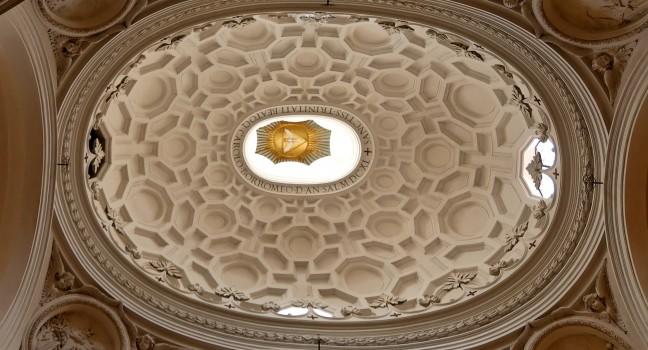
Sometimes known as San Carlino because of its tiny size, this is one of Borromini's masterpieces. In a space no larger than the base of one of the piers of St. Peter's Basilica, he created a church that is an intricate exercise in geometric perfection, with a coffered dome that seems to float above the curves of the walls. Borromini's work is often bizarre, definitely intellectual, and intensely concerned with pure form. In San Carlo, he invented an original treatment of space that creates an effect of rippling movement, especially evident in the double-S curves of the facade. Characteristically, the interior decoration is subdued, in white stucco with no more than a few touches of gilding, so as not to distract from the form. Don't miss the cloister: a tiny, understated Baroque jewel, with a graceful portico and loggia above, echoing the lines of the church.
When Pope Sixtus V (Felice Peretti) completed the restoration of the Acqua Felice aqueduct toward the end of the 16th century, Domenico Fontana was commissioned to design its monumental fountain. Sculptors Leonardo Sormani and Prospero da Brescia had the unhappy task of executing the central figure of Moses; the comparison with Michelangelo's magnificent Moses in the church of San Pietro in Vincoli was inevitable, and the giant sculpture was widely criticized. But the new fountain served to position the formerly rustic Quirinale neighborhood as a thriving urban center.
The upper shell and inscription of this fountain, which is decorated with the famous heraldic bees of the Barberini family, are from a fountain that Bernini designed for Pope Urban VIII; the rest was lost when the fountain was moved to make way for a new street. The inscription caused considerable uproar when the fountain was first built in 1644. It said that the fountain had been erected in the 22nd year of the pontiff's reign, although, in fact, the 21st anniversary of Urban's election to the papacy was still some weeks away. The last numeral was hurriedly erased, but to no avail—Urban died eight days before the beginning of his 22nd year as pope. The superstitious Romans, who had regarded the inscription as a foolhardy tempting of fate, were vindicated.
This strategic location atop the Quirinale has long been important. Indeed, it served as home of the Sabines in the 7th century BC—when they were deadly enemies of the Romans, who lived on the Campidoglio and Palatino (all of 1 km [½ mile] away). Today, it's the foreground for the presidential residence, Palazzo del Quirinale, and home to the Palazzo della Consulta, where Italy's Constitutional Court sits.
The open side of the piazza has a vista over the rooftops and domes of central Rome and St. Peter's. The Fontana di Montecavallo, or Fontana dei Dioscuri, has a statuary group of Dioscuri trying to tame two massive marble steeds that was found in the Baths of Constantine, which once occupied part of the Quirinale's summit. Unlike many ancient statues in Rome, this group survived the Dark Ages intact, becoming one of the city's great sights during the Middle Ages. The obelisk next to the figures is from the Mausoleo di Augusto (Tomb of Augustus) and was put here by Pope Pius VI in the late 18th century.
Often the first view that spells "Rome" to weary travelers walking from Termini station, this round piazza was laid out in the late 1800s and follows the line of the caldarium of the vast ancient public baths, the Terme di Diocleziano. At its center, the exuberant Fontana delle Naiadi (Fountain of the Naiads) teems with voluptuous bronze ladies happily wrestling with marine monsters. The nudes weren't there when the pope unveiled the fountain in 1888—sparing him any embarrassment—but when the figures were added in 1901, they caused a scandal. It's said that the sculptor, Mario Rutelli, modeled them on the ample figures of two musical-comedy stars of the day. The colonnades now house the luxe hotel Anantara Palazzo Naiadi and various shops and caffès.
This intersection takes its name from its four Baroque fountains, which represent the Tiber (on the San Carlo corner), the Arno, Juno, and Diana. Despite the nearby traffic and the tightness of the sidewalk, it's worth taking in the views in all four directions from this point: to the southwest, as far as the obelisk in Piazza del Quirinale; to the northeast, along Via XX Settembre to the Porta Pia; to the northwest, across Piazza Barberini to the obelisk of Trinità dei Monti; and to the southeast, as far as the obelisk and apse of Santa Maria Maggiore. The prospect is a highlight of Pope Sixtus V's campaign of urban beautification and an example of Baroque influence on city planning.
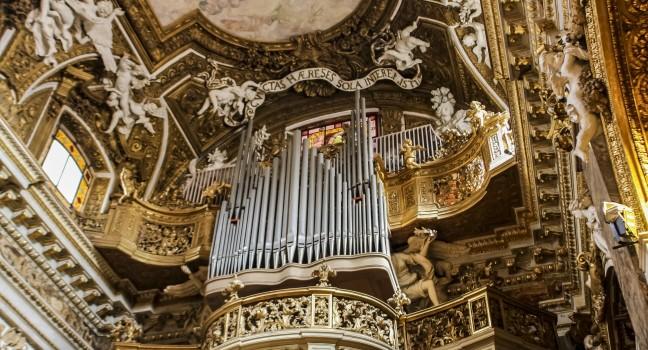
Designed by Bernini, this small church is one of the triumphs of the Roman Baroque period. His son wrote that Bernini considered it his best work and that he used to come here occasionally, just to sit and contemplate. Bernini's simple oval plan, a classic form in Baroque architecture, is given drama and movement by the decoration, which depicts St. Andrew's martyrdom and ascension into heaven and starts with the painting over the high altar, up past the figure of the saint above, to the angels at the base of the lantern and the dove of the Holy Spirit that awaits on high.
The curving brick facade on the northeast side of Piazza della Repubblica is one small remnant of the colossal Terme di Diocleziano, the largest and most impressive of the baths of ancient Rome. A gift to the city from Emperor Diocletian, the complex was completed in AD 306. In 1561 Michelangelo was commissioned to convert the vast frigidarium, the central hall of the baths, into a church. His work was later altered by Vanvitelli in the 18th century, but the huge transept, which formed the nave in Michelangelo's plan, has remained. The eight enormous monolithic columns of red granite that support the great beams are the original columns of the tepidarium, 45 feet high and more than 5 feet in diameter. The great hall is 92 feet high.
This small, verdant park across the street from the Piazza del Quirinale is a good spot to stop and take a break. In the center sits an equestrian statue of King Carlo Alberto, the king of Piedmont-Sardinia during the turbulent period of the Reunification of Italy. There are benches to sit and kids often play on the grass. If you happen to be in the area at sunset, cross the street to see the spectacular sunset over Piazza del Quirinale and the rooftops of Rome.


