5 Best Sights in Canal Rings, Amsterdam

Background Illustration for Sights

We've compiled the best of the best in Canal Rings - browse our top choices for the top things to see or do during your stay.

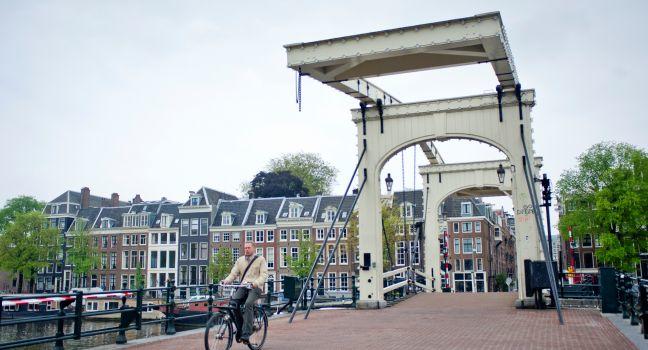
Magere Brug

Fodor's Choice
Bridge, Magere Brug, Amsterdam, Holland
© Zach Nelson / Fodors Travel

Of Amsterdam's 60-plus drawbridges, this is the most famous, and it provides gorgeous views of the Amstel and surrounding area. It's said to have been first built in the 1660s, around the time of the construction of the Eastern Canal Ring. While there are many theories about the origins of its name, the most colorful tells a tale of two sisters living on opposite sides of the Amstel who wanted an efficient way of sharing that grandest of Dutch traditions: the gezellige (socially cozy) midmorning coffee break. Whether "mager" referred to their surname, slim physiques, or possibly even their miserliness, we'll never know. Walk by at night when it's spectacularly lighted. Many replacements to the narrow original bridge have come and gone; the current one dates from 1931 but bears a close resemblance to the 19th-century design.

Between Kerkstraat and Nieuwe Kerkstraat, 1018 EK, Netherlands

Something incorrect in this review?

Westerkerk

Fodor's Choice

Built between 1620 and 1631 by Hendrick de Keyser, the Dutch Renaissance-style Westerkerk was the largest Protestant church in the world until St. Paul's Cathedral in London was built in 1675. The Westerkerk's 85-meter-tall Ouwe Wester, still the tallest church tower in the city, is topped by a bright blue copy of the crown of the Habsburg emperor Maximilian I, who gave Amsterdam the right to use his royal insignia in 1489 in gratitude for support given to the Austro-Burgundian princes.

The church is renowned for its organ and carillon (there are regular lunchtime concerts from March through September). The carillon is played every Tuesday at noon by a real person (a carillonneur) but is automated at other times with different songs tinkling out on the quarter hour, day and night. Anne Frank described the tunes in her diary. Rembrandt, who lived on Rozengracht during his poverty-stricken last years, and his son, Titus, are buried (somewhere) here. The Westertoren (Westerkerk Tower) is a fun climb from April to the end of October, though it's closed for renovations until 2025. 

Prinsengracht 281, 1016 GW, Netherlands
020-624–7766
Sight Details
Interior free
Closed Sat. Oct.–Mar. and Sun. all yr (open for church services only)

Something incorrect in this review?

Homomonument

The world's first memorial to persecuted gays and lesbians was designed by Karin Daan and unveiled here in 1987. Three huge triangles of pinkish granite—representing past, present, and future—form a larger triangle. On May 4 (Remembrance Day), there are services here commemorating all homosexual victims in history, with an emphasis on the victims of World War II, when thousands were killed (the 50,000 sentenced were all forced to wear pink triangles stitched to their clothing). Flowers are laid daily for lost friends, especially on the descending triangle that forms a dock of sorts into Keizersgracht. The points of the triangles point to the Anne Frank House, the National Monument on Dam Square, and the COC Center, the gay-and-lesbian organization founded in 1946 (discreetly called the Center of Culture and Leisure Activities). Near the Homomonument is the kiosk housing Pink Point, the best source of information on gay and lesbian Amsterdam.

Westermarkt, 1016 GW, Netherlands
062-474–3350
Sight Details
Free

Something incorrect in this review?

Recommended Fodor's Video

Munttoren

This tower received its current name in 1672, when French troops occupied much of the surrounding republic, and Amsterdam was given the right to mint its own coins here for a brief one-year period. The spire was added by Hendrick de Keyser in 1620, and the weather vane on top in the shape of a gilded ox is a reference to the calves market close by: Kalverstraat. The guardhouse, which now houses a rather touristy Dutch porcelain shop, has a gable stone above its entrance that portrays two men and a dog in a boat. This is a symbolic representation of the city, in which warrior and merchant are bound together by loyalty—that would be the dog—and sailing toward the future.

Muntplein, 1012 WR, Netherlands
Sight Details
Free

Something incorrect in this review?

Stadsarchief Amsterdam

Established in 1848, the city's archives comprise millions of maps, drawings, prints, books, photographs, and film about Amsterdam: there are a staggering 50 km (30 miles) worth, making it the largest municipal archive in the world. Highlights—300 of the "most attractive, unusual, valuable, and moving" items—are on permanent display in the Treasury, former bank vaults that look like the tomb of an Egyptian pharaoh. The epic checkerboard building, completed in 1926 and named in honor of its theosophist architect Karel de Bazel, is also fascinating and infused with its creator's religious beliefs. In theosophy, a building is an art form that can express a higher message using mathematical principles to achieve total harmony. Have deep thoughts over lunch in the café or browse the excellent on-site bookstore, which sells just about every available Amsterdam-relevant publication. Special exhibitions are usually also excellent.

Vijzelstraat 32, 1017 HL, Netherlands
020-251–1511
Sight Details
Free, special exhibitions €10
Closed Mon. and weekend mornings

Something incorrect in this review?