46 Best Sights in New York City, New York

Background Illustration for Sights

We've compiled the best of the best in New York City - browse our top choices for the top things to see or do during your stay.

Bryant Park

Midtown West Fodor's Choice
NEW YORK, USA - MAY 16: People enjoying a nice day in Bryant Park on May 16, 2013 in New York City, NY. Bryant Park is a 9,603 acre privately managed park in the center of Manhattan.
(c) Friday | Dreamstime.com

This lovely green space spread out among landmarks and skyscrapers is one of Manhattan's most popular parks. Tall London plane trees line the perimeter of the sunny central lawn, overlooking stone terraces, flower beds, and snack kiosks. The garden tables scattered about fill with lunching office workers and folks enjoying the park's free Wi-Fi. In summer, there are free readings, live jazz, and "Broadway in Bryant Park" musical theater performances. Most popular of all is the summer film festival: locals leave work early to snag a spot on the lawn for the outdoor screenings each Monday at dusk.

At the east side of the park, near a bronze cast of Gertrude Stein, is the stylish Bryant Park Grill, which has a rooftop garden, and the adjacent open-air Bryant Park Café, open seasonally. On the south side of the park is an old-fashioned carousel ($4) where kids can also attend storytellings and magic shows. Come late October, the park rolls out the artificial frozen "pond" (October–March, daily 8 am–10 pm) for free ice-skating (bring your own padlock for the lockers; skate rental starts at $18). Surrounding the ice rink are the Christmas-market stalls of the holiday shops, selling handcrafted goods and local foods.

Central Park

Upper West Side Fodor's Choice
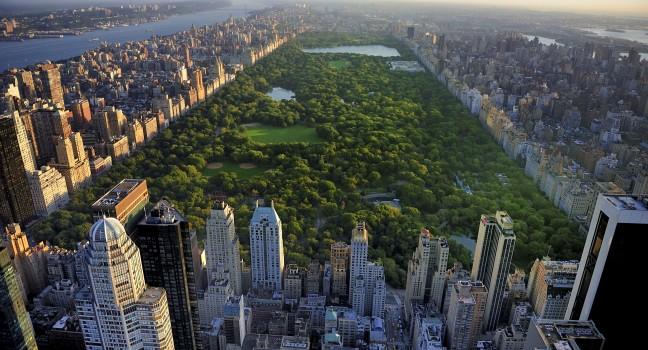
Central Park aerial view, Manhattan, New York; Park is surrounded by skyscraper.
T photography / Shutterstock

Central Park's creators, landscape architects Frederick Law Olmsted and Calvert Vaux, had a simple goal when they submitted their plan in 1858: to design a place where city dwellers could go to forget the city. Even though New York eventually grew far taller than the trees planted to hide it, the park has always been an urbanized Eden that gives residents and visitors alike a bite of the apple. Indeed, without Central Park's 843 acres of meandering paths, tranquil lakes, ponds, and open meadows, New Yorkers (especially Manhattanites) might be a lot less sane. Olmsted and Vaux also designed Brooklyn's Prospect Park and the grounds of the White House.

The busy southern section of Central Park, from 59th to 72nd Street, is where most people get their first impression. But no matter how many people congregate around here, you can always find a spot to picnic, ponder, or just take in the foliage, even on a sunny weekend day. In the southern corner is the Hallett Nature Sanctuary, one of the park's lesser-known areas. The nature sanctuary is a 4-acre patch of wilderness—one of the park’s three woodlands—and is home to native flora and fauna and rustic trails that lead to quiet overlooks; it's also a popular birding spot. Playgrounds, lawns, jogging and biking paths, and striking buildings populate the midsection of the park, from 72nd Street to the reservoir. You can soak up the sun, take in the public art, take pictures at Bethesda Fountain, visit the penguins at the Central Park Zoo, or join the runners huffing counterclockwise on the dirt track that surrounds the reservoir. North of the reservoir and up to 110th Street, Central Park is less crowded and feels more rugged. In 2025, the Central Park Conservancy completed a revitalization of the area around the Harlem Meer (a man-made lake) at the north end of the park to add a full-scale ice rink, an additional new skating experience on the meer, a larger-than-Olympic-size pool, and revamp the parkland around it. The new facility is called the Davis Center at the Harlem Meer (formerly the Lasker Rink and Pool site). To find out about park events and year-round walking tours, check the website of the Central Park Conservancy ( www.centralparknyc.org).

If you're taking the subway to the park's southernmost parts, the stops at either Columbus Circle (southwest corner) or 5th Avenue–59th Street (southeast corner) are handy. If headed for points north, the A, B, C, and D subway lines travel along Central Park West (beware of local versus express stops); the 4, 5, and 6 lines travel along Lexington Avenue, three blocks east of 5th Avenue and the park.

There are many paved pedestrian entrances into the park from 5th Avenue, Central Park North (110th Street), Central Park West, and Central Park South (59th Street). Four roads, or transverses, for cars and city buses cut through the park from east to west—66th, 79th, 86th, and 96th Streets. The East and West drives are both along the north–south axis; Center Drive enters the south edge of the park at 6th Avenue and connects with East Drive around 66th Street. Cars are no longer allowed on the drives, which are exclusively for pedestrians, cyclists, and horse-drawn carriages. Along the main loop, lampposts are marked with location codes that include a letter—always "E" (for east) or "W" (for west)—followed by numbers, the first two of which tell you the nearest cross street. For example, E7803 means you're near 78th Street; above 99, the initial "1" is omitted, so W0401 is near West 104th Street. Download the Central Park Conservancy's free app for a GPS-enabled map to help you navigate the park. The app also includes an audio guide, self-guided tours, and current events in the park, as well as a new interactive Cherry Blossom Tracker Map to help visitors and locals track when and where the flowers will peak in the park in spring.

If you haven't packed a picnic and you want a snack, you can usually find one of those rather tired-looking food carts selling hot dogs, pretzels, and ice-cream sandwiches. Specialty food carts are often around, too, mostly in the park's southern half, especially when there are concerts or other major events—your taste buds will thank you. Other reliable options include the café next to the Boathouse Restaurant (midpark at 74th Street), or a branch of Le Pain Quotidien (midpark at 69th Street). Both serve sandwiches, soups, pastries, and other satisfying on-the-go grub (and Le Pain also has free Wi-Fi). For something a little more elegant, you can stop for brunch, lunch, or dinner at the Tavern on the Green.

As part of a park-wide restoration project named Plan for Play, all 21 playgrounds have undergone (or are still scheduled to receive) updates. Most have seen renovations to play structures, plus other improvements that will ensure each one's structural stability and ongoing maintenance for years to come.

The High Line

Chelsea Fodor's Choice
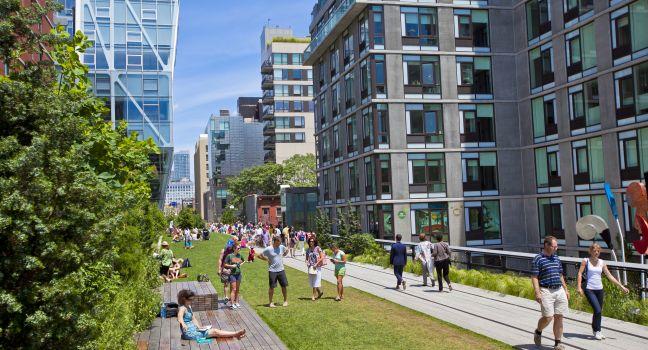
NEW YORK CITY - JUN 3: High Line Park in NYC seen on June 3rd, 2012.The High Line is a public park built on an historic freight rail line elevated above the streets on Manhattans West Side.; Shutterstock ID 105076949; Project/Title: Summer Plans for Kids;
Stuart Monk/Shutterstock

Once a railroad track carrying freight trains, this elevated space has been transformed into one of the city’s top attractions—a 1½-mile landscaped “walking park,” with curving walkways, picnic tables and benches, public art installations, and views of the Hudson River and the Manhattan skyline. Running from Gansevoort Street in the Meatpacking District (at the Whitney Museum of American Art) to West 34th Street and Hudson Yards, the High Line somehow manages to host about 5 million visitors a year and still feel like a wonderful retreat. That said, the crowds can seem overwhelming when the weather is nice, so visit as early in the morning as possible and avoid the lunchtime and weekend mass of humanity.

One of the main draws of the High Line is the landscaping, which is both wild and cultivated at the same time, and dotted with public art. Chelsea Market Passage, between 15th and 16th Streets, is accented with Spencer Finch’s stained-glass art and is home to public art displays, video programs, music performances, and sit-down events. A feature that illustrates the High Line’s greatest achievement—the ability to see the city with fresh eyes—is the 10th Avenue Square (between 16th and 17th Streets). This viewing window with stadium seating and large picture windows frames the city below as art, encouraging viewers to linger.

To fully appreciate the High Line, walk a length in one direction (preferably from Gansevoort Street uptown so that you can end with panoramic city and river views) and then make the return journey at street level, taking in the Chelsea neighborhood below. Nearby Chelsea Market and Market 57 are convenient places to pick up fixings for a picnic lunch.

Recommended Fodor's Video

Prospect Park

Prospect Park Fodor's Choice
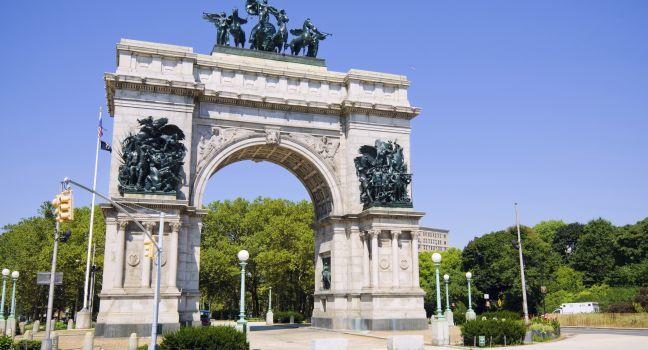
Soldiers' and Sailors' Arch at Grand Army Plaza in Brooklyn, dedicated on October 21, 1892 with an inscription that reads "To the Defenders of the Union, 1861-1865."
gregobagel/iStockphoto

Brooklyn residents are passionate about Prospect Park, and with good reason: lush green spaces, gently curved walkways, summer concerts, vivid foliage in autumn, and an all-season skating rink make it a year-round getaway. In 1859, the New York Legislature decided to develop plans for a park in the fast-growing city of Brooklyn. After landscape architects Frederick Law Olmsted and Calvert Vaux completed the park in the late 1880s, Olmsted remarked that he was prouder of it than any of his other works—including Manhattan's Central Park—and many critics agree. On weekends, those not jogging the 3.35-mile loop gravitate to the rolling hills of the Long Meadow to picnic, fly kites, or play cricket, flag football, or Frisbee. On summer Sundays, foodies flock to Breeze Hill, site of outdoor food market Smorgasburg's second Brooklyn location. The park's north entrance is at Grand Army Plaza, where the Soldiers' and Sailors' Memorial Arch (patterned on the Arc de Triomphe in Paris) honors Civil War veterans. On Saturday, year-round, a greenmarket at the plaza throngs with shoppers.

\n

A good way to experience the park is to walk the Long Meadow—venue for the occasional free yoga class—and then head to the eastern side and south towards the lake. Along the way, you'll encounter attractions including a few waterfalls, the Prospect Park Zoo, and the Lefferts Historic House. Nearby, the Prospect Park Carousel, built in 1912, still thrills the kids. The Boathouse, dating from 1905, is a stunning example of Beaux-Arts architecture, and houses a cafe and the Prospect Park Audubon Center. The annual Celebrate Brooklyn! Festival takes place at the Prospect Park Bandshell from early June through mid-August.

Union Square Park and Greenmarket

Fodor's Choice
NEW YORK CITY - APR. 20: Woman selects produce at Union Square Greenmarket in NYC on Apr 20, 2012. This world famous farmers' market began in 1976 and has grown to 140 farmers during peak season.; Shutterstock ID 100566316; Project/Title: Weekend Getaways;
littleny/Shutterstock

A park, farmers' market, meeting place, and the site of rallies and demonstrations, this pocket of green space and surrounding public square sit in the center of a bustling residential and commercial neighborhood. The name "Union" originally signified that two main roads—Broadway and 4th Avenue—crossed here. It took on a different meaning in the late 19th and early 20th centuries, when the square became a rallying spot for labor protests; many unions, as well as fringe political parties, moved their headquarters nearby.

Union Square is at its best on Monday, Wednesday, Friday, and Saturday (8–6), when the largest of the city's greenmarkets draws farmers and food purveyors from the tristate area selling fruit and vegetables, plants, fresh-baked pies and breads, cheeses, cider, fish, and meat. Between Thanksgiving and Christmas, artisans sell gift items and food at the large Union Square Holiday Market ( www.usqholiday.nyc).

New York University dormitories, theaters, and cavernous commercial spaces occupy the restored 19th-century commercial buildings that surround the park, along with some chain stores and restaurants. Statues in the park include those of George Washington, Abraham Lincoln, Mahatma Gandhi (often wreathed in flowers), and the Marquis de Lafayette (sculpted by Frédéric-Auguste Bartholdi, designer of the Statue of Liberty).

Washington Square Park

Greenwich Village Fodor's Choice
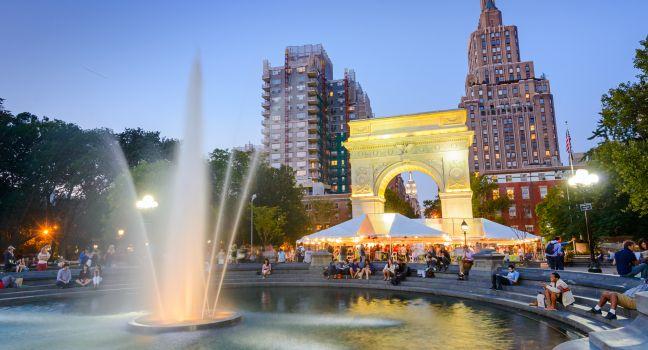
NEW YORK CITY - SEPTEMBER 12, 2012: Crowds gather at Washington Square Park. The historic park is popular in the summer.
(c) Sepavo | Dreamstime.com

NYU students, street musicians, skateboarders, chess players, and those just watching the grand opera of it all generate a maelstrom of activity in this physical and spiritual heart of Greenwich Village. The 9¾-acre park with its gorgeous central fountain had inauspicious beginnings as a cemetery, principally for yellow-fever victims—an estimated 10,000–22,000 bodies lie below (a headstone was even unearthed in 2009). In the early 1800s, the park was a parade ground and the site of public executions; the notorious Hanging Elm still stands at the northwest corner of the square. 

The triumphal European-style Washington Arch at the square's northern flank marks the start of 5th Avenue. The original wood-and-papier-mâché arch, situated a half block north, was erected in 1889 to commemorate the 100th anniversary of George Washington's presidential inauguration. The arch was reproduced in Tuckahoe marble in 1892, and the statues—Washington as General Accompanied by Fame and Valor on one side, and Washington as Statesman Accompanied by Wisdom and Justice on the other—were added in 1916 and 1918, respectively.

5th Ave. between Waverly Pl. and 4th St., New York, NY, 10003, USA

Something incorrect in this review?

Brooklyn Bridge Park

DUMBO Fodor's Choice

This sprawling, 85-acre industrial-turned-recreational riverside park stretches from the Manhattan Bridge in DUMBO, under the Brooklyn Bridge, and all the way south to Pier 6 at the end of Atlantic Avenue. It's a gathering spot for tourists and Brooklynites alike, who come to picnic or watch movies on the lawn in the summer, play various sports on its many courts and playing fields, or simply stroll the promenade and gawk at the most postcard perfect view of the downtown Manhattan skyline—especially at sunset. The DUMBO section has a playground and a small pebble beach, plus the wonderfully restored Jane’s Carousel ( janescarousel.com).

Fort Tryon Park

Inwood Fodor's Choice

Come to Fort Tryon Park to visit the Met Museum's medieval branch, the Cloisters, and stay for the glorious Hudson River views, the gorgeous landscaped gardens, the 8 miles of winding pathways, and the Revolutionary War history. Perched on one of the highest points in Manhattan (hence "the Heights,") the 67-acre oasis was designed by Frederick Law Olmsted Jr. and gifted to New York City in 1935 by John D. Rockefeller Jr., and today its more than 650 varieties of plants, trees, and shrubs are the gifts that keep on giving with every season. During the Revolutionary War, the area was part of the Battle of Fort Washington, a seminal Continental army defeat in the American Revolution. While the Continental Army ultimately prevailed, the site originally named for the last British governor of colonial New York, William Tryon, continued to be referred to as Fort Tryon. Look for the monument to Margaret Corbin, a woman who took up her husband's canon when he was shot and killed during battle: “On this hilltop stood Fort Tryon, the northern outwork of Fort Washington, its gallant defense against the Hessian troops by the Maryland and Virginia regiment 16-November-1776 was shared by Margaret Corbin, the first American woman to take a soldier’s part in the war for liberty.” Other highlights include the Billings Arcade, the remains of a stunning arched entrance to a grand mansion (you've likely seen this on Instagram), and the Heather Garden, where locals welcome spring with parading bagpipes and heather shearings. Don't miss the gatehouse on your way into the park with the apt sign "NYC's coolest office."

Grand Ferry Park

Fodor's Choice
Hipsters, Hasidic Jews, and others hang out at this small waterfront park named for the ferry that for a century connected Williamsburg to Manhattan. The views of Manhattan and the Williamsburg Bridge are sublime anytime. Sand covers the ground in summer, and if you sit on a bench near the waves that crash against the rocks, you can almost pretend you're at the beach. Check out the inscription on the redbrick smokestack, which figured in the development of penicillin.

Hudson River Park

TriBeCa Fodor's Choice

The quiet green spaces of New York City are treasured by locals, and one of the best is Hudson River Park, a 5-mile path from Battery Place to 59th Street. This riverside stretch, incorporating the piers that jut out into the Hudson, has been renovated into a landscaped park with walking and cycling paths, a seasonal minigolf course, dog runs, and skate parks. The TriBeCa portion consists of Piers 25 and 26, and has picnic spaces, playgrounds, a sand volleyball court, and an educational river-ecology area. The areas adjacent to the West Village (Piers 45 and 46) and near Chelsea (Piers 63 and 64) are equally attractive, with lots of spots for leisure and recreation. To the north, beginning at 72nd Street, is Riverside Park.

Little Island

Meatpacking District Fodor's Choice

Much like the High Line when it opened, Little Island was an instant hit with locals and visitors when the gates to this man-made isle in the middle of the Hudson River first swung open in May 2021. The 2.4-acre park is elevated on 132 tulip-looking concrete stilts and connected to Manhattan by two footbridges. Funded mostly by Barry Diller and Diane von Fürstenberg, the island park and its rolling stair-clad hills make for a fun wander. It also provides stunning views of the Manhattan skyline. There's a small outdoor food court and an ambient amphitheater for free concerts.

Louis Valentino, Jr. Park and Pier

Red Hook Fodor's Choice
This small pier and park, named for a fallen firefighter, has awe-inspiring views of the Statue of Liberty and across the Hudson. You won't need prompting to take pictures. There are a few benches for relaxing.

Riverside Park

Upper West Side Fodor's Choice

This expansive green space runs alongside the Hudson River—hence its name—and offers a welcome dose of tranquility from 72nd to 158th Street, as does the park's south extension, from about 59th to 72nd Street. Walking and biking paths dot the entire park, among them the broad Promenade between 83rd and 96th Streets. The park's original sections were designed by Frederick Law Olmsted and Calvert Vaux of Central Park fame and laid out between 1873 and 1888. Riverside Park also includes the soaring white marble Soldiers' and Sailors' Monument (at 89th Street), dedicated to New Yorkers who served in the Civil War, and the Warsaw Ghetto Memorial Plaza (at 80th Street), dedicated in 1947. The 79th Street Marina, with its café, visiting yachts, and permanently moored houseboats, is closed for renovations to make the marina climate resilient and expand access for boaters.

Shore Park and Parkway

Fodor's Choice
This narrow park follows the Bay Ridge waterfront and has spectacular views of the Verrazano-Narrows Bridge and the ships in New York Harbor. The promenade is perfect for a long walk or a bike ride. At the north end is the American Veterans Memorial Pier, where the NYC Ferry docks. The pier is also home to Brooklyn’s official monument honoring those lost on 9/11.

Sunset Park

Fodor's Choice
The neighborhood’s namesake park offers fabulous views of New York Harbor and the Lower Manhattan skyline from one of Brooklyn’s highest hills. Stretching three blocks between 5th and 7th avenues, the green space has a seasonal public swimming pool, playgrounds, and multiple ball courts. Head to the park at sunset to see why it’s worthy of its name.

Tompkins Square Park

East Village Fodor's Choice

This leafy park is a favorite spot, year-round, for the neighborhood locals who lunch on the benches, picnic in the central green spaces, and put on impromptu jazz concerts. There's a year-round farmers' market by the southwest corner on Sunday, and an annual Halloween dog-costume event. It wasn't always so rosy in the park, though: in 1988, police followed then-mayor Ed Koch's orders to evict the many homeless people who had set up makeshift shelters here, and homeless rights and anti-gentrification activists fought back with sticks and bottles. The park was reclaimed and reopened in 1992 with a midnight curfew, still in effect today.

WNYC Transmitter Park

Greenpoint Fodor's Choice
Greenpoint residents of all ages head to this waterfront park to soak up the sun and stunning views of the Midtown skyline. From the manicured lawn and the benches on the esplanade, the Chrysler Building and the Empire State Building seem just a stone’s throw away. Formerly the site of WNYC radio's transmission towers, this pristine public space opened in 2012, part of the city's ongoing project to redevelop waterfront property throughout the five boroughs.

Flushing Meadows Corona Park

Flushing
Unisphere globe in Flushing Meadows Corona Park in Queens New York at sunset.
Paul Hakimata Photography / Shutterstock

The gleaming Unisphere (an enormous, 140-foot-high, steel globe) might tip you off that this 898-acre park, which is the largest in the borough, was the site of two World's Fairs. Take advantage of the park's barbecue pits, seasonal boat and kayak rentals, sports fields, and cultural festivals, but don't forget the art museum, science hall, zoo, theater, carousel, indoor pool, ice-skating rink, pitch-and-putt and mini-golf courses, and model-airplane field. Set aside a day to hit a few primary spots: several are clustered together on the park's northwest side, but reaching others will require long (though peaceful) walks.

The outdoor Queens Night Market ( www.queensnightmarket.com) is held Saturday evening, late April through October, near the New York Hall of Science. It's reminiscent of Asia's popular food markets and generally has about 100 vendors serving flavorful, often-adventurous global fare.

The flat grounds are ideal for family biking; bike rentals are available at two locations from March to early November.

The park is open from 6 am to 9 pm, 365 days a year (as in most city parks, exercise caution when visiting outside daytime hours).

Bowling Green

Financial District

The small plaza that is Bowling Green, at the foot of Broadway, became New York's first public park in 1733. Legend has it that before that, this was the site upon which Peter Minuit purchased the island of Manhattan from the Indigenous Lenape people, in 1626, supposedly for what amounted to 24 U.S. dollars. On July 9, 1776, a few hours after citizens learned about the signing of the Declaration of Independence, rioters toppled a statue of British king George III that had occupied the spot for 11 years; much of the statue's lead was melted down into bullets. In 1783, when the occupying British forces fled the city, they defiantly hoisted a Union Jack on a greased, uncleated flagpole so it couldn't be lowered; but patriot John Van Arsdale drove his own cleats into the pole to replace it with the Stars and Stripes. The copper-top subway entrance across State Street is the original one, built in 1904–05. Many know Bowling Green as the home of Arturo Di Modica's 7,000-pound, bronze Charging Bull statue (1989); look for it on the northern tip of the park.

Bush Terminal Park

The opening of this park in 2014 marked a major milestone in the effort to reclaim Sunset Park's formerly industrial waterfront. Once part of the Bush Terminal port complex, the 11-acre public green space has soccer and baseball fields, as well as a nature preserve containing saltwater tidal pools. The preserve's restored wetlands are helping to purify the nearby aquatic habitat. Enter the park at 43rd Street and 1st Avenue and walk past several industrial buildings to get to the park gates. The waterfront esplanade has sweeping views of New York Harbor, including the Statue of Liberty and the Manhattan skyline.
Marginal St., Brooklyn, NY, 11232, USA
888-697–2757
Sight Details
Oct., daily 8–5; Nov.–Feb., daily 8–4; Mar. and Apr., daily 8–5; May–Sept., daily 8–8

Something incorrect in this review?

Bushwick Inlet Park

A $30 million investment turned a former parking lot into this lush green space adjacent to East River State Park. Part of a major revitalization project aimed at the Williamsburg and Greenpoint waterfront, the renovation added a sloped pavilion leading up to a public promenade, a playground, an athletic field, and an environmentally sophisticated building (with restrooms) for community activities. The views are expansive, taking in everything from the Williamsburg Bridge to the Empire State Building.

Carl Schurz Park

Upper East Side

Named for a German immigrant who was a prominent statesman and newspaper editor in the 19th century, this 14.9-acre park is so tranquil that you'd never guess you're directly above the FDR Drive. Walk along the esplanade and soak up views of the East River and Roosevelt Island across the way. To the north is Randalls (which is conjoined with Wards Island on the east side) and the Robert F. Kennedy Bridge (formerly the Triborough Bridge)—while the sights of locals pushing strollers, riding bikes, or walking their dogs surround visitors. Within the park is a Federal-style, wood-frame house that belies the grandeur of its name: Gracie Mansion, the official residence of the city's mayor. It was built in the 18th century.

Central Park Conservancy: Dairy Visitor Center

Central Park

The Dairy (midpark at 65th Street) is one of five visitor centers in the park. The others include Belvedere Castle (midpark at 79th Street), the Chess & Checkers House (midpark at 64th Street), the Charles A. Dana Discovery Center (at the top northeast corner of the park at 110th Street, on the shore of Harlem Meer), and the Columbus Circle Information Kiosk (southwest corner of the park at West 59th Street). All have directions, park maps, event calendars, and volunteers who can give you guidance. The Conservancy also offers themed guided tours, such as views, gardens, and statues and monuments.

Christopher Park

West Village

You might have to share a bench in this tiny park with George Segal's life-size sculptures of a lesbian couple: titled Gay Liberation, the white-painted bronzes were cast in 1980 but not installed until 1992. Standing next to them is a gay male couple, captured mid-chat.

Bordered by Stonewall Pl. and W. 4th, Grove, and Christopher Sts., New York, NY, 10014, USA

Something incorrect in this review?

Columbus Park

People-watching and/or eating takeout lunch are the things to do in this park. Swing by in the morning, and you'll see men and women practicing tai chi; the afternoons bring intense games of cards and mah-jongg. In the 1880s, a neighborhood-improvement campaign brought about the creation of the park, which was, in the mid-19th century, the site of the infamous area—ruled by dangerous Irish gangs—known as the Five Points because it was the intersection of Mulberry Street, Anthony (now Worth) Street, Cross (now Park) Street, Orange (now Baxter) Street, and Little Water Street (no longer in existence).

Domino Park

Williamsburg

Once the grounds of the Domino Sugar Factory, this riverside park tastefully incorporates clunky metal remnants of its refinery past, including its Artifact Walk, an elevated walkway with Manhattan skyline views. There's also a playground, a garden, dancing fountains, and Tacocina, a walk-up eatery from Danny Meyer of Shake Shack fame. You’ll see locals at the bocce court or playing with their pooches at the dog run, but most of all, you’ll marvel at a truly spectacular view of the Williamsburg Bridge, seemingly right above your head.

East River State Park

Cherished by residents for its grassy knolls and superb Manhattan views, this park contains vestiges of the 19th-century dock that once occupied these 7 acres. On Saturday, more than a hundred vendors sell artisanal goods at the Smorgasburg open-air market (see Chapter 8, Park Slope and Prospect Park, for full listing). The park can get crowded on summer weekends, so don't be surprised if you find yourself scavenging for an open patch of grass.

Fort Washington Park and the Little Red Lighthouse

Washington Heights

Join New Yorkers cyling, strolling, playing tennis, picnicking, and in summer, partying in droves on the lively and scenic stretch of park that runs from West 155th Street alongside the Hudson River under the George Washington Bridge (G.W.B.) and up to Dyckman Street in Inwood. The park offers unique views of Manhattan, and spectacular views of the bridge and the tree-filled cliffs of New Jersey Palisades across the way. The Little Red Lighthouse, a beloved local icon (and popular photo op) made famous in a children's storybook—The Little Red Lighthouse and the Great Gray Bridge, written by Hildegarde Swift and Lynd Ward in 1942—is the island of Manhattan's last remaining lighthouse.  If you don't want to walk along the river from 155th Street and just want to visit the lighthouse and linger in the park under the G.W.B., enter the park at 181st Street. You can also grab a CitiBike on 181st Street.

Franklin D. Roosevelt Boardwalk and Beach

With a walking and biking path extending from Fort Wadsworth 2½ miles southwest to Miller Field, this Atlantic Ocean–facing city park is one of New York City’s four spacious beachfront areas. Not just for sunbathing or a dip in the ocean on a hot summer day, it also has a skate park, a seasonal snack stand, a fishing pier, and numerous sports fields. About three-quarters of the way down—easily accessible by seasonal bike rental—the Turtle Fountain at Midland Beach is a fun stop for photos.

Franklin D. Roosevelt Four Freedoms Park

Roosevelt Island

Designed by Louis Kahn, this triangular-shaped park, at Roosevelt Island's southernmost tip, is a public memorial to FDR and honors his 1941 State of the Union address emphasizing the universal freedoms of speech, worship, and freedom from want and fear. A large stone inscribed with this portion of his speech and a bronze bust of the president by sculptor Jo Davidson are on view here. Venture up a 100-foot-wide staircase or along the linden-tree aligned paved walkways going toward a three-sided open-air chamber. Here, the skyline views of Manhattan and Queens's Long Island City neighborhood are rewardingly photogenic.

1 FDR Four Freedoms Park, New York, NY, 10044, USA
212-204–8831
Sight Details
Free
Closed Tues.

Something incorrect in this review?