24 Best Sights in New York City, New York

Background Illustration for Sights

We've compiled the best of the best in New York City - browse our top choices for the top things to see or do during your stay.

Central Park

Upper West Side Fodor's Choice
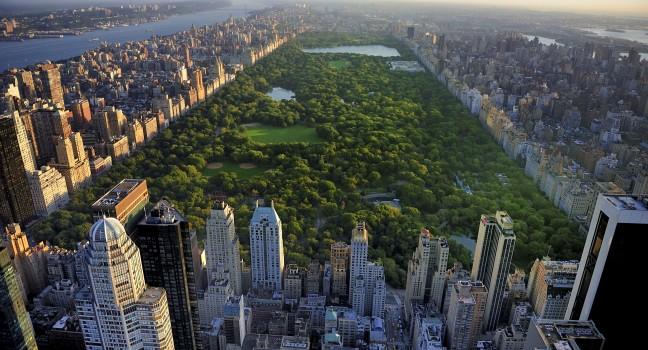
Central Park aerial view, Manhattan, New York; Park is surrounded by skyscraper.
T photography / Shutterstock

Central Park's creators, landscape architects Frederick Law Olmsted and Calvert Vaux, had a simple goal when they submitted their plan in 1858: to design a place where city dwellers could go to forget the city. Even though New York eventually grew far taller than the trees planted to hide it, the park has always been an urbanized Eden that gives residents and visitors alike a bite of the apple. Indeed, without Central Park's 843 acres of meandering paths, tranquil lakes, ponds, and open meadows, New Yorkers (especially Manhattanites) might be a lot less sane. Olmsted and Vaux also designed Brooklyn's Prospect Park and the grounds of the White House.

The busy southern section of Central Park, from 59th to 72nd Street, is where most people get their first impression. But no matter how many people congregate around here, you can always find a spot to picnic, ponder, or just take in the foliage, even on a sunny weekend day. In the southern corner is the Hallett Nature Sanctuary, one of the park's lesser-known areas. The nature sanctuary is a 4-acre patch of wilderness—one of the park’s three woodlands—and is home to native flora and fauna and rustic trails that lead to quiet overlooks; it's also a popular birding spot. Playgrounds, lawns, jogging and biking paths, and striking buildings populate the midsection of the park, from 72nd Street to the reservoir. You can soak up the sun, take in the public art, take pictures at Bethesda Fountain, visit the penguins at the Central Park Zoo, or join the runners huffing counterclockwise on the dirt track that surrounds the reservoir. North of the reservoir and up to 110th Street, Central Park is less crowded and feels more rugged. In 2025, the Central Park Conservancy completed a revitalization of the area around the Harlem Meer (a man-made lake) at the north end of the park to add a full-scale ice rink, an additional new skating experience on the meer, a larger-than-Olympic-size pool, and revamp the parkland around it. The new facility is called the Davis Center at the Harlem Meer (formerly the Lasker Rink and Pool site). To find out about park events and year-round walking tours, check the website of the Central Park Conservancy ( www.centralparknyc.org).

If you're taking the subway to the park's southernmost parts, the stops at either Columbus Circle (southwest corner) or 5th Avenue–59th Street (southeast corner) are handy. If headed for points north, the A, B, C, and D subway lines travel along Central Park West (beware of local versus express stops); the 4, 5, and 6 lines travel along Lexington Avenue, three blocks east of 5th Avenue and the park.

There are many paved pedestrian entrances into the park from 5th Avenue, Central Park North (110th Street), Central Park West, and Central Park South (59th Street). Four roads, or transverses, for cars and city buses cut through the park from east to west—66th, 79th, 86th, and 96th Streets. The East and West drives are both along the north–south axis; Center Drive enters the south edge of the park at 6th Avenue and connects with East Drive around 66th Street. Cars are no longer allowed on the drives, which are exclusively for pedestrians, cyclists, and horse-drawn carriages. Along the main loop, lampposts are marked with location codes that include a letter—always "E" (for east) or "W" (for west)—followed by numbers, the first two of which tell you the nearest cross street. For example, E7803 means you're near 78th Street; above 99, the initial "1" is omitted, so W0401 is near West 104th Street. Download the Central Park Conservancy's free app for a GPS-enabled map to help you navigate the park. The app also includes an audio guide, self-guided tours, and current events in the park, as well as a new interactive Cherry Blossom Tracker Map to help visitors and locals track when and where the flowers will peak in the park in spring.

If you haven't packed a picnic and you want a snack, you can usually find one of those rather tired-looking food carts selling hot dogs, pretzels, and ice-cream sandwiches. Specialty food carts are often around, too, mostly in the park's southern half, especially when there are concerts or other major events—your taste buds will thank you. Other reliable options include the café next to the Boathouse Restaurant (midpark at 74th Street), or a branch of Le Pain Quotidien (midpark at 69th Street). Both serve sandwiches, soups, pastries, and other satisfying on-the-go grub (and Le Pain also has free Wi-Fi). For something a little more elegant, you can stop for brunch, lunch, or dinner at the Tavern on the Green.

As part of a park-wide restoration project named Plan for Play, all 21 playgrounds have undergone (or are still scheduled to receive) updates. Most have seen renovations to play structures, plus other improvements that will ensure each one's structural stability and ongoing maintenance for years to come.
Prospect Park

Prospect Park Fodor's Choice
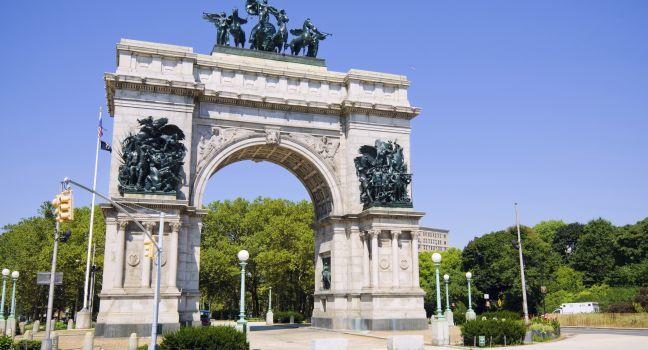
Soldiers' and Sailors' Arch at Grand Army Plaza in Brooklyn, dedicated on October 21, 1892 with an inscription that reads "To the Defenders of the Union, 1861-1865."
gregobagel/iStockphoto

Brooklyn residents are passionate about Prospect Park, and with good reason: lush green spaces, gently curved walkways, summer concerts, vivid foliage in autumn, and an all-season skating rink make it a year-round getaway. In 1859, the New York Legislature decided to develop plans for a park in the fast-growing city of Brooklyn. After landscape architects Frederick Law Olmsted and Calvert Vaux completed the park in the late 1880s, Olmsted remarked that he was prouder of it than any of his other works—including Manhattan's Central Park—and many critics agree. On weekends, those not jogging the 3.35-mile loop gravitate to the rolling hills of the Long Meadow to picnic, fly kites, or play cricket, flag football, or Frisbee. On summer Sundays, foodies flock to Breeze Hill, site of outdoor food market Smorgasburg's second Brooklyn location. The park's north entrance is at Grand Army Plaza, where the Soldiers' and Sailors' Memorial Arch (patterned on the Arc de Triomphe in Paris) honors Civil War veterans. On Saturday, year-round, a greenmarket at the plaza throngs with shoppers.

\n

A good way to experience the park is to walk the Long Meadow—venue for the occasional free yoga class—and then head to the eastern side and south towards the lake. Along the way, you'll encounter attractions including a few waterfalls, the Prospect Park Zoo, and the Lefferts Historic House. Nearby, the Prospect Park Carousel, built in 1912, still thrills the kids. The Boathouse, dating from 1905, is a stunning example of Beaux-Arts architecture, and houses a cafe and the Prospect Park Audubon Center. The annual Celebrate Brooklyn! Festival takes place at the Prospect Park Bandshell from early June through mid-August.

Union Square Park and Greenmarket

Fodor's Choice
NEW YORK CITY - APR. 20: Woman selects produce at Union Square Greenmarket in NYC on Apr 20, 2012. This world famous farmers' market began in 1976 and has grown to 140 farmers during peak season.; Shutterstock ID 100566316; Project/Title: Weekend Getaways;
littleny/Shutterstock

A park, farmers' market, meeting place, and the site of rallies and demonstrations, this pocket of green space and surrounding public square sit in the center of a bustling residential and commercial neighborhood. The name "Union" originally signified that two main roads—Broadway and 4th Avenue—crossed here. It took on a different meaning in the late 19th and early 20th centuries, when the square became a rallying spot for labor protests; many unions, as well as fringe political parties, moved their headquarters nearby.

Union Square is at its best on Monday, Wednesday, Friday, and Saturday (8–6), when the largest of the city's greenmarkets draws farmers and food purveyors from the tristate area selling fruit and vegetables, plants, fresh-baked pies and breads, cheeses, cider, fish, and meat. Between Thanksgiving and Christmas, artisans sell gift items and food at the large Union Square Holiday Market ( www.usqholiday.nyc).

New York University dormitories, theaters, and cavernous commercial spaces occupy the restored 19th-century commercial buildings that surround the park, along with some chain stores and restaurants. Statues in the park include those of George Washington, Abraham Lincoln, Mahatma Gandhi (often wreathed in flowers), and the Marquis de Lafayette (sculpted by Frédéric-Auguste Bartholdi, designer of the Statue of Liberty).

Recommended Fodor's Video

Brooklyn Bridge Park

DUMBO Fodor's Choice

This sprawling, 85-acre industrial-turned-recreational riverside park stretches from the Manhattan Bridge in DUMBO, under the Brooklyn Bridge, and all the way south to Pier 6 at the end of Atlantic Avenue. It's a gathering spot for tourists and Brooklynites alike, who come to picnic or watch movies on the lawn in the summer, play various sports on its many courts and playing fields, or simply stroll the promenade and gawk at the most postcard perfect view of the downtown Manhattan skyline—especially at sunset. The DUMBO section has a playground and a small pebble beach, plus the wonderfully restored Jane’s Carousel ( janescarousel.com).

The Bushwick Collective

Bushwick Fodor's Choice

Bushwick is well known for its street art, as the Brooklyn graffiti scene endures with colorful, larger-than-life murals. It's all encouraged, supported, and curated by this urban art collective, under the helm of Joseph Ficalora. The outdoor street art gallery is omnipresent as you walk Troutman Street and the adjacent blocks of St. Nicholas Avenue and Wyckoff Avenue, the area's main drag. Fans of global street art will recognize featured artists, including Sam Lao, Robert Vargas, and Case Maclaim. Every summer, the Collective throws a block party that's a mix of DJs, hip-hop performances, food trucks, and local vendors. Check their social media for details.

Fort Greene Park

Fort Greene Fodor's Choice
With 30 acres of green hills, Brooklyn's oldest park is the unofficial nucleus of the neighborhood. It served as a military fort during the Revolutionary War and again during the War of 1812. At its center, the Prison Ship Martyrs Monument commemorates American war prisoners. Although it predates them, landscape architects Olmsted and Vaux (known for designing Central Park and Prospect Park) designed the current layout of Fort Greene Park.

Grand Ferry Park

Fodor's Choice
Hipsters, Hasidic Jews, and others hang out at this small waterfront park named for the ferry that for a century connected Williamsburg to Manhattan. The views of Manhattan and the Williamsburg Bridge are sublime anytime. Sand covers the ground in summer, and if you sit on a bench near the waves that crash against the rocks, you can almost pretend you're at the beach. Check out the inscription on the redbrick smokestack, which figured in the development of penicillin.

Herbert Von King Park

Fodor's Choice
This 7.8-acre park is one of Brooklyn's oldest idylls—a leafy expanse with a playground, baseball field, dog run, and an amphitheater that serves as a venue for SummerStage and Bed-Stuy Pride.

Riegelmann Boardwalk

Coney Island Fodor's Choice

Built in 1923, this famous wood-planked walkway is better known as the Coney Island Boardwalk, and in summer it seems like all of Brooklyn is out strolling along the 2½-mile stretch. The quintessential walk starts at the end of the pier in Coney Island, opposite the Parachute Jump, where you can see the shoreline stretched out before you, where the waves of the Atlantic Ocean meet the Big Apple. From here to Brighton Beach is a little over a mile and should take about a half hour at a leisurely amble. Admire the modernistic, rectangular structures perched over the beach, housing bathrooms and lifeguard stations.

Riverside Park

Upper West Side Fodor's Choice

This expansive green space runs alongside the Hudson River—hence its name—and offers a welcome dose of tranquility from 72nd to 158th Street, as does the park's south extension, from about 59th to 72nd Street. Walking and biking paths dot the entire park, among them the broad Promenade between 83rd and 96th Streets. The park's original sections were designed by Frederick Law Olmsted and Calvert Vaux of Central Park fame and laid out between 1873 and 1888. Riverside Park also includes the soaring white marble Soldiers' and Sailors' Monument (at 89th Street), dedicated to New Yorkers who served in the Civil War, and the Warsaw Ghetto Memorial Plaza (at 80th Street), dedicated in 1947. The 79th Street Marina, with its café, visiting yachts, and permanently moored houseboats, is closed for renovations to make the marina climate resilient and expand access for boaters.

Shore Park and Parkway

Fodor's Choice
This narrow park follows the Bay Ridge waterfront and has spectacular views of the Verrazano-Narrows Bridge and the ships in New York Harbor. The promenade is perfect for a long walk or a bike ride. At the north end is the American Veterans Memorial Pier, where the NYC Ferry docks. The pier is also home to Brooklyn’s official monument honoring those lost on 9/11.

Tompkins Square Park

East Village Fodor's Choice

This leafy park is a favorite spot, year-round, for the neighborhood locals who lunch on the benches, picnic in the central green spaces, and put on impromptu jazz concerts. There's a year-round farmers' market by the southwest corner on Sunday, and an annual Halloween dog-costume event. It wasn't always so rosy in the park, though: in 1988, police followed then-mayor Ed Koch's orders to evict the many homeless people who had set up makeshift shelters here, and homeless rights and anti-gentrification activists fought back with sticks and bottles. The park was reclaimed and reopened in 1992 with a midnight curfew, still in effect today.

Brighton Beach

Brighton Beach

Just steps from the subway, this stretch of golden sand is the showpiece of Brooklyn's oceanside playground. Families set up beach blankets, umbrellas, and coolers, and pickup games of beach volleyball and football add to the excitement. Calm surf, a lively boardwalk, and a handful of restaurants for shade and refreshments complete the package. That spit of land in the distance is the Rockaway Peninsula, in Queens. Amenities: toilets. Best for: people-watching; sunsets.

Brightwater Ct., Brooklyn, NY, 11235, USA

Something incorrect in this review?

Bushwick Inlet Park

A $30 million investment turned a former parking lot into this lush green space adjacent to East River State Park. Part of a major revitalization project aimed at the Williamsburg and Greenpoint waterfront, the renovation added a sloped pavilion leading up to a public promenade, a playground, an athletic field, and an environmentally sophisticated building (with restrooms) for community activities. The views are expansive, taking in everything from the Williamsburg Bridge to the Empire State Building.

Carl Schurz Park

Upper East Side

Named for a German immigrant who was a prominent statesman and newspaper editor in the 19th century, this 14.9-acre park is so tranquil that you'd never guess you're directly above the FDR Drive. Walk along the esplanade and soak up views of the East River and Roosevelt Island across the way. To the north is Randalls (which is conjoined with Wards Island on the east side) and the Robert F. Kennedy Bridge (formerly the Triborough Bridge)—while the sights of locals pushing strollers, riding bikes, or walking their dogs surround visitors. Within the park is a Federal-style, wood-frame house that belies the grandeur of its name: Gracie Mansion, the official residence of the city's mayor. It was built in the 18th century.

Fort Washington Park and the Little Red Lighthouse

Washington Heights

Join New Yorkers cyling, strolling, playing tennis, picnicking, and in summer, partying in droves on the lively and scenic stretch of park that runs from West 155th Street alongside the Hudson River under the George Washington Bridge (G.W.B.) and up to Dyckman Street in Inwood. The park offers unique views of Manhattan, and spectacular views of the bridge and the tree-filled cliffs of New Jersey Palisades across the way. The Little Red Lighthouse, a beloved local icon (and popular photo op) made famous in a children's storybook—The Little Red Lighthouse and the Great Gray Bridge, written by Hildegarde Swift and Lynd Ward in 1942—is the island of Manhattan's last remaining lighthouse.  If you don't want to walk along the river from 155th Street and just want to visit the lighthouse and linger in the park under the G.W.B., enter the park at 181st Street. You can also grab a CitiBike on 181st Street.

Gansevoort Peninsula

Meatpacking District

One of the last stretches of the Hudson River Park to be transformed from wasteland to a verdant well-manicured oasis, Gansevoort Peninsula opened in fall 2023. The main attraction is a sandy beach on the Hudson, complete with Adirondack chairs and beach umbrellas to take in the view. The 5.5 acre pierlike space just south of Little Island also boasts a soccer field, picnic tables, and large patches of lawn for frolicking.

Great Lawn

Central Park

The truly great 14-acre oval has endured billions of footsteps, thousands of ball games, hundreds of downpours, scores of concerts including regular events by the New York Philharmonic and the Metropolitan Opera, the annual Global Citizen concert of superstars, and even the crush of people attending one papal Mass. The lawn and adjoining Turtle Pond are located on the site of a former reservoir for the 19th-century Croton Aqueduct system, which was filled in early in the 20th century. Yet it's the stuff of a suburbanite's dream—perfectly tended turf (a mix of rye and Kentucky bluegrass), state-of-the-art drainage systems, automatic sprinklers, and careful horticultural monitoring. The area hums with action on weekends and most summer evenings, when its softball fields and picnicking grounds provide a popular and much-needed outlet for city folk (and city dogs) of all ages, just as the Sheep Meadow does a bit farther south in the park. Although Central Park is dog-friendly, dogs must be on a leash.

John V. Lindsay East River Park

East Village

This popular green space that runs along the East River is undergoing large-scale renovations as the City of New York, in conjunction with the federal government, work on a project to reduce the risks of flooding from storms and sea-level rising. Sections of the park, with its spectacular views of Brooklyn and the Manhattan Bridge, will remain open, but check the website for changing access points. The NYC Ferry dock, located at Corlears Hook, will also remain accessible.

LeFrak Center at Lakeside

Prospect Park

The highlight of this 26-acre space in Prospect Park is the pair of all-season open-air rinks—for ice-skating when it's frigid, and roller skating otherwise. Walkways, a lakeside esplanade, and the Music Island nature reserve—all part of the original Olmsted and Vaux plans—contribute to this area of the park that's a pleasant place for a stroll, bike or pedal-boat ride, bumper car session, or a bite at its Bluestone Cafe. In the summer, kids can cool off at the splash pad by day, while DJs spin at theme roller-skating nights on weekends by night.

171 East Dr., Brooklyn, NY, 11225, USA
718-462–0010
Sight Details
Roller skating $9.80 weekdays, $14.15 weekends; rentals $9.25; bumper cars $8 for 10 mins; pedal boats starting at $34.85 per hr
Rink's closed days vary by season

Something incorrect in this review?

McCarren Park

On warm weekends, locals flock to this park that forms the border between Williamsburg and Greenpoint. The 35 acres include baseball diamonds, benches, tree-lined paths, and plenty of dogs out enjoying the sunshine with their owners. Across Driggs Avenue are a running track, soccer field, and tennis courts. The outdoor McCarren Park Pool, open in summer, tends to hit capacity pretty quickly. There's a skating rink in winter.

Monsignor McGolrick Park

Greenpoint
The tree-lined allées and historic colonnaded pavilion (1910) of this park in southeastern Greenpoint evoke 18th-century France. Neighborhood kids skateboard and play on the paths after school and on weekends. On Sunday between 10 and 4, local purveyors like Brooklyn Grange (rooftop farmers) and Ovenly (bakers) sell their wares at the farmers' market.

Owl's Head Park

With gently rolling hills and awe-inspiring views of the Verrazano-Narrows Bridge and Manhattan’s skyline, as well as stately old trees, this 24-plus-acre park is a popular retreat for local families, dog walkers, and loungers basking in the view of ships entering and leaving New York Harbor. In addition, there are basketball courts, a playground, a dog run, a skate park, and a spray pool. In winter, kids launch themselves down the park’s sledding hill.

Strawberry Fields

Central Park

This memorial to John Lennon, who penned the classic 1967 song "Strawberry Fields Forever," is sometimes called the "international garden of peace." The curving paths, shrubs, trees, and flower beds create a deliberately informal landscape reminiscent of English parks. Every year on December 8, Beatles fans mark the anniversary of Lennon's death by gathering around the star-shape black-and-white "Imagine" mosaic set into the pavement. Lennon's 1980 murder took place across the street at The Dakota, which was home to Lennon and Yoko Ono and has been the residence of other celebrities from Boris Karloff to Leonard Bernstein. The building's elaborate exterior is best admired from Central Park West, as visitors are not welcome in the lobby, and there are no tours.